Introduction
Mergers, acquisitions, business takeovers and brand transfers can significantly change the ownership and operational structure of a business. However, one compliance area that is often overlooked during such transactions is Extended Producer Responsibility (EPR).
For businesses dealing with products or packaging covered under India’s EPR framework, a merger or acquisition is not merely a corporate transaction. The parties must also examine existing EPR registrations, historical obligations, EPR targets, returns, environmental compensation exposure and the compliance responsibility attached to products and brands being transferred.
This makes an EPR compliance review an important part of regulatory due diligence before completing a merger, acquisition or brand transfer.
What is EPR?
Extended Producer Responsibility or EPR is an environmental compliance framework under which specified entities are made responsible for managing waste generated from products or packaging placed on the market.
Depending upon the applicable waste-management framework, obligations can arise for producers, manufacturers, importers, brand owners and other specified entities.
Businesses should therefore determine their exact legal category and applicable EPR obligations before and after any corporate restructuring.
Why Does EPR Matter During Mergers and Acquisitions?
An acquisition may transfer a business, brand, product portfolio, manufacturing operation or other assets to another entity. However, the corporate transaction itself does not automatically resolve regulatory obligations associated with EPR.
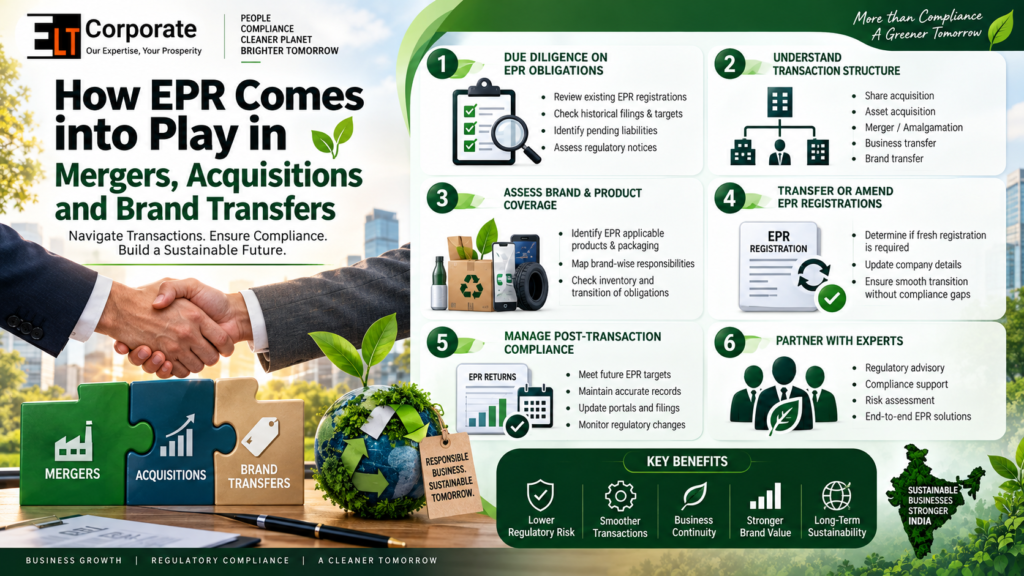
Before completing the transaction, the parties should review:
- Existing EPR registrations of the target company
- Products and brands covered under the registrations
- Applicable EPR targets and obligations
- EPR certificates obtained or required
- Previous returns and filings
- Pending compliance requirements
- Notices or regulatory proceedings, if any
- Environmental compensation or other liabilities, where applicable
- Registration details that may require amendment
- Responsibility for future EPR compliance after completion of the transaction
EPR Due Diligence Before an Acquisition
EPR should form part of environmental and regulatory due diligence wherever the target business falls within an applicable EPR framework.
1. Verify Existing EPR Registration
The acquiring company should verify whether the target company has obtained the registrations required for its activities.
Registration details should be compared with the actual business operations of the company.
2. Check Products and Brands
The due diligence should identify all products, brands and packaging streams handled by the target company and determine whether they fall within an EPR-regulated category.
3. Review Historical EPR Compliance
Previous EPR returns, certificates, target fulfilment records and other compliance documents should be reviewed.
This helps identify whether historical obligations have been properly discharged.
4. Identify Pending EPR Targets
Any pending or unfulfilled EPR obligations should be identified before closing the transaction.
The transaction documents should clearly address responsibility for such obligations.
5. Check Regulatory Notices
The target company’s records should be reviewed for notices, show-cause proceedings, environmental compensation demands or other communications from the relevant authorities.
6. Verify Portal Information
Information appearing on the applicable EPR portal should be reconciled with the company’s corporate and operational records.
Changes in company name, registered office, authorised persons or other particulars may require regulatory action depending upon the applicable framework.
What Happens to EPR Registration After a Merger?
This depends heavily upon the legal structure of the transaction.
For example, the compliance implications of a statutory merger may differ from those of:
- Share acquisition
- Asset acquisition
- Slump sale
- Business transfer
- Brand acquisition
- Internal restructuring
- Change in company name
- Transfer of manufacturing operations
Therefore, businesses should not assume that an existing EPR registration can simply be used by the acquiring entity.
The legal identity of the registered entity and the nature of the transaction should first be examined.
EPR Implications in a Share Acquisition
In a share acquisition, ownership of the company changes while the underlying corporate entity may continue to exist.
The parties should nevertheless check whether the transaction results in changes to information recorded under the relevant EPR registration, such as authorised persons, corporate particulars or operational information.
More importantly, the buyer should conduct due diligence on the company’s existing EPR liabilities because the same legal entity continues after the acquisition.
EPR Implications in an Asset or Business Acquisition
An asset acquisition can create different compliance issues.
If products, brands, manufacturing assets or a particular business division are transferred to another legal entity, the acquiring entity should independently determine whether it becomes subject to EPR registration and compliance obligations.
The parties should clearly establish the effective date from which the purchaser assumes responsibility for placing the relevant products or packaging on the Indian market.
How EPR Applies to Brand Transfers
Brand transfers require particular attention because several EPR frameworks impose obligations based on the role performed by a business in relation to the products or packaging it places on the market.
Suppose Company A owns and markets a consumer brand and subsequently transfers that brand to Company B.
The parties should determine:
- The effective date of the brand transfer
- Who placed products on the market before the transfer
- Who will place products on the market after the transfer
- Applicable EPR registration requirements
- Historical EPR obligations
- Future EPR targets
- Responsibility for unsold inventory
- Packaging already introduced into the market
- Applicable return and reporting obligations
Simply transferring intellectual property rights in a brand should therefore not be treated as automatically transferring every regulatory registration associated with the previous owner.
Treatment of Existing Inventory After Brand Transfer
Existing stock is one of the most important practical issues in a brand acquisition.
The agreement should identify:
- Inventory manufactured before the transfer
- Inventory already placed on the market
- Inventory remaining with distributors
- Inventory transferred to the purchaser
- Products manufactured after the effective transfer date
- Party responsible for applicable EPR reporting
Clear cut-off dates and inventory reconciliation can substantially reduce future disputes regarding EPR responsibility.
EPR Compliance Checklist for M&A Transactions
Before completing an acquisition or brand transfer, businesses should review:
- Existing EPR registrations
- Applicable waste category
- Registration validity
- Product and brand details
- Historical returns
- EPR targets
- EPR certificates
- Pending obligations
- Regulatory notices
- Environmental compensation exposure
- Portal information
- Existing inventory
- Brand ownership
- Import and manufacturing arrangements
- Responsibility after the transaction
- Required amendments or fresh registrations
- Post-closing compliance requirements
Documents Required for EPR Due Diligence
Important documents may include:
- EPR Registration Certificate
- Previous EPR returns
- EPR certificates and supporting records
- Product and packaging details
- Import and sales data
- Waste-generation information
- Agreements with recyclers or other registered entities, where applicable
- Regulatory correspondence
- Environmental compensation orders, if any
- Brand ownership documents
- Trademark assignment documents
- Business Transfer Agreement
- Share Purchase Agreement
- Asset Purchase Agreement
- Scheme of Amalgamation or Merger
- Company incorporation documents
- GST and PAN details
- Previous compliance records
Common EPR Risks in Mergers and Acquisitions
Unregistered Business Activities
The target business may be operating in an EPR-regulated category without having obtained the required registration.
Unfulfilled Historical Targets
Historical EPR targets may remain outstanding even though the company has continued its operations.
Incorrect Reporting
Sales, import, production or packaging data reported on the portal may not reconcile with the company’s actual records.
Undisclosed Regulatory Proceedings
Environmental notices or proceedings can materially affect the compliance position of the acquired business.
Assuming EPR Registration Automatically Transfers
A regulatory registration should not automatically be treated in the same manner as an ordinary commercial asset. Its treatment must be examined under the applicable regulatory framework.
EPR Clauses to Consider in M&A Agreements
From a transaction perspective, parties may consider clearly allocating responsibility for:
- Pre-closing EPR liabilities
- Post-closing EPR liabilities
- Pending EPR targets
- Environmental compensation
- Regulatory notices
- Incorrect historical filings
- Cost of completing outstanding compliance
- Cooperation for regulatory amendments
- Transfer-period inventory
- Records and supporting documentation
- Indemnification for undisclosed environmental liabilities
The wording should be customised according to the transaction structure and applicable EPR regulations.
Post-Acquisition EPR Compliance
EPR compliance does not end when the acquisition closes.
The acquiring entity should conduct a post-closing review covering:
Step 1: Confirm the final legal structure of the transaction.
Step 2: Determine which entity will manufacture, import or market the relevant products.
Step 3: Review the EPR registration requirements of that entity.
Step 4: Complete required amendments or fresh registration, as applicable.
Step 5: Reconcile historical and transferred inventory.
Step 6: Establish responsibility for future EPR targets.
Step 7: Maintain proper records for future filings and regulatory verification.
Why EPR Should Be Included in M&A Due Diligence
EPR should not be considered merely an environmental registration exercise.
For a business acquisition, EPR due diligence can help the purchaser identify:
- Undisclosed regulatory liabilities
- Pending compliance costs
- Deficiencies in registrations
- Historical reporting discrepancies
- Potential environmental compensation
- Post-acquisition compliance requirements
Identifying these issues before closing enables the parties to appropriately structure representations, warranties, indemnities and post-closing obligations.
How ELT Corporate Can Help
ELT Corporate provides regulatory and compliance support for businesses undergoing mergers, acquisitions, restructuring and brand transfers.
Our EPR support can include:
- EPR compliance due diligence
- Review of existing EPR registrations
- Identification of applicable EPR obligations
- Review of historical filings and targets
- Regulatory gap assessment
- Brand-transfer compliance review
- Assistance with fresh EPR registration
- Assistance with amendment requirements
- Post-acquisition compliance planning
- Ongoing EPR advisory and compliance support
Conclusion
EPR can become an important regulatory consideration in mergers, acquisitions and brand transfers, particularly where the transaction involves products, packaging, electronics, batteries or other regulated waste streams.
The parties should not assume that a change in ownership automatically transfers, eliminates or settles existing EPR responsibilities.
Before closing the transaction, businesses should identify the responsible legal entity, review historical compliance, reconcile EPR targets and inventory, identify outstanding liabilities and establish a clear post-closing compliance structure.
A structured EPR due diligence exercise can help prevent regulatory issues from emerging after the acquisition has already been completed.
FAQs
Is EPR registration automatically transferred when a company is acquired?
Not necessarily. The impact depends on the transaction structure, legal identity of the registered entity and the applicable EPR framework.
Should EPR be checked during M&A due diligence?
Yes. Where the target company operates within an EPR-regulated sector, its registrations, filings, targets and potential liabilities should be reviewed.
Does a brand transfer automatically transfer EPR responsibility?
A brand transfer alone should not be assumed to transfer all regulatory obligations. The applicable legal entity, business activity and EPR framework should be examined.
What happens to pending EPR targets after an acquisition?
Responsibility will depend on the applicable law, identity of the obligated entity and structure of the transaction. Pending targets should therefore be specifically examined during due diligence.
Can ELT Corporate assist with EPR compliance after an acquisition?
Yes. ELT Corporate can assist businesses with EPR registration, compliance review, regulatory gap assessment and post-transaction EPR planning.