Battery usage in India is expanding rapidly across electric vehicles, consumer electronics, energy storage systems, automotive applications and industrial equipment. With the increasing use of batteries, the responsible collection, recycling and environmentally sound management of used batteries have become an important regulatory requirement.
To address battery waste, the Government of India introduced the Battery Waste Management Rules, 2022 (BWM Rules, 2022) under the Extended Producer Responsibility (EPR) framework.
In 2026, producers and importers dealing with batteries need to pay close attention to their CPCB registration, EPR targets, battery sales data, recycling obligations, EPR certificates, annual returns and compliance records.
This guide explains the key Battery EPR compliance requirements for producers and importers in India.
What is Battery EPR?
Extended Producer Responsibility (EPR) means that producers are responsible for managing the environmental impact of the batteries they introduce into the Indian market, including their end-of-life management.
Under the Battery Waste Management Rules, 2022, producers are required to fulfil prescribed obligations relating to the collection and recycling or refurbishment of waste batteries.
The CPCB states that producers, including manufacturers and importers, have EPR obligations for batteries introduced into the market and must meet the applicable collection and recycling targets.
The framework covers batteries irrespective of their chemistry, shape, volume, weight, material composition or use. It includes battery categories such as:
- Electric Vehicle (EV) batteries
- Portable batteries
- Automotive batteries
- Industrial batteries
The rules therefore have a broad impact on businesses involved in manufacturing, importing, selling or placing batteries and battery-containing equipment in the Indian market.
Who Needs Battery EPR Registration in India?
Battery EPR requirements can apply to businesses that fall within the definition of a Producer under the Battery Waste Management Rules.
This can include businesses involved in:
- Manufacturing and selling batteries under their own brand
- Manufacturing or selling batteries incorporated into equipment under their own brand
- Selling batteries under their own brand where the batteries are manufactured by another entity
- Importing batteries
- Importing equipment containing batteries
Therefore, an importer should not assume that Battery EPR is applicable only to companies manufacturing batteries in India.
If your business imports batteries or products containing batteries into India, it is important to evaluate whether you fall under the Producer category and whether CPCB registration is required.
Battery EPR Registration with CPCB
The Central Pollution Control Board (CPCB) operates a centralized online portal for Battery Waste Management.
The CPCB portal provides registration facilities for producers and also handles processes associated with recyclers and refurbishers.
The current CPCB registration portal requires business and authorized-person information such as:
- GST details
- Company name and legal name
- Business type
- Registered address
- PAN
- CIN, where applicable
- Authorized person’s details
- Contact information
- Email and login details
The exact documents and information required may depend on the applicant and the registration process applicable to the business.
What Are the Main Battery EPR Compliance Requirements in 2026?
Battery EPR compliance is not limited to obtaining a registration number.
A producer or importer needs to manage multiple compliance activities throughout the year.
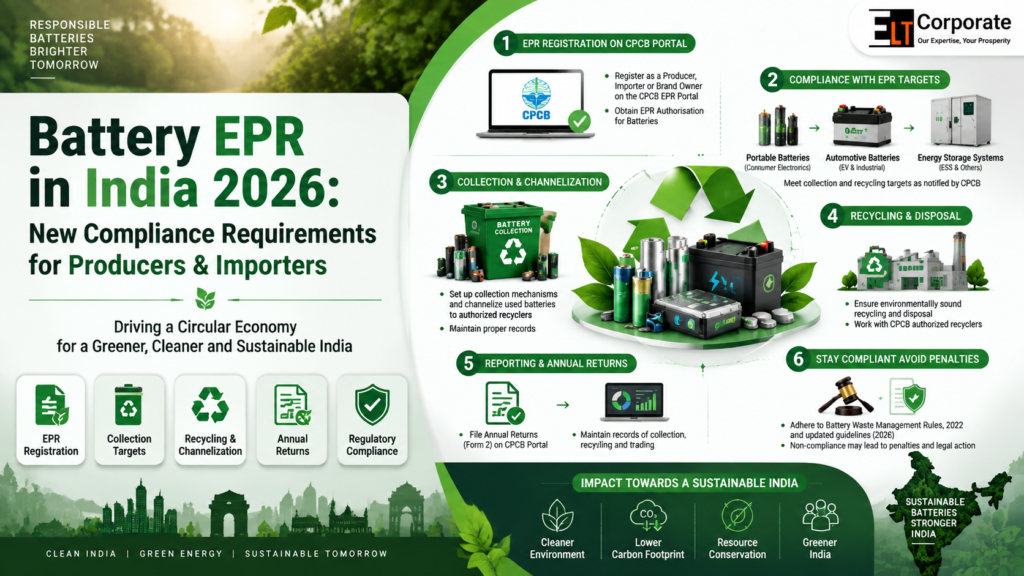
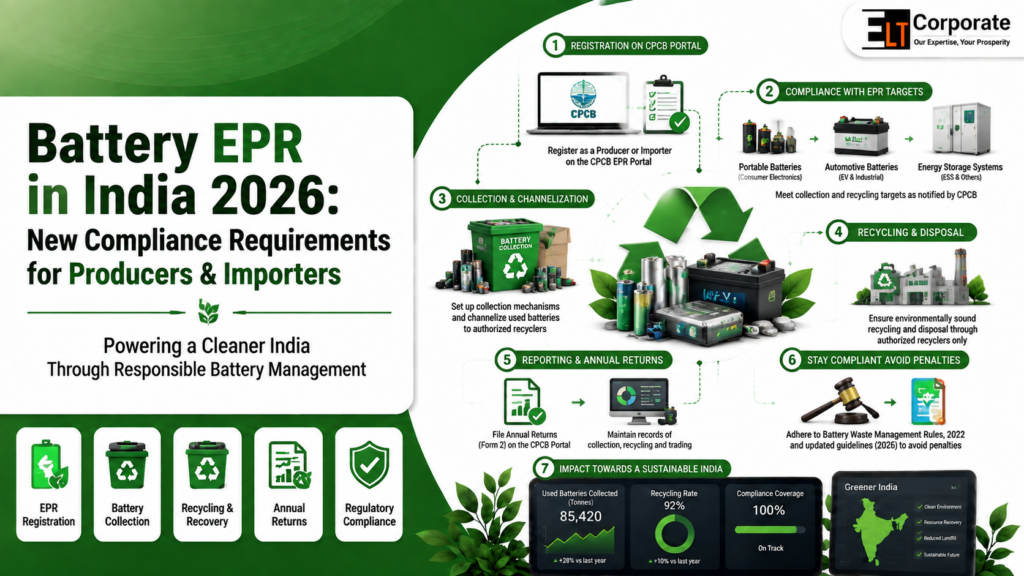
1. CPCB Registration
Eligible producers need to register through the centralized Battery EPR Portal developed by CPCB.
Registration establishes the producer’s presence within the regulatory framework and enables the producer to undertake applicable EPR activities through the portal.
2. Maintain Accurate Battery Sales Data
Producers need to maintain accurate information about the batteries they introduce into the market.
This information is important because EPR obligations are linked to the quantity of batteries placed on the market.
Businesses should therefore maintain proper records of:
- Battery type
- Battery chemistry
- Quantity sold
- Weight
- Import details
- Sales data
- Battery-containing products
- Applicable categories and materials
Accurate data helps reduce discrepancies during EPR target calculation and annual return filing.
3. Fulfil EPR Targets
One of the most important responsibilities of a registered producer is fulfilling the applicable EPR target.
The CPCB explains that producers are required to meet collection and recycling targets specified under the Battery Waste Management Rules.
The EPR system connects the batteries placed in the market with the producer’s responsibility for their end-of-life management.
4. Work with Registered Recyclers or Refurbishers
Producers need to ensure that waste batteries are managed through appropriate registered entities.
CPCB’s framework provides for EPR certificates generated through the recycling or refurbishment of waste batteries. These certificates can be used by producers to meet their applicable EPR obligations.
Businesses should therefore verify the registration status and relevant credentials of recyclers or refurbishers before entering into compliance arrangements.
5. Obtain and Use EPR Certificates
EPR certificates are an important component of the Battery EPR framework.
Registered recyclers process waste batteries and generate EPR certificates based on eligible recycling activity. Producers can use applicable EPR certificates to fulfil their EPR targets through the CPCB system.
This makes proper documentation and traceability particularly important for producers.
6. File Annual Returns
Producers are also required to submit applicable annual returns through the CPCB Battery EPR Portal.
Annual return information should be consistent with the producer’s registration, sales data, EPR targets and certificates/credits used for compliance.
The CPCB Battery EPR Portal currently carries notices and communications relating to annual-return filing timelines, including FY 2025-26.
Therefore, producers should monitor the CPCB portal regularly instead of relying on old filing dates or third-party information.
Recycled Material Requirements for Battery Producers
Battery EPR compliance is also moving beyond simple collection and recycling targets.
The Government has stated that producers are required to use a minimum percentage of domestically recycled materials in the manufacture of new batteries from FY 2027-28 onwards.
This is an important development for battery manufacturers because future compliance will increasingly involve not only waste management but also the use of recycled material in new battery production.
Businesses should therefore start maintaining better material-flow and sourcing records well before the applicable requirements become operational for them.
What About Imported Batteries and Battery-Containing Products?
Importers should pay particular attention to Battery EPR.
Under the BWM framework, import of batteries as well as equipment containing batteries can bring an entity within the Producer definition.
For example, a business importing products that contain batteries should evaluate:
- Whether the imported product contains a covered battery
- Whether the business falls within the Producer definition
- Whether CPCB Battery EPR registration is required
- How imported battery quantities will be reported
- How EPR obligations will be calculated
- How recycling/refurbishment obligations will be fulfilled
- How annual returns will be filed
Importers should evaluate these requirements before or during the import and product-placement process rather than waiting until the end of the financial year.
Battery Categories Covered Under EPR
The Battery Waste Management framework covers different categories of batteries.
Broadly, the framework includes:
Portable Batteries
These are commonly used in consumer and electronic products such as small electronic devices and portable equipment.
Electric Vehicle Batteries
EV batteries are becoming increasingly important because of the growth of electric mobility in India.
Automotive Batteries
These include batteries used in conventional automotive applications.
Industrial Batteries
Industrial batteries can be used in energy storage, industrial equipment, backup systems and other applications.
The BWM Rules cover these categories as part of the broader battery waste management framework.
Battery Chemistry and EPR Compliance
Battery EPR is not limited to one particular battery chemistry.
The CPCB portal states that the BWM Rules apply regardless of battery chemistry.
Depending on the battery and its application, businesses may deal with chemistries such as:
- Lithium-ion
- Lead-acid
- Nickel-based batteries
- Zinc-based batteries
- Other covered battery chemistries
This is particularly relevant for businesses involved in EVs, electronics, energy storage systems, automotive products and industrial equipment.
EPR Targets and EPR Credits
The Battery EPR framework uses a target-based approach.
The CPCB’s Battery EPR Portal provides a national dashboard showing producer EPR targets and EPR credits across different battery metals, demonstrating that the system tracks compliance at a detailed level.
Producers should therefore maintain accurate information regarding:
- Batteries placed on the market
- Applicable battery category
- Material/metal information
- EPR target
- EPR certificates or credits procured
- Annual compliance status
This data should be properly reconciled before filing returns.
Environmental Compensation for Non-Compliance
Non-compliance with Battery Waste Management requirements can have financial consequences.
CPCB has developed an Environmental Compensation (EC) framework for non-compliance under the Battery Waste Management Rules.
The framework covers non-fulfilment of EPR targets and other specified non-compliances by producers, recyclers and refurbishers.
This makes Battery EPR more than a routine registration requirement.
For businesses, proper compliance can help reduce the risk of:
- Regulatory action
- Environmental compensation
- Compliance discrepancies
- Problems with EPR targets
- Issues during regulatory review
- Inaccurate annual reporting
Common Battery EPR Compliance Mistakes
Businesses often face compliance problems because of incomplete or inconsistent records.
Some common mistakes include:
Not Taking Registration Seriously
Some importers assume that Battery EPR applies only to battery manufacturers.
However, the rules specifically include producers such as importers within the EPR framework.
Incorrect Sales Data
Incorrect quantity, weight, battery category or product data can affect EPR target calculations.
Buying Certificates Without Proper Verification
Producers should ensure that their EPR compliance transactions are carried out through the applicable CPCB framework and with eligible registered entities.
Missing Annual Returns
Even after obtaining registration, businesses need to monitor their annual compliance and filing obligations.
Ignoring New CPCB Notices
Battery EPR requirements and operational procedures can evolve through amendments, notices, guidelines and portal updates.
The CPCB Battery EPR Portal currently publishes rules, amendments, notices, SOPs and compliance communications.
Battery EPR Compliance Checklist for 2026
Businesses can use the following checklist to review their Battery EPR compliance:
- Determine whether the business qualifies as a Producer
- Identify all batteries and battery-containing products
- Determine applicable battery categories
- Complete CPCB Battery EPR registration
- Maintain accurate battery sales/import data
- Calculate applicable EPR obligations
- Identify suitable registered recyclers/refurbishers
- Obtain applicable EPR certificates
- Track EPR target fulfilment
- Maintain transaction and compliance records
- File applicable annual returns
- Monitor CPCB notifications and amendments
- Review environmental compensation exposure
- Maintain supporting documents for audit and regulatory purposes
Why Battery EPR Compliance Is Important for Businesses
Battery EPR is increasingly becoming an important part of environmental and regulatory compliance in India.
For producers and importers, compliance helps establish a structured system for managing the end-of-life stage of batteries while supporting recycling and resource recovery.
The centralized CPCB portal is designed to improve accountability, traceability and transparency in the fulfilment of EPR obligations.
For businesses operating in EVs, electronics, energy storage, automotive products and industrial equipment, Battery EPR should therefore be treated as an ongoing compliance responsibility rather than a one-time registration exercise.
How to Get Battery EPR Registration in India?
The Battery EPR registration process is handled through the CPCB’s centralized Battery EPR Portal.
A typical compliance process involves:
Step 1: Identify whether your business qualifies as a Producer.
Step 2: Identify the battery categories and products placed on the Indian market.
Step 3: Collect the required company, GST, PAN, authorized-person and battery-related information.
Step 4: Register on the CPCB Battery EPR Portal.
Step 5: Submit the required information and documents.
Step 6: Maintain accurate sales and battery data.
Step 7: Fulfil applicable EPR targets through eligible recycling/refurbishment mechanisms.
Step 8: Obtain and use applicable EPR certificates.
Step 9: File annual returns and maintain compliance records.
The CPCB currently provides dedicated SOPs and guidance manuals for producer registration and EPR target/certificate processes.
Final Takeaway
Battery EPR compliance in India is becoming increasingly important for manufacturers, importers and other businesses placing batteries or battery-containing products on the Indian market.
The Battery Waste Management Rules, 2022 establish the EPR framework, while CPCB’s centralized portal provides the mechanism for registration, target tracking, EPR certificate transactions and return filing.
For 2026, businesses should focus on more than simply obtaining a Battery EPR registration. They should maintain accurate market-placement data, fulfil applicable recycling or refurbishment obligations, use valid EPR certificates, file returns on time and continuously monitor CPCB updates.
If your business manufactures or imports batteries or equipment containing batteries, taking a structured approach to Battery EPR compliance can help minimize regulatory risk and keep your operations aligned with India’s evolving environmental regulations.
Frequently Asked Questions (FAQs)
Is Battery EPR mandatory in India?
Battery EPR obligations apply to producers, including manufacturers and importers, covered under the Battery Waste Management Rules, 2022. Producers are required to fulfil applicable EPR obligations for batteries introduced into the market.
Does Battery EPR apply to importers?
Yes. Importers can fall within the definition of Producer under the Battery Waste Management Rules, including entities importing batteries and equipment containing batteries.
Which batteries are covered under Battery EPR?
The Battery Waste Management Rules cover all types of batteries regardless of chemistry, shape, volume, weight, material composition or use. The framework includes portable, automotive, industrial and EV batteries.
Where is Battery EPR registration done?
Battery EPR registration is handled through the centralized online Battery EPR Portal developed by CPCB.
What is an EPR certificate for batteries?
An EPR certificate is generated through eligible recycling/refurbishment activity and can be used by producers to fulfil applicable EPR obligations under the CPCB framework.
Do Battery EPR requirements apply to lithium-ion batteries?
Yes. The BWM Rules apply irrespective of battery chemistry, and lithium-ion batteries fall within the broad battery waste management framework.
Are annual returns required for Battery EPR?
Producers are required to file applicable annual returns through the CPCB Battery EPR system. Producers should check the CPCB portal for the current filing timeline and applicable instructions.
What happens if a producer does not fulfil its EPR obligations?
Non-compliance can result in Environmental Compensation and other regulatory consequences under the applicable Battery Waste Management framework.
What should an importer do before starting Battery EPR compliance?
An importer should first determine whether it qualifies as a Producer, identify the batteries or battery-containing products being imported, complete applicable CPCB registration and establish a process for tracking quantities, EPR targets, certificates and annual returns.