
Plastic has become an essential part of modern life. It is used in packaging, automobiles, electronics, healthcare, construction, agriculture and almost every other industry. However, the increasing use of plastic has also created a major environmental challenge: how to manage plastic waste after its useful life is over.
Mechanical recycling is one of the most widely used methods of plastic waste management. However, not all plastic waste can be recycled effectively through conventional mechanical processes. Contaminated plastic, mixed polymer waste, multilayer packaging and certain low-value plastic fractions may be difficult or uneconomical to process through traditional recycling methods.
This is where pyrolysis of plastic waste becomes an important waste-management technology.
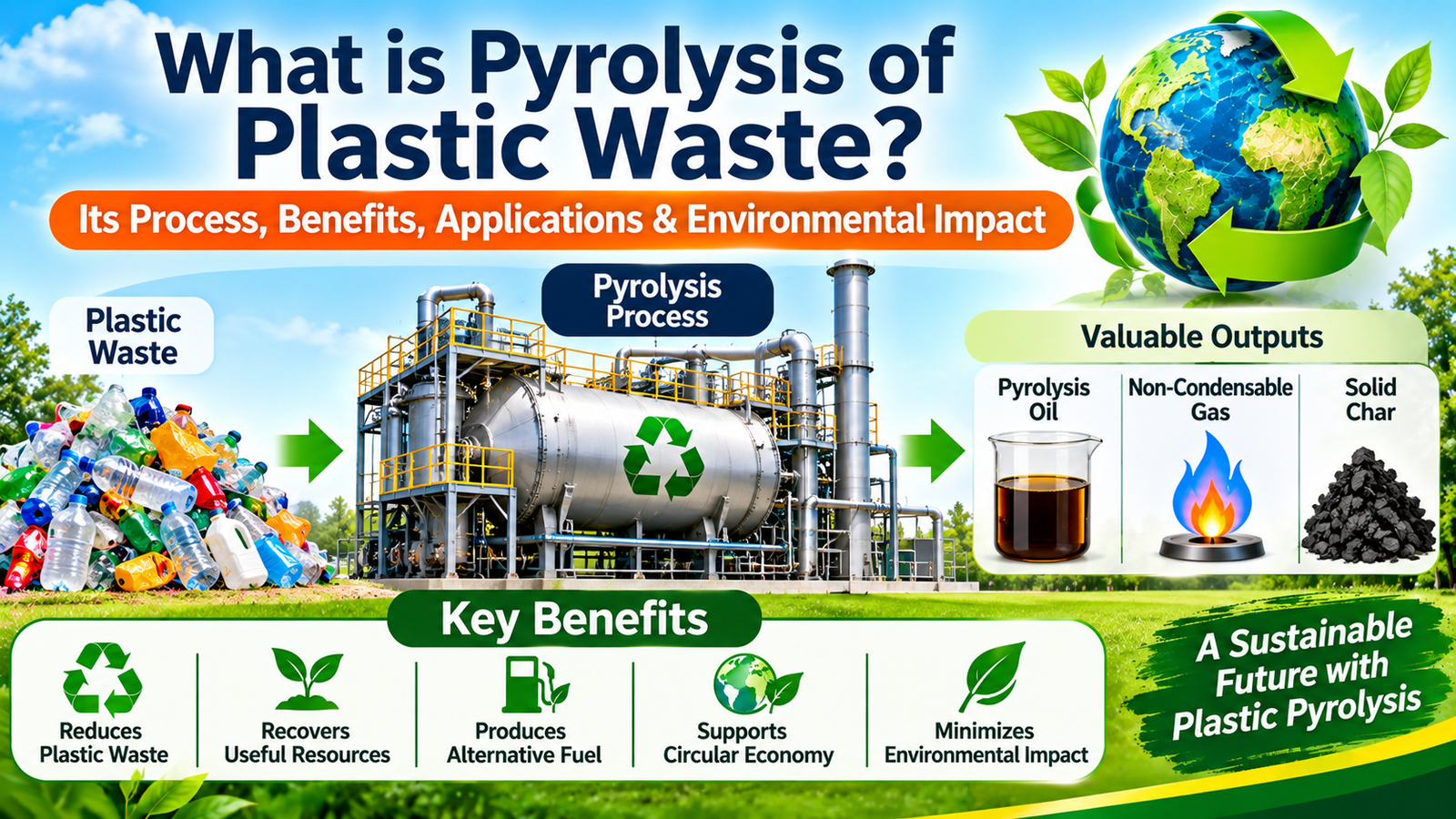
Plastic pyrolysis is a thermochemical process in which plastic waste is heated at high temperatures in the absence of oxygen. The process breaks long polymer chains into smaller hydrocarbon compounds, producing liquid oil, combustible gases and solid residue.
Depending on the technology, feedstock and operating conditions, these outputs may be used as industrial fuel, energy sources or chemical feedstock.
In this guide, we will explain what plastic waste pyrolysis is, how the process works, what products are generated, its benefits and limitations, and the important regulatory considerations for setting up and operating a plastic pyrolysis plant in India.
Quick Overview: Plastic Waste Pyrolysis
| Parameter | Explanation |
|---|---|
| Technology | Thermochemical conversion |
| Basic principle | Heating plastic in the absence of oxygen |
| Typical operating temperature | Commonly around 300°C–600°C, depending on technology and feedstock |
| Main outputs | Pyrolysis oil, non-condensable gas and solid char |
| Common feedstock | Selected polyethylene and polypropylene-rich plastic waste |
| Main applications | Energy recovery and, where suitably processed, chemical feedstock production |
| Main advantage | Can process selected plastic fractions that are difficult to recycle mechanically |
| Key challenge | Feedstock quality, emissions control, product quality and economic viability |
| Indian regulatory framework | Plastic Waste Management Rules, 2016, as amended, and applicable pollution-control requirements |
1. What is Pyrolysis of Plastic Waste?
Pyrolysis of plastic waste is a thermal decomposition process that converts selected plastic waste into smaller hydrocarbon molecules by heating it in an oxygen-free or oxygen-deficient environment.
Unlike conventional burning, pyrolysis does not rely on direct combustion of the plastic inside the reactor. Instead, heat breaks down the long molecular chains of polymers into vapours and other products.
The vapours are then cooled through a condensation system to recover liquid hydrocarbons, commonly called pyrolysis oil. Non-condensable gases and solid carbon-rich residues are also generated.
For example, waste plastic films, certain packaging materials and selected polyethylene or polypropylene waste can be processed in a properly designed pyrolysis system to recover hydrocarbon products.
Simple Example
Imagine a plastic packaging waste processing facility that receives selected post-consumer plastic waste.
The facility first sorts and prepares the plastic. The prepared material is then fed into a sealed reactor. When heated in the absence of oxygen, the plastic breaks down into smaller hydrocarbon compounds.
The resulting vapours pass through a cooling system, where a portion condenses into liquid oil. The remaining gas may be treated and reused as process fuel, while the solid residue is collected separately.
This is the basic principle of plastic-to-oil conversion through pyrolysis.
Is Pyrolysis the Same as Burning Plastic?
No. Pyrolysis and open burning are different processes.
| Basis | Pyrolysis | Open Burning |
|---|---|---|
| Oxygen availability | Absence or controlled limitation of oxygen | Oxygen is available |
| Main mechanism | Thermal decomposition | Combustion |
| Process control | Conducted in a designed reactor | Usually uncontrolled |
| Main outputs | Oil, gas and solid residue | Heat, smoke, gases and ash |
| Environmental management | Requires engineered gas treatment and emission controls | Can release harmful pollutants without adequate control |
| Purpose | Recovery of useful products or energy | No controlled material recovery |
Pyrolysis should not automatically be considered pollution-free. Its environmental performance depends on the feedstock, plant design, emission-control system, operating practices and safe management of residues.
2. Why is Plastic Waste Pyrolysis Important?
Plastic waste management is not limited to collecting and disposing of discarded plastic. It requires a suitable treatment method for different types of plastic waste.
Some plastic waste can be cleaned, melted and converted into new products through mechanical recycling. However, certain mixed, contaminated or low-value fractions may be difficult to process through this route.
Plastic pyrolysis can provide an alternative treatment route for selected waste streams.
It is particularly relevant for:
- Selected mixed plastic waste that is unsuitable for conventional mechanical recycling.
- Certain contaminated plastic fractions, after appropriate preparation.
- Selected polyethylene and polypropylene waste.
- Certain multilayer packaging fractions, subject to technical suitability and regulatory requirements.
- Plastic waste streams for which there is a technically and environmentally viable recovery route.
However, pyrolysis should not be treated as a reason to avoid segregation, reuse or mechanical recycling. Material that can be safely and economically recycled into new plastic products should generally be evaluated for material recycling first.
3. Which Types of Plastic Can Be Used for Pyrolysis?
The suitability of plastic waste depends on its polymer composition, contamination, additives and the design of the pyrolysis plant.
Different plastic polymers behave differently when heated.
Common Plastic Types
| Plastic Type | Full Form | Common Applications | Pyrolysis Considerations |
|---|---|---|---|
| PE | Polyethylene | Films, bags, containers | Commonly considered suitable |
| HDPE | High-Density Polyethylene | Bottles, pipes, containers | Commonly considered suitable |
| LDPE | Low-Density Polyethylene | Carry bags, packaging films | Commonly considered suitable |
| PP | Polypropylene | Food containers, automotive parts, packaging | Commonly considered suitable |
| PS | Polystyrene | Disposable products, protective packaging | Can be processed using suitable technology |
| PET | Polyethylene Terephthalate | Beverage bottles, polyester packaging | Requires careful process selection; not usually treated like PE/PP feedstock |
| PVC | Polyvinyl Chloride | Pipes, cable insulation, profiles | Requires special consideration because of chlorine-containing compounds |
Which Plastic is Most Suitable?
Polyethylene (PE) and polypropylene (PP) are commonly used feedstocks for conventional plastic pyrolysis because their chemical structures can produce hydrocarbon-rich products.
PVC requires particular caution because it contains chlorine. During thermal treatment, chlorine-containing compounds may be released and can create serious corrosion, product-contamination and emission-control challenges.
PET also behaves differently from PE and PP because of its oxygen-containing chemical structure. It may require a different process strategy and does not necessarily produce the same quality or quantity of hydrocarbon oil.
Practical recommendation: A plant should not accept all plastic waste indiscriminately. It should establish written feedstock acceptance criteria, polymer identification procedures, contamination limits and a rejection process for unsuitable material.
4. How Does the Plastic Pyrolysis Process Work?
The plastic pyrolysis process involves several stages, beginning with the collection of waste and ending with the recovery and management of the output products.
A typical industrial process is explained below.
Step 1: Collection of Plastic Waste
Plastic waste is collected from different sources, such as:
- Municipal solid waste collection systems.
- Industrial plastic waste generators.
- Packaging waste collection agencies.
- Material recovery facilities.
- Authorised waste aggregators.
- Other permitted waste collection channels.
The plant should maintain records of the source, quantity and type of incoming plastic waste.
Step 2: Sorting and Segregation
The collected plastic is segregated according to polymer type, quality and suitability.
Unwanted materials such as metal, glass, stones, soil, organic waste and other contaminants are removed.
PVC and other unsuitable fractions should be identified and managed according to the plant’s approved feedstock criteria.
Proper segregation is important because mixed or contaminated feedstock can reduce process efficiency, affect oil quality and increase the burden on pollution-control systems.
Step 3: Cleaning and Drying
The sorted plastic may be washed to remove dirt, labels, food residue and other contaminants.
After washing, the material is dried to reduce moisture.
Excess moisture can affect heating efficiency, condensation and the quality of the recovered products.
The washing process itself may generate wastewater. Therefore, the facility must provide appropriate wastewater collection and treatment arrangements wherever washing is undertaken.
Step 4: Shredding and Size Reduction
The prepared plastic is fed into a shredder or granulator.
The purpose is to reduce the size of the material so that it can be fed into the reactor more consistently.
The required particle size depends on the reactor design and equipment specifications.
Step 5: Feeding the Plastic into the Pyrolysis Reactor
The prepared plastic is transferred into a sealed pyrolysis reactor through an appropriate feeding arrangement.
The reactor is designed to operate under controlled process conditions and to restrict the entry of oxygen.
Depending on the technology, the system may use batch, semi-continuous or continuous feeding arrangements.
Step 6: Heating in the Absence of Oxygen
The reactor is heated to the required operating temperature.
The heat breaks down long polymer chains into smaller molecules. This process is known as thermal cracking or thermal decomposition.
The vapours generated during this stage contain different hydrocarbon compounds.
The operating temperature, heating rate, pressure, residence time and catalyst selection (where applicable) influence the product distribution.
There is no single temperature suitable for every type of plastic pyrolysis plant.
Step 7: Vapour Cooling and Condensation
The vapours generated inside the reactor are directed through a condensation system.
The cooling system reduces the temperature of the vapours and converts condensable hydrocarbons into liquid form.
The recovered liquid is collected in suitable storage tanks.
Depending on the process and product specifications, the liquid may require further separation, distillation, filtration or refining before it can be used for a particular application.
Step 8: Collection and Treatment of Non-Condensable Gas
Not all vapours condense into liquid oil.
The remaining non-condensable gas may contain combustible hydrocarbons and other gases.
After appropriate treatment, part of this gas may be reused as a source of process heat, subject to the plant design and applicable environmental and safety requirements.
Excess gas and emergency releases must be managed through engineered systems such as suitable flaring arrangements, as required by the approved design and applicable conditions.
Uncontrolled venting is not an acceptable substitute for gas treatment.
Step 9: Collection of Solid Residue
A solid carbon-rich residue, commonly called char, is also generated.
This material may contain carbon, inorganic matter, additives and contaminants from the incoming plastic.
It should be characterised before deciding whether it can be recovered for a beneficial use or must be sent for authorised disposal.
Step 10: Storage, Testing and Dispatch of Products
The recovered oil, gas and solid residue should be managed separately.
The plant should maintain:
- Batch-wise production records.
- Product quality test reports.
- Storage tank inspection records.
- Dispatch and transport records.
- Records of residue generation and disposal.
- Safety and emergency response records.
The product should only be sold or supplied for an application for which it meets the applicable specifications and legal requirements.
5. Plastic Pyrolysis Process Flow Diagram
The following simplified flow represents a typical plastic-to-oil process:
- Plastic waste collection.
- Sorting and segregation.
- Cleaning and drying.
- Shredding and size reduction.
- Feeding into the pyrolysis reactor.
- Heating in an oxygen-free environment.
- Thermal decomposition and vapour generation.
- Condensation and separation.
- Recovery of pyrolysis oil, non-condensable gas and solid char.
- Product testing, storage and compliant utilisation.
6. What are the Main Products of Plastic Pyrolysis?
Plastic pyrolysis generally produces three major output streams.
A. Pyrolysis Oil
Pyrolysis oil is a liquid mixture of hydrocarbons obtained by cooling and condensing the vapours produced during the process.
Its composition depends on the type of plastic used, operating conditions and reactor technology.
Potential applications may include:
- Industrial fuel applications, where permitted.
- Further refining and upgrading.
- Use as a chemical feedstock, where the product meets the required specifications and is accepted by the downstream process.
Pyrolysis oil should not automatically be called diesel, petrol or a finished transportation fuel. It may require extensive testing and further processing before it can qualify for a particular application.
B. Non-Condensable Gas
A portion of the vapour stream does not condense into liquid.
This gas may contain combustible hydrocarbons and can potentially be reused for heating the pyrolysis reactor after suitable treatment.
Its composition and usability depend on feedstock and process conditions.
C. Solid Char or Residue
Solid char is the carbon-rich solid residue remaining after thermal decomposition.
It may contain inorganic fillers, pigments, additives and other contaminants.
Its potential use depends on its composition, quality and compliance with applicable requirements. It should not be sold or reused without suitable characterisation.
Indicative Output Distribution
The proportion of oil, gas and char is not fixed.
It can vary significantly depending on:
- Type and composition of plastic waste.
- Feedstock contamination.
- Operating temperature.
- Heating rate.
- Residence time.
- Reactor design.
- Catalyst use.
- Condensation efficiency.
Therefore, plant owners should not rely on a generic oil-yield percentage when preparing a project report or calculating profitability. Actual performance should be established through representative feedstock trials and validated plant data.
7. What are the Benefits of Plastic Pyrolysis?
Plastic pyrolysis can provide several technical and waste-management benefits when the right feedstock and process conditions are selected.
1. Helps Manage Selected Difficult-to-Recycle Plastic Waste
Certain mixed or contaminated plastic fractions may not be suitable for conventional mechanical recycling.
Pyrolysis may provide an alternative recovery route for selected fractions that meet the plant’s technical acceptance criteria.
2. Recovers Useful Hydrocarbon Products
The process converts long polymer chains into smaller hydrocarbon compounds.
Depending on product quality and downstream requirements, these products may be used for energy recovery or chemical applications.
3. Reduces Dependence on Virgin Fossil Feedstock in Suitable Applications
Where recovered pyrolysis products are used as suitable chemical feedstock, they may help reduce the need for some virgin fossil-based inputs.
The actual benefit depends on product quality, substitution rate and the overall life-cycle impact.
4. Potential for Process Energy Recovery
Non-condensable gases generated during pyrolysis may be used to supply part of the heat required by the process after suitable treatment and subject to safety controls.
This may reduce the requirement for external fuel.
5. Supports Resource Recovery
Instead of treating every suitable plastic fraction only as a disposal problem, pyrolysis can recover potentially useful hydrocarbon products.
6. Supports a Circular Economy
When pyrolysis products are converted into feedstock chemicals and used to manufacture new plastic, the process can contribute to a circular material system.
However, conversion into fuel for combustion is an energy-recovery route, not the same as closed-loop plastic-to-plastic recycling.
7. Provides an Alternative Treatment Route for Certain Waste Streams
A properly designed plant may provide an additional option for selected plastic waste fractions that cannot be effectively handled by mechanical recycling.
8. What are the Limitations and Challenges of Plastic Pyrolysis?
Although plastic pyrolysis has potential, it is not a universal solution to plastic pollution.
Some important challenges are discussed below.
1. Feedstock Quality
Mixed, wet or contaminated plastic can affect plant performance and product quality.
A reliable supply of segregated and suitable plastic waste is essential.
2. High Capital Investment
A commercial plant may require investment in:
- Pyrolysis reactor.
- Feed preparation equipment.
- Shredders and conveyors.
- Heating system.
- Condensers and cooling systems.
- Gas treatment equipment.
- Storage tanks.
- Pollution-control systems.
- Fire protection and safety infrastructure.
The overall investment depends on plant capacity, automation, technology and site conditions.
3. Emission-Control Requirements
Pyrolysis plants must manage process gases, fugitive emissions, odour and other potential pollutants.
Inadequate gas treatment, leakage or poor operating conditions can create environmental and public-health risks.
4. Product Quality Variations
The quality of pyrolysis oil may vary depending on the incoming waste and process parameters.
A buyer may require testing for parameters such as:
- Density.
- Viscosity.
- Flash point.
- Sulphur content.
- Chlorine content.
- Water content.
- Heating value.
- Distillation characteristics.
The exact testing requirements depend on the intended application.
5. Management of Solid Residues
Char and other residues may contain contaminants that restrict their reuse.
The plant must identify an appropriate, legally compliant route for their storage, recovery or disposal.
6. Economic Viability
A plant’s financial performance depends on feedstock availability, procurement cost, product yield, product selling price, energy consumption, maintenance, pollution-control costs and regulatory compliance.
A high theoretical oil yield does not automatically mean a profitable plant.
7. Safety Risks
The process involves high temperatures, combustible gases and flammable liquids.
Inadequate pressure control, gas leakage, poor maintenance or unsafe storage can result in fire, explosion or occupational hazards.
9. What is the Difference Between Pyrolysis and Mechanical Recycling?
Both technologies are used in plastic waste management, but they work differently.
| Basis | Mechanical Recycling | Plastic Pyrolysis |
|---|---|---|
| Process | Physical processing of plastic | Thermal decomposition |
| Main operation | Sorting, washing, shredding, melting and remoulding | Heating in the absence of oxygen |
| Output | Recycled plastic flakes, granules or products | Oil, gas and solid residue |
| Polymer structure | Generally retained | Broken into smaller molecules |
| Suitable feedstock | Clean and segregated recyclable plastic | Selected plastic fractions suitable for thermal conversion |
| Main objective | Recover plastic material | Recover hydrocarbons or energy |
| Product application | Manufacture of new plastic products | Fuel or chemical feedstock applications, subject to specifications |
Which is Better?
Neither technology is universally better.
Mechanical recycling is generally preferable where plastic can be effectively converted into usable recycled material. Pyrolysis may be considered for selected waste streams that are unsuitable for conventional mechanical recycling, provided the technology is environmentally sound and economically viable.
10. Difference Between Pyrolysis, Gasification and Incineration
These technologies are sometimes confused because all involve thermal treatment.
| Basis | Pyrolysis | Gasification | Incineration |
|---|---|---|---|
| Oxygen supply | Absent or highly restricted | Limited, controlled oxygen or steam | Sufficient oxygen for combustion |
| Main mechanism | Thermal decomposition | Partial oxidation and conversion into syngas | Complete or near-complete combustion |
| Main outputs | Oil, gas and char | Syngas and solid residue | Heat, flue gas and ash |
| Main objective | Recover hydrocarbons or chemicals | Produce combustible synthesis gas | Reduce waste volume and recover energy where designed |
| Process conditions | Depend on feedstock and reactor | Depend on gasifier design | Depend on combustion system |
The choice of technology depends on the waste composition, desired output, pollution-control infrastructure and applicable regulatory requirements.
11. Plastic Pyrolysis Plant: Major Machinery and Equipment
A commercial plastic pyrolysis plant may include the following equipment.
| Machinery / Equipment | Function |
|---|---|
| Sorting Conveyor | Separates suitable and unsuitable plastic waste |
| Shredder / Granulator | Reduces plastic waste to the required size |
| Washing System | Removes dirt and contaminants where required |
| Dryer | Reduces moisture in prepared feedstock |
| Feeding System | Transfers prepared plastic into the reactor |
| Pyrolysis Reactor | Performs thermal decomposition |
| Heating System | Supplies controlled heat to the reactor |
| Condenser | Cools vapours and recovers liquid hydrocarbons |
| Gas Treatment System | Treats non-condensable gas and process emissions |
| Gas Reuse / Flaring System | Manages combustible process gas safely |
| Oil Storage Tanks | Stores recovered liquid products |
| Residue Collection System | Collects char and other solid residues |
| Pumps and Pipelines | Transfer liquids and process streams |
| Instrumentation and Controls | Monitors temperature, pressure, flow and operating conditions |
| Fire Protection System | Helps prevent and respond to fire emergencies |
The actual equipment list must be finalised based on the plant’s process design, capacity, feedstock and applicable environmental and safety conditions.
12. Environmental Considerations in Plastic Pyrolysis
A pyrolysis plant must be designed to manage the environmental risks associated with thermal treatment.
The major environmental considerations include:
A. Air Emissions
Potential emissions may arise from process gases, combustion of fuel gas, fugitive releases and equipment leakage.
Suitable gas treatment, emission-control equipment, monitoring and maintenance are essential.
B. Chlorine-Containing Compounds
PVC and other chlorine-containing materials can create additional treatment challenges.
Feedstock screening and appropriate process controls are important to prevent chlorine-related corrosion, contamination and harmful emissions.
C. Wastewater
If plastic washing is carried out, wastewater may contain suspended solids, dirt, oil and other contaminants.
The facility should provide appropriate collection and treatment arrangements and comply with applicable discharge requirements.
D. Solid Waste and Char
Char, sludge, filter residues and other process wastes should be characterised and managed through suitable authorised channels.
E. Odour and Noise
The facility should control odour from waste storage and processing areas and manage noise from shredders, pumps, blowers and other equipment.
F. Fire and Explosion Prevention
The plant should have appropriate:
- Temperature and pressure monitoring.
- Gas detection systems.
- Emergency shutdown arrangements.
- Suitable ventilation and gas handling.
- Fire detection and firefighting systems.
- Safe storage and transfer arrangements.
- Emergency response procedures.
- Operator training.
Environmental and occupational safety controls should be considered during plant design, not added only after installation.
13. Regulatory Requirements for Plastic Pyrolysis Plants in India
Plastic pyrolysis facilities in India must evaluate their compliance obligations under the applicable environmental and waste-management framework.
The regulatory position should be assessed according to the exact process, feedstock, output and intended end use.
The principal framework includes the Plastic Waste Management Rules, 2016, as amended from time to time, along with applicable CPCB and State Pollution Control Board requirements.
A. Plastic Waste Management Rules, 2016
The Plastic Waste Management Rules, 2016 establish the framework for collection, segregation, processing and environmentally sound management of plastic waste.
The framework covers relevant stakeholders such as waste generators, local bodies, producers, importers, brand owners and plastic waste processors.
The Rules have been amended several times, including changes relating to Extended Producer Responsibility (EPR) for plastic packaging.
B. Plastic Waste Processor Registration
An entity undertaking plastic waste processing should assess the applicable registration requirements and portal procedures for its activity.
The 2026 amendment expressly includes entities engaged in end-of-life disposal within the definition of Plastic Waste Processors.
Accordingly, a plastic pyrolysis facility must examine its classification and registration obligations based on whether its process is waste-to-oil energy recovery or a qualifying chemical-recycling process.
The exact registration route and supporting documents should be confirmed against the current CPCB portal instructions and applicable State requirements.
C. Important Clarification Under the 2026 Amendment
The Plastic Waste Management (Amendment) Rules, 2026, notified on 31 March 2026, made an important clarification regarding end-of-life disposal and recycling.
Under the amended definition:
- Utilisation of plastic waste for energy recovery, including waste-to-oil conversion, is covered within end-of-life disposal.
- Processes that convert plastic waste into feedstock chemicals or produce new plastic are treated as recycling under the amended definition.
This distinction is important for plastic pyrolysis businesses.
For example:
Scenario 1: Plastic waste is converted into pyrolysis oil for use as fuel.
This is generally treated as waste-to-oil and falls within the end-of-life disposal framework, subject to applicable conditions.
Scenario 2: Plastic waste is converted into feedstock chemicals that are used to manufacture new plastic.
This may fall within the recycling definition under the 2026 amendment, subject to the applicable technical and regulatory requirements.
Therefore, a plant should not claim recycling status merely because it produces pyrolysis oil. The actual downstream use and process route matter.
D. Consent from the State Pollution Control Board
The facility should assess the requirement for applicable approvals from the concerned State Pollution Control Board (SPCB) or Pollution Control Committee (PCC).
Depending on the project and the applicable State classification, this may include:
- Consent to Establish (CTE).
- Consent to Operate (CTO).
- Applicable waste-processing permissions or authorisations.
- Compliance with prescribed emission and effluent conditions.
The applicability and exact approval route should be confirmed with the concerned SPCB/PCC before establishing or operating the plant.
E. Environmental and Pollution-Control Requirements
The plant must evaluate requirements relating to:
- Air pollution control.
- Process gas treatment.
- Stack emissions and monitoring.
- Wastewater management.
- Solid residue management.
- Safe storage of recovered oil.
- Fire and industrial safety.
- Environmental monitoring and reporting.
F. CPCB Guidelines and Technical Requirements
CPCB has published guidance on segregation, collection and disposal of plastic waste, including the conversion of plastic waste into fuel oil and other treatment routes.
However, older technical guidance should not be treated as a substitute for checking current regulatory amendments, updated standards and the specific approval conditions applicable to the proposed facility.
G. EPR and Plastic Pyrolysis
Extended Producer Responsibility (EPR) under the Plastic Waste Management framework applies to the relevant Producer, Importer and Brand Owner obligations for plastic packaging.
A pyrolysis facility may participate in the plastic waste management ecosystem as a processor, but the treatment route and applicable recognition or certificate mechanism must be assessed under the current rules.
A business should not assume that every tonne of plastic waste processed through pyrolysis automatically generates an eligible EPR recycling certificate.
The distinction between recycling and end-of-life disposal is particularly important after the 2026 amendment.
14. Documents and Information to Prepare Before Setting Up a Plastic Pyrolysis Plant
Before starting a plastic pyrolysis project, the entrepreneur should prepare a compliance and technical file.
The following is an indicative checklist. The final document list will depend on the State, project size, process design and applicable approvals.
Company and Site Documents
- Certificate of Incorporation or business registration.
- PAN and authorised signatory details.
- GST registration, where applicable.
- Land ownership documents or lease agreement.
- Site layout and location plan.
- Land-use and zoning-related documents, where applicable.
Technical Documents
- Detailed Project Report (DPR).
- Process flow diagram.
- Plant and machinery list.
- Reactor specifications.
- Plant capacity details.
- Feedstock acceptance criteria.
- Mass balance and expected output details.
- Fuel and energy consumption estimates.
- Storage and handling arrangements.
- Process description and operating parameters.
Environmental Documents
- Pollution-control system details.
- Air emission control plan.
- Wastewater management plan, where applicable.
- Solid residue management plan.
- Stack and monitoring arrangements.
- Environmental risk assessment, where required.
- Fire and emergency response plan.
Operational Documents
- Plastic waste procurement records.
- Supplier and source details.
- Feedstock testing and inspection records.
- Production and batch records.
- Product quality test reports.
- Oil storage and dispatch records.
- Residue disposal records.
- Equipment maintenance records.
- Employee training records.
15. How to Set Up a Plastic Pyrolysis Plant in India: Practical Steps
A business planning to establish a plastic pyrolysis plant should follow a structured project-development approach.
- Conduct a feasibility study. Assess the availability of suitable plastic waste, local competition, transport costs, product demand and technology options.
- Identify the correct feedstock. Determine which polymers and waste streams can be processed safely and consistently by the selected technology.
- Select the technology provider. Evaluate reactor design, operating capacity, automation, gas treatment, product recovery, safety systems and after-sales support.
- Prepare a Detailed Project Report. The DPR should include technical specifications, capacity, expected input-output balance, capital expenditure, operating expenditure and financial projections.
- Identify the applicable regulatory route. Determine the applicable plastic waste processor registration, SPCB/PCC consents and other site-specific approvals.
- Develop pollution-control and safety systems. Design suitable air pollution controls, gas treatment, fire protection, wastewater arrangements and residue-management systems.
- Install and commission the plant. Installation, testing and commissioning should follow the approved design and equipment specifications.
- Conduct trial runs and validate performance. Evaluate actual feedstock consumption, product yield, product quality, gas generation, emissions and residue generation.
- Establish operational records. Maintain traceable records of incoming waste, processing, output products, dispatch, pollution-control performance and residue management.
- Maintain ongoing compliance. Monitor consent conditions, registration requirements, reporting obligations, environmental standards and safety procedures.
16. Is Plastic Pyrolysis Environmentally Friendly?
Plastic pyrolysis can contribute to improved plastic waste management, but its environmental performance depends on how the plant is designed and operated.
It may offer environmental advantages when:
- Suitable plastic waste is selected.
- Material suitable for mechanical recycling is not unnecessarily diverted.
- Process gases are properly treated.
- Emissions are monitored and controlled.
- Solid residues are safely managed.
- Recovered products genuinely substitute for suitable virgin feedstock or conventional energy sources.
- The overall environmental impact is favourable.
However, poorly designed or poorly operated facilities can create air pollution, odour, residue-management and safety problems.
The environmental benefits should therefore be evaluated through actual operating data and, where appropriate, a life-cycle assessment (LCA).
The objective should not simply be to convert plastic waste into oil. It should be to recover value responsibly while controlling environmental impacts.
17. Future Scope of Plastic Pyrolysis in India
India’s plastic waste management sector is evolving with increasing attention to recycling infrastructure, waste processing, resource recovery and EPR compliance.
Plastic pyrolysis may have a role in this changing landscape, particularly for selected plastic fractions that are technically unsuitable for conventional mechanical recycling.
Potential areas of development include:
- Improved continuous pyrolysis systems.
- Better sorting and feedstock preparation.
- Advanced catalysts and process optimisation.
- Improved gas treatment and emission monitoring.
- Better product quality and refining.
- Chemical recycling and feedstock recovery.
- Integration with industrial petrochemical value chains.
- Improved traceability and regulatory reporting.
However, the long-term success of the technology will depend on commercially viable operations, transparent environmental performance and compliance with applicable rules.
18. Conclusion
Pyrolysis of plastic waste is a thermochemical technology that converts selected plastic waste into liquid hydrocarbons, non-condensable gases and solid residues by heating the material in the absence of oxygen.
It can provide an alternative treatment route for certain plastic waste streams that are difficult to manage through conventional mechanical recycling.
The technology offers opportunities for resource recovery, energy recovery and, in suitable process configurations, the production of feedstock chemicals for further manufacturing.
However, its success depends on proper feedstock selection, reliable technology, pollution-control systems, product quality, safe plant operations and regulatory compliance.
For businesses planning to establish a plastic pyrolysis facility in India, it is essential to understand the Plastic Waste Management Rules, the 2026 amendments, applicable CPCB requirements and the approvals of the concerned SPCB/PCC.
Responsible plastic waste management is not just about processing waste. It is about selecting the right technology, recovering resources safely and ensuring environmental compliance at every stage.
Frequently Asked Questions (FAQs)
Pyrolysis of plastic waste is a thermal decomposition process in which selected plastic waste is heated in the absence of oxygen to produce liquid hydrocarbons, combustible gases and solid residue.
The main purpose is to recover useful hydrocarbons or energy from selected plastic waste that may be difficult to process through conventional mechanical recycling.
Plastic waste is sorted, cleaned, dried and shredded before being fed into a sealed reactor. It is heated in the absence of oxygen, producing vapours that are condensed into liquid oil. Non-condensable gas and solid residue are collected separately.
The operating temperature depends on the feedstock and reactor design. Many conventional plastic pyrolysis processes operate within a broad range of approximately 300°C–600°C.
Polyethylene (PE), high-density polyethylene (HDPE), low-density polyethylene (LDPE) and polypropylene (PP) are commonly considered suitable feedstocks for conventional plastic pyrolysis.
PVC requires special caution because it contains chlorine. Its thermal treatment may generate chlorine-containing compounds, requiring specialised process and pollution controls. It should not be mixed into ordinary feedstock without a validated process design and regulatory assessment.
The main products are pyrolysis oil, non-condensable gas and solid char or residue.
No. Pyrolysis oil is a complex mixture of hydrocarbons. It may require testing, separation, refining and compliance with applicable specifications before it can be used for a particular application.
Yes. Plastic pyrolysis can produce a liquid hydrocarbon mixture and combustible gas. Their use as fuel depends on product quality, applicable specifications and legal requirements.
Not in every situation. Mechanical recycling is generally preferable when plastic can be effectively converted into new material. Pyrolysis may be considered for selected waste fractions that are unsuitable for conventional mechanical recycling.
It can contribute to responsible waste management when operated with suitable feedstock controls, emission treatment, residue management and safety systems. It is not automatically pollution-free.
Pyrolysis thermally decomposes plastic in the absence of oxygen, while incineration burns waste in the presence of oxygen to release heat and combustion gases.
Pyrolysis takes place without oxygen or with highly restricted oxygen, while gasification uses a controlled limited supply of oxygen or steam to produce synthesis gas.
A plastic pyrolysis plant is an industrial facility that processes selected plastic waste through a controlled thermal decomposition system to recover oil, gas and solid residue.
Typical equipment includes a sorting system, shredder, washing and drying equipment where required, feeding system, pyrolysis reactor, heating system, condenser, gas treatment equipment, storage tanks and residue collection systems.
Yes. The facility must assess and provide suitable pollution-control arrangements for process gases, emissions, wastewater, residues and fugitive releases according to applicable requirements and approval conditions.
The business should assess plastic waste processor registration, applicable Consent to Establish and Consent to Operate from the concerned SPCB/PCC, and other site-specific environmental and safety approvals.
The applicable registration requirements should be assessed under the Plastic Waste Management Rules and current CPCB portal procedures. The 2026 amendment includes entities engaged in end-of-life disposal within the definition of Plastic Waste Processors. The exact route should be confirmed for the proposed activity.
Not automatically. Under the 2026 amendment, waste-to-oil conversion for energy recovery is included in end-of-life disposal. Conversion into feedstock chemicals or production of new plastic is treated as recycling under the amended definition, subject to applicable requirements.
A business should not assume that all plastic waste processed through pyrolysis automatically qualifies for EPR recycling certificates. The treatment category, applicable rules, registration and current portal requirements must be checked.
Waste-to-oil for energy recovery is an end-of-life disposal route under the 2026 amendment. Chemical recycling that converts plastic waste into feedstock chemicals or new plastic is treated as recycling under the amended definition.
Certain multilayer plastic fractions may be technically processable, depending on their composition and contamination. The facility must validate feedstock suitability and ensure that the process meets applicable environmental requirements.
Major challenges include feedstock availability, contamination, investment cost, product quality variation, emissions management, residue disposal, plant safety and commercial viability.
Profitability depends on feedstock cost, plant capacity, product yield, oil quality, selling price, energy consumption, operating cost, maintenance and regulatory compliance. A feasibility study based on actual local conditions is essential.
Plastic pyrolysis may contribute to India’s plastic waste processing infrastructure, especially for selected difficult-to-recycle fractions. Its growth will depend on technology improvements, environmental performance, market demand and regulatory clarity.
How ELT Corporate Can Help
Setting up or operating a plastic waste processing facility requires more than purchasing machinery. Businesses must understand the applicable environmental framework, registration requirements, pollution-control consents and ongoing compliance obligations.
ELT Corporate provides regulatory, legal and consulting support to businesses dealing with environmental and regulatory compliance.
Our support may include:
- Understanding applicable Plastic Waste Management Rules.
- Guidance on plastic waste processor registration.
- Assistance with relevant EPR compliance requirements.
- Regulatory documentation and application support.
- Guidance on applicable SPCB/PCC consents.
- Compliance review and regulatory gap assessment.
- Support in understanding applicable environmental obligations.
Planning to establish a plastic pyrolysis plant or seeking guidance on plastic waste compliance in India? Connect with ELT Corporate for professional regulatory and compliance assistance.
Website: https://eltcorporate.com/
This article is intended for general educational and informational purposes. It does not constitute legal, technical, engineering or environmental approval advice. The suitability of a plastic pyrolysis process and the applicable registration, consent, authorisation and reporting requirements depend on the specific feedstock, technology, plant location, process outputs and intended end use. Businesses should verify the latest notifications, CPCB instructions and applicable SPCB/PCC requirements before establishing or operating a facility.