
Used lubricating oil may look like an ordinary waste product, but improper handling can cause serious environmental damage. Used oil can contaminate soil and water, while uncontrolled burning or disposal may release harmful pollutants.
To regulate this waste stream, India introduced an Extended Producer Responsibility framework for Used Oil under the Hazardous and Other Wastes (Management and Transboundary Movement) Rules.
The framework applies to specified producers of base oil and lubrication oil, importers of used oil, recyclers and collection agents.
For businesses dealing with lubricants or base oil, understanding EPR for Used Oil Certificate, registration, recycling targets and annual compliance has therefore become essential.
This guide explains who needs registration, what documents are generally required, how the CPCB registration process works, how EPR targets are calculated and how EPR Certificates are used for compliance.
What Is EPR for Used Oil?
Extended Producer Responsibility (EPR) means that a producer remains responsible for ensuring environmentally sound management of the used oil generated from the base oil or lubrication oil introduced into the Indian market.
Under the current framework, producers are required to meet prescribed recycling targets through registered recyclers.
The EPR system became effective from 1 April 2024 under the Hazardous and Other Wastes (Management and Transboundary Movement) Second Amendment Rules, 2023.
In practical terms, a producer may need to:
- register on the CPCB Used Oil EPR Portal;
- declare production, import and sales information;
- calculate annual EPR liability;
- purchase eligible EPR Certificates;
- maintain proper records; and
- complete prescribed portal compliance.
What Is the Difference Between EPR Registration and EPR Certificate?
These two terms are often used interchangeably in the market, but they are different.
EPR Registration
A producer, recycler, importer of used oil or collection agent registers with CPCB through the prescribed Used Oil EPR Portal.
EPR Certificate
An EPR Certificate is generated through the prescribed system in favour of a registered recycler based on eligible recycling activity.
A producer then purchases eligible certificates through the portal to fulfil its EPR obligation.
So, in simple terms:
| Term | Meaning |
|---|---|
| Registration | Entry into the CPCB EPR system |
| EPR Certificate | Credit used to fulfil recycling liability |
The Rules specifically provide that producers may fulfil EPR obligations through online purchase of certificates from registered recyclers only.
Who Needs Used Oil EPR Registration?
The CPCB FAQ identifies several categories that must register on the Used Oil Portal.
These include:
1. Producers of Base Oil or Lubrication Oil
Businesses manufacturing or importing base oil, lubrication oil or other relevant products manufactured from base oil may need registration as a Producer.
2. Importers of Used Oil
An entity importing used oil is required to register separately as an Importer on the portal.
3. Recyclers of Used Oil
Businesses engaged in authorised recycling or re-refining of used oil must register as Recyclers.
4. Collection Agents
Entities collecting used oil and supplying it into the authorised recycling chain must register as Collection Agents.
CPCB currently lists all four categories under the Used Oil EPR framework.
Who Is Considered a Producer?
A producer can broadly include an entity that:
- manufactures and sells base oil or lubrication oil under its own brand;
- sells lubrication oil under its own brand using base oil obtained from another manufacturer or supplier;
- sells imported base oil or lubrication oil in the domestic market; or
- undertakes other activities falling within the notified producer definition.
The important factor is not only who physically manufactures the oil, but who introduces the relevant oil into the domestic market under the applicable producer category.
Do Automobile OEMs Automatically Become Producers?
No.
CPCB clarifies that an automobile Original Equipment Manufacturer does not automatically become a Used Oil EPR Producer merely because it manufactures cars.
However, if the OEM itself procures base oil or lubrication oil and sells the lubrication oil domestically under its own brand, it may fall within the producer definition.
This distinction is important because many vehicle manufacturers and automotive businesses assume that EPR automatically applies to every OEM.
Which Oils May Not Attract an EPR Recycling Target?
CPCB has clarified that certain oils which do not normally result in residual used oil may not attract an EPR recycling obligation.
Examples may include:
- white oil;
- certain process oils consumed during manufacturing;
- grease; and
- other products that do not generate residual used oil.
However, this does not necessarily remove the registration requirement.
CPCB specifically states that producers of such oils may still need to register and submit details so that the exemption claim can be evaluated.
Therefore, businesses should not simply assume exemption based on product type.
Are Export-Only Businesses Exempt?
An export-oriented entity that does not introduce base oil, lubrication oil or used oil into the domestic Indian market may not have an EPR recycling target.
However, CPCB’s FAQ indicates that such entities may still need registration on the Used Oil EPR Portal.
Why Is EPR Required for Used Oil?
Used oil may contain contaminants, degraded additives and other substances that can damage the environment if improperly handled.
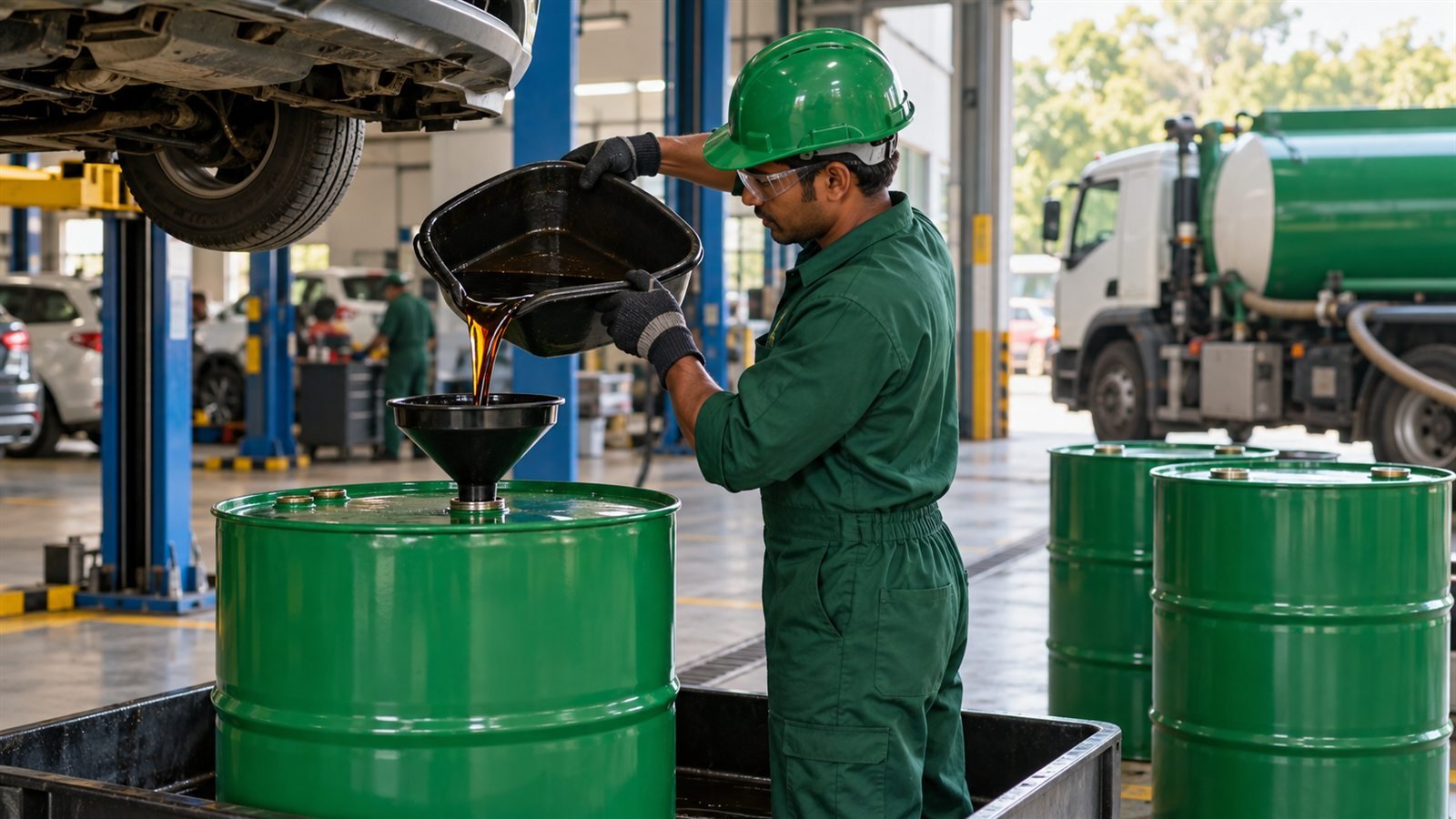
The EPR framework is intended to:
- prevent dumping of used lubricating oil;
- promote authorised collection;
- increase re-refining and recycling;
- reduce illegal burning;
- encourage recovery of usable base oil;
- create traceability through the CPCB portal; and
- place recycling responsibility on producers introducing oil into the market.
For businesses, compliance also helps reduce the risk of environmental compensation and regulatory action.
Documents Required for Used Oil EPR Registration
The exact checklist can vary depending on whether the applicant is a producer, recycler, importer or collection agent.
For a producer, the CPCB Standard Operating Procedure generally requires business, registration and operational information.
Commonly required information may include:
Company Documents
- PAN of the entity
- GST Registration Certificate
- CIN or incorporation details, where applicable
- Registered office address
- Business constitution details
- Official email address
- Mobile number
Import-Related Documents
Where applicable:
- Import Export Code
- Import details of base oil or lubrication oil
- Import details of used oil
- Relevant customs/import records
Authorised Person Details
- Name
- Designation
- PAN/Aadhaar or other required identity details
- Mobile number
- Email address
- Authorisation documentation, where required
Product and Sales Information
The applicant should maintain:
- type of base oil or lubrication oil;
- product description;
- quantity manufactured;
- quantity imported;
- quantity sold in domestic market;
- quantity exported;
- historical sales/import data; and
- product-wise classification.
Supporting Declarations
Depending on the portal and applicant category, CPCB may require declarations, undertakings and supporting documentation in prescribed formats.
Applicants should always check the latest CPCB SOP before filing because portal requirements can be updated.
Used Oil EPR Registration Process
The overall registration process can be understood in the following steps.
Step 1: Determine Applicability
First identify whether the company is:
- Producer
- Used Oil Importer
- Recycler
- Collection Agent
For producers, also determine whether the product actually results in generation of residual used oil.
Step 2: Identify the Correct Product Category
Review whether the product is:
- base oil;
- finished lubrication oil;
- re-refined/recycled base oil;
- process oil;
- grease; or
- another base-oil-derived product.
This is important because registration and EPR target applicability may differ.
Step 3: Collect Documents and Historical Data
Compile:
- PAN
- GST
- CIN
- IEC
- authorised person details
- production data
- import data
- domestic sales
- exports
- product-wise quantities
Historical data should be checked carefully because the EPR liability is linked to previous financial-year data.
Step 4: Register on the CPCB Used Oil Portal
Create the applicable account on the CPCB portal under the correct stakeholder category.
Step 5: Complete the Online Application
Fill in:
- business details;
- product information;
- manufacturing/import information;
- sales data; and
- authorised person information.
Step 6: Upload Supporting Documents
Upload the required certificates, declarations and other prescribed documents.
Step 7: Submit the Application
Review the information carefully before final submission.
Step 8: Respond to CPCB Queries
If CPCB identifies:
- inconsistent quantities;
- missing documents;
- incorrect producer category;
- product classification issues; or
- other discrepancies,
clarification may be sought.
Step 9: Obtain Registration
After satisfactory review, the entity becomes registered under the appropriate CPCB Used Oil EPR category.
Used Oil EPR Targets
The most important ongoing requirement is the annual recycling target.
For producers of base oil or lubrication oil, the Rules prescribe the following phased targets:
| Financial Year | Used Oil Recycling Target |
|---|---|
| 2024-25 | 5% of base/lubrication oil sold or imported in FY 2022-23 |
| 2025-26 | 10% of base/lubrication oil sold or imported in FY 2023-24 |
| 2026-27 | 20% of base/lubrication oil sold or imported in FY 2024-25 |
| 2027-28 | 20% of base/lubrication oil sold or imported in FY 2025-26 |
| 2028-29 | 40% of base/lubrication oil sold or imported in FY 2026-27 |
| 2029-30 | 40% of base/lubrication oil sold or imported in FY 2027-28 |
| 2030-31 onwards | 50% of base/lubrication oil sold or imported in Year Y-2 |
For the current FY 2026-27, the prescribed target is therefore 20% of the applicable base oil or lubrication oil sold or imported during FY 2024-25, subject to the prescribed operational-loss adjustment.
Operational Loss Adjustment
The Rules recognize that not all base oil introduced into the market will ultimately be recoverable as used oil.
Accordingly, the producer’s EPR target may be reduced by a factor specified by CPCB to account for operational loss of base oil.
Businesses should therefore rely on the liability generated or recognised through the current CPCB portal rather than applying the headline percentage mechanically.
EPR Target for New Units
For units established after 1 April 2024, the EPR obligation starts after two years from the end of the financial year in which the unit was established.
Thereafter, the applicable target is calculated under the prescribed phased framework.
EPR Obligation for Importers of Used Oil
Used Oil Importers have a separate and much stricter obligation.
For a used oil importer:
EPR obligation in Year Y = 100% of the used oil imported in Year Y-1.
The Rules also state that import of used oil is permitted for the purpose of re-refining only under this EPR framework.
How Does the Used Oil EPR Certificate Mechanism Work?
The compliance chain can be understood as:
- Producer sells/imports base oil or lubrication oil
- EPR liability is calculated
- Used oil is collected
- Registered recycler processes used oil
- EPR Certificate is generated
- Producer purchases certificate through portal
- Certificate is adjusted against EPR liability
This mechanism provides traceability and helps ensure that the producer’s recycling obligation is fulfilled through registered entities.
Who Generates Used Oil EPR Certificates?
Under the Rules, CPCB generates EPR Certificates through the portal in favour of a registered recycler based on eligible recycling activity.
The producer then purchases eligible certificates online to meet its EPR target.
CPCB has also developed an EPR certificate trading framework for Used Oil, under which certificate transfer is permitted between eligible certificate-generating entities and obligated producers/importers in the prescribed manner.
Can a Producer Buy Unlimited EPR Certificates?
No.
Under the CPCB certificate trading framework, a producer may generally purchase certificates up to:
Current-year EPR liability + leftover liability of previous years + up to 10% of current-year liability
subject to portal rules and applicable conditions.
This prevents unlimited speculative accumulation of EPR credits.
What Is Re-Refining?
Re-refining is the process of treating used lubricating oil to recover base oil that can again be used for manufacturing lubricants or other permitted products.

It is different from simply burning used oil as fuel.
The Used Oil EPR framework gives importance to environmentally sound recycling and re-refining through authorised facilities.
What Is a Bulk Generator of Used Oil?
The Rules define a bulk generator broadly to include entities such as:
- automobile industries;
- railways;
- defence establishments;
- transport companies;
- industrial units;
- power transmission companies;
- hotels;
- restaurants; and
- other similar entities
that generate more than 100 metric tonnes of used oil per year.
Bulk generators should ensure that the used oil generated is handled through authorised channels in accordance with the applicable requirements.
Responsibilities After Obtaining Used Oil EPR Registration
Registration is only the starting point.
A producer should establish an ongoing compliance system covering:
1. Sales and Import Data
Maintain year-wise records of base oil and lubrication oil:
- manufactured;
- imported;
- sold domestically; and
- exported.
2. Annual EPR Liability
Calculate and monitor the applicable recycling obligation for every financial year.
3. EPR Certificate Procurement
Obtain eligible EPR Certificates from registered recyclers through the prescribed system.
4. Portal Reconciliation
Ensure that quantities declared by the producer and recycler match.
The Rules provide that if there is a difference between producer and recycler data, the lower quantity may be considered for fulfilment of the EPR obligation.
5. Record Maintenance
Maintain supporting:
- invoices;
- sales records;
- import records;
- certificate transactions;
- product details; and
- compliance documentation.
6. Return and Portal Compliance
Complete the applicable online reporting and return requirements within prescribed timelines.
Businesses should regularly review the current CPCB portal because filing dates and system requirements may be updated through CPCB notices.
Common Mistakes in Used Oil EPR Compliance
Treating Every Oil as Exempt
Grease, process oil or white oil may qualify for target exemption in some circumstances, but registration and CPCB assessment may still be required.
Incorrect Producer Classification
A business may wrongly assume that only manufacturers need registration.
Importers and own-brand sellers can also fall within the producer definition.
Wrong Historical Sales Data
EPR targets are linked to historical domestic sales/import quantities.
Incorrect data can result in incorrect liability.
Including Export Quantities in Domestic Liability
Export-only quantities that are not introduced into the Indian market may not attract the same EPR target, though registration obligations can still apply.
Confusing Registration With Compliance
Having a registration number does not mean the annual EPR target is fulfilled.
Buying Certificates Outside the Prescribed System
EPR Certificates should be purchased through the prescribed CPCB mechanism from eligible registered recyclers.
Ignoring Used Oil Import Liability
Importers of used oil have a separate 100% EPR obligation linked to the previous year’s imports.
Penalty for Non-Compliance
Failure to comply with Used Oil EPR requirements can attract regulatory action under the Hazardous and Other Wastes framework and the Environment (Protection) Act.
Non-compliance can include:
- operating without mandatory registration;
- failure to meet EPR targets;
- false or incorrect information;
- improper used oil handling;
- unauthorised recycling;
- dealing with unregistered entities;
- false certificate transactions; and
- failure to complete applicable reporting requirements.
Environmental Compensation may also be imposed under the polluter-pays principle and applicable CPCB guidelines.
Benefits of Proper Used Oil EPR Compliance
A structured compliance system helps businesses:
- reduce regulatory risk;
- ensure legal disposal and recycling;
- maintain traceability;
- improve waste-oil recovery;
- avoid informal handling;
- improve ESG performance;
- maintain clean historical data; and
- reduce last-minute EPR certificate procurement pressure.
For lubricant manufacturers and importers, EPR compliance should therefore become part of routine sales and regulatory reporting.
How ELT Corporate Can Assist With Used Oil EPR
ELT Corporate can assist businesses with:
- Used Oil EPR applicability assessment
- Producer-category identification
- CPCB Used Oil EPR Registration
- Product classification
- EPR exemption assessment
- Historical sales/import data preparation
- Documentation review
- CPCB query handling
- EPR target calculation
- EPR Certificate compliance
- Used oil importer registration
- Recycler/collection-agent compliance support
- Ongoing EPR advisory and reporting
Whether you manufacture lubricants, import base oil, sell products under your own brand or import used oil for re-refining, it is important to determine your regulatory position before filing.
Conclusion
EPR for Used Oil Certificate is now an important environmental compliance requirement for companies dealing with base oil, lubrication oil and used oil in India.
The framework does not stop at obtaining registration.
A producer must continuously:
- maintain sales and import records;
- calculate EPR liability;
- obtain eligible EPR Certificates;
- deal with registered recyclers;
- maintain portal data; and
- complete prescribed compliance requirements.
For FY 2026-27, the headline recycling target for established producers is 20% of the applicable base oil or lubrication oil sold or imported in FY 2024-25, subject to CPCB’s operational-loss adjustment.
Businesses that establish proper EPR processes early can reduce regulatory risk and avoid last-minute compliance issues.
Frequently Asked Questions
EPR for Used Oil is the responsibility placed on eligible producers and used oil importers to ensure prescribed quantities of used oil are recycled through registered recyclers.
The framework came into force on 1 April 2024.
Producers of base oil/lubrication oil, used oil importers, recyclers and collection agents are among the categories required to register on the CPCB Used Oil Portal.
Yes, entities importing and selling lubrication oil in the Indian domestic market can fall within the producer definition.
Certain oils such as white oils, process oils and greases that do not result in residual used oil may not attract an EPR target. However, registration may still be required and CPCB evaluates the exemption claim.
The prescribed target is 20% of the applicable base oil or lubrication oil sold or imported during FY 2024-25, subject to the operational-loss adjustment.
From FY 2030-31 onwards, the prescribed target is 50% of base oil or lubrication oil sold or imported in Year Y-2.
The obligation in Year Y is 100% of used oil imported in Year Y-1.
Under the notified EPR framework, import of used oil is permitted for the purpose of re-refining.
Eligible EPR Certificates are generated through the CPCB portal in favour of registered recyclers based on eligible recycling activity.
No. Producers are required to fulfil EPR through certificates from registered recyclers under the prescribed CPCB mechanism.
No. Registration is only the initial requirement. Annual recycling liability and certificate compliance must also be completed.
An entity that does not introduce the relevant oil into the Indian domestic market may not have an EPR target for those export quantities, though CPCB indicates registration may still be required.
Non-compliance may lead to Environmental Compensation and other regulatory action under the applicable environmental laws.