
Plastic has become an essential part of our everyday lives. From food packaging and water bottles to electronic products, household appliances, medical equipment and industrial components, plastic is used across almost every sector.
Its lightweight nature, durability, flexibility and affordability make it a popular material for manufacturing and packaging. However, the increasing use of plastic has also created a major environmental challenge: plastic waste.
One important thing to understand is that not all plastics are the same, and not every type of plastic can be recycled in the same way. Some plastics are comparatively easy to collect and recycle, while others require specialised processing or may not be practically recyclable through conventional recycling systems.
Understanding different plastic types is therefore important for manufacturers, importers, brand owners, packaging companies, recyclers and consumers.
In this guide, we will explore the seven commonly recognised plastic identification codes, their properties, everyday applications, recycling possibilities and the role of plastic waste management and EPR compliance in India.
1. What Is Plastic?
Plastic is a material made primarily from polymers, which are large molecules formed by linking smaller chemical units called monomers.
Depending on the type of polymer and the manufacturing process, plastic can be hard, soft, flexible, transparent, rigid, heat-resistant or lightweight.
Some common characteristics of plastic include:
- Lightweight and easy to transport.
- Resistant to moisture and corrosion.
- Flexible and easy to mould into different shapes.
- Suitable for a wide range of applications.
- Relatively economical for mass production.
- Available in different colours, grades and compositions.
These characteristics make plastic useful in packaging, construction, automobiles, electronics, healthcare, agriculture and many other industries.
However, its environmental impact depends significantly on how plastic products are designed, used, collected, recycled and disposed of after use.
2. Understanding the Seven Types of Plastics
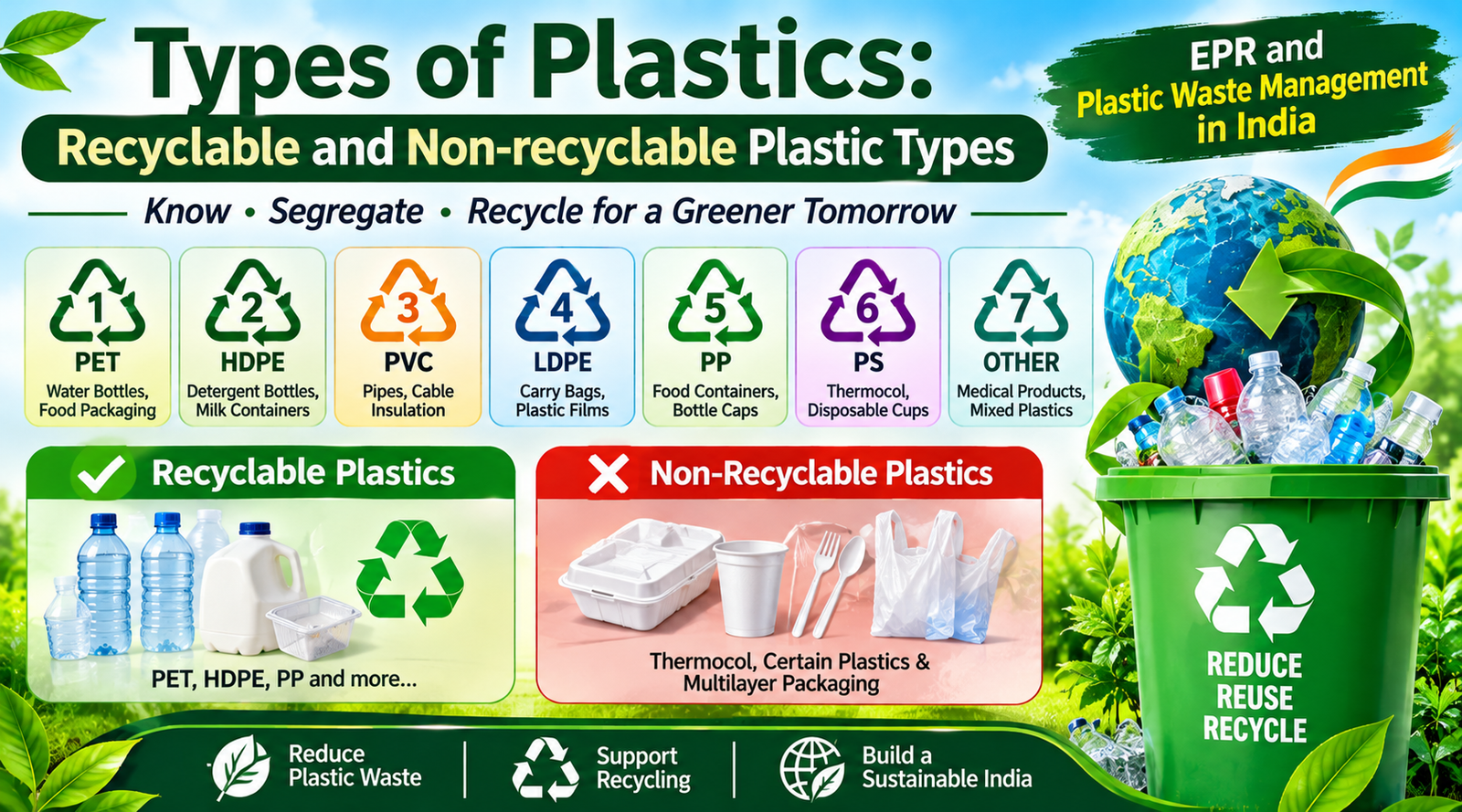
Plastic products are commonly marked with Resin Identification Codes (RIC), numbered from 1 to 7. These numbers help identify the primary type of plastic resin used in a product. They are commonly displayed inside a triangular symbol on the product or packaging.
These codes identify the plastic material; they do not automatically guarantee that the product is recyclable in every location.
The seven commonly recognised types are:
- PET or PETE – Polyethylene Terephthalate
- HDPE – High-Density Polyethylene
- PVC – Polyvinyl Chloride
- LDPE – Low-Density Polyethylene
- PP – Polypropylene
- PS – Polystyrene
- Other Plastics – Miscellaneous Plastic Materials
Let us understand each type in detail.
3. PET or PETE – Polyethylene Terephthalate (Plastic Code 1)
PET is one of the most commonly used plastics, particularly in the packaging industry. It is lightweight, transparent, strong and widely used for manufacturing beverage and food containers.
Common Applications
- Mineral water bottles.
- Soft drink bottles.
- Cooking oil bottles.
- Food jars and containers.
- Certain food packaging trays.
- Polyester fibres used in textiles.
Is PET Recyclable?
Yes. PET is one of the most commonly recycled plastic materials.
Collected PET bottles can be processed into recycled PET flakes or granules, which may be used in the production of new bottles, packaging materials, polyester fibres and other products, subject to applicable quality and safety requirements.
Recycling Considerations
- Bottles should be collected separately.
- Caps, labels and other components may require separation.
- Contamination from food, oil or other substances should be minimised.
- Material should be sorted and processed through appropriate recycling facilities.
Recycling status: Generally recyclable where suitable collection and recycling facilities are available.
4. HDPE – High-Density Polyethylene (Plastic Code 2)
HDPE is a strong, durable and comparatively rigid plastic. It has good chemical resistance and is widely used in household, industrial and commercial applications.
Common Applications
- Shampoo and conditioner bottles.
- Detergent containers.
- Milk and juice containers.
- Household chemical containers.
- Plastic drums and jerry cans.
- Pipes and industrial containers.
- Certain plastic crates and storage bins.
Is HDPE Recyclable?
Yes. HDPE is widely accepted by many plastic recycling systems.
After collection and sorting, HDPE products can be cleaned, shredded, melted and converted into recycled plastic granules. These granules may be used to manufacture products such as pipes, containers, crates, bins and other suitable plastic articles.
Recycling Considerations
- Containers should be emptied before recycling.
- Different colours and grades may need separate sorting.
- Chemical residues must be managed appropriately.
- The intended recycled application should meet relevant quality requirements.
Recycling status: Generally recyclable and commercially recycled in many markets.
5. PVC – Polyvinyl Chloride (Plastic Code 3)
PVC is a versatile plastic known for its durability, strength and resistance to chemicals and weather conditions. It is available in rigid and flexible forms, depending on the additives and manufacturing process.
Common Applications
- Water and drainage pipes.
- Electrical cable insulation.
- Window profiles and frames.
- Flooring materials.
- Flexible hoses and tubing.
- Certain medical-grade tubing and products.
- Construction and building materials.
Is PVC Recyclable?
PVC can be recycled, but its recycling process is more specialised than that of commonly recycled PET and HDPE.
The presence of additives, plasticisers, stabilisers, pigments and other materials can make sorting and processing more complicated. PVC waste should therefore be handled through suitable recycling systems that are equipped to process the relevant PVC grade.
Recycling Considerations
- Rigid and flexible PVC may require separate processing.
- Additives and contaminants can affect recycled material quality.
- PVC should not be mixed indiscriminately with other plastic waste.
- Uncontrolled burning of PVC waste must be avoided.
Recycling status: Recyclable through specialised systems, but collection and processing can be more challenging.
6. LDPE – Low-Density Polyethylene (Plastic Code 4)
LDPE is a lightweight, flexible and soft plastic. It is commonly used in products that require flexibility, moisture resistance and easy handling.
Common Applications
- Plastic carry bags.
- Packaging films.
- Bread and grocery bags.
- Shrink wraps.
- Flexible food packaging.
- Plastic liners.
- Squeezable bottles and containers.
Is LDPE Recyclable?
Yes. LDPE can be recycled, but flexible films and bags often create practical challenges for conventional recycling systems.
They may become entangled in machinery, contain food residues or be mixed with different materials. Specialised collection, sorting and processing systems are therefore important.
Recycling Considerations
- Keep plastic films and bags separate from rigid plastic waste.
- Avoid mixing heavily contaminated materials.
- Clean and dry material wherever required by the recycling facility.
- Use appropriate collection channels for flexible plastic packaging.
Recycling status: Recyclable, but collection and recycling infrastructure may be more limited than for rigid PET and HDPE products.
7. PP – Polypropylene (Plastic Code 5)
Polypropylene is a lightweight and durable plastic with good chemical resistance and heat resistance compared with many other common plastics. It is widely used in household products, food packaging, automobiles and industrial applications.
Common Applications
- Food storage containers.
- Yoghurt and dairy containers.
- Bottle caps and closures.
- Microwave-safe containers designed for the purpose.
- Packaging tubs.
- Automotive components.
- Household storage products.
- Industrial fibres and woven sacks.
Is PP Recyclable?
Yes. PP can be recycled through suitable mechanical recycling processes.
After collection and sorting, the material can be cleaned, shredded and converted into recycled granules for use in manufacturing suitable products.
Recycling Considerations
- Different colours and grades may need sorting.
- Food contamination should be reduced.
- Labels, adhesives and mixed materials may affect processing.
- Recycled PP should be used in applications suitable for its quality and regulatory requirements.
Recycling status: Recyclable, with growing use of PP recycling systems.
8. PS – Polystyrene (Plastic Code 6)
Polystyrene is a plastic used in both rigid and expanded forms. Expanded polystyrene is commonly known as EPS or thermocol. It is lightweight and can provide cushioning and insulation, making it useful in packaging and protective applications.
Common Applications
- Disposable cups and plates.
- Protective packaging.
- Electronic product packaging.
- Food trays.
- Insulation materials.
- Certain disposable containers.
- Protective packaging blocks.
Is PS Recyclable?
Polystyrene can technically be recycled, but its recycling is often challenging.
Expanded polystyrene contains a large amount of air, making transportation and storage inefficient unless it is compressed or densified. Food contamination and the low economic value of some PS waste streams can also limit recycling.
Recycling Considerations
- EPS may require densification before transportation.
- Clean and contaminated material should be separated.
- Specialised recycling facilities may be needed.
- Collection economics can influence whether recycling is practical.
Recycling status: Technically recyclable, but often difficult to collect and recycle economically.
9. Other Plastics – Miscellaneous Plastics (Plastic Code 7)
Plastic Code 7 covers plastics that do not fall under the first six categories. It includes several different polymer types and mixed plastic materials.
Because this category contains many different materials, its recycling possibilities vary significantly.
Common Applications
- Polycarbonate water containers.
- Acrylic products.
- Nylon components.
- Certain electronic and electrical components.
- Engineering plastic parts.
- Multilayer plastic materials.
- Some specialised food and industrial containers.
Is Code 7 Plastic Recyclable?
There is no single answer.
Some Code 7 plastics may be recyclable through specialised facilities, while others may be difficult to separate, process or recycle economically. For example, certain engineering thermoplastics can be recycled, whereas mixed laminates and thermosetting plastics may require alternative waste-management methods.
Recycling Considerations
- Identify the exact polymer wherever possible.
- Check whether the product contains multiple materials.
- Separate thermoplastics from thermosetting materials.
- Use specialised recyclers where required.
- Avoid assuming that all Code 7 plastics have the same recycling properties.
Recycling status: Depends on the specific polymer, composition and available processing technology.
10. Quick Comparison: Recyclable and Difficult-to-Recycle Plastics
The following table provides a general comparison of the seven plastic identification codes.
| Plastic Code | Plastic Type | Common Applications | General Recycling Potential |
|---|---|---|---|
| 1 | PET | Water and soft drink bottles | High |
| 2 | HDPE | Detergent and shampoo bottles | High |
| 3 | PVC | Pipes and cable insulation | Specialised |
| 4 | LDPE | Carry bags and plastic films | Moderate; infrastructure-dependent |
| 5 | PP | Food containers and bottle caps | Good where facilities exist |
| 6 | PS | Disposable products and thermocol | Limited or specialised |
| 7 | Other | Mixed and engineering plastics | Varies by material |
These are general descriptions, not universal recycling guarantees. Actual recyclability depends on material composition, product design, contamination, collection systems, sorting technology, local recycling infrastructure and market demand.
11. Thermoplastics vs Thermosetting Plastics
Apart from the seven resin identification codes, plastics can also be classified according to how they behave when exposed to heat. This distinction is important for understanding whether a plastic material can be remoulded and mechanically recycled.
A. Thermoplastics
Thermoplastics soften when heated and harden again when cooled. This property allows them to be reshaped through suitable processing methods.
Common examples include:
- PET
- HDPE
- PVC
- LDPE
- PP
- PS
Many thermoplastics can be mechanically recycled, although the number of recycling cycles and the quality of recycled material may vary.
B. Thermosetting Plastics
Thermosetting plastics undergo a chemical curing process that creates a cross-linked structure. Once cured, they cannot simply be melted and reshaped like ordinary thermoplastics.
Common examples include:
- Bakelite.
- Certain epoxy resins.
- Melamine formaldehyde.
- Phenolic resins.
- Fibre-reinforced thermoset composites.
Thermosetting plastics are generally difficult to recycle through conventional melting and remoulding processes. Certain materials may be processed through specialised recovery or alternative treatment technologies.
Thermoplastics can generally be softened and reshaped through heating, whereas thermosetting plastics retain a permanently cross-linked structure after curing.
12. Which Plastics Are Difficult to Recycle?
Some plastic products are technically recyclable but may be difficult to recycle in practice. Others may not be suitable for conventional mechanical recycling. Common examples include:
1. Multilayer Plastic Packaging
Multilayer packaging combines different layers of materials, such as plastic, aluminium foil and paper. It is commonly used in:
- Snack packets.
- Food pouches.
- Sachets.
- Certain beverage packaging.
- Flexible packaging for consumer goods.
Separating the different layers can be difficult, making conventional mechanical recycling more challenging.
2. Thermocol and Expanded Polystyrene
Thermocol is lightweight and bulky. Its low density makes collection, transportation and storage difficult unless it is compressed or processed through specialised facilities.
3. Thermosetting Plastics
Bakelite, certain epoxy materials and fibre-reinforced thermoset plastics cannot be conventionally melted and remoulded after curing.
4. Mixed Plastic Waste
When different plastic types are mixed together, their melting properties and chemical characteristics may differ. This can reduce the quality of the recycled material and make processing more difficult.
5. Contaminated Plastic Packaging
Plastic contaminated with food, chemicals, oil or other substances may require additional cleaning and treatment before recycling. In some cases, contamination can make recycling impractical.
13. Understanding Plastic Packaging Categories Under India’s EPR Framework
It is important to distinguish between the seven plastic resin identification codes and the plastic packaging categories used under India’s Extended Producer Responsibility framework.
The resin codes identify the material used to manufacture a plastic product. EPR packaging categories classify plastic packaging according to its form and composition.
Under the Plastic Waste Management Rules and applicable EPR guidelines, plastic packaging is classified into categories that include:
Category I – Rigid Plastic Packaging
This category includes rigid plastic packaging such as bottles, containers, jars and other rigid packaging formats. Examples:
- Plastic beverage bottles.
- Shampoo bottles.
- Detergent containers.
- Rigid food containers.
Category II – Flexible Plastic Packaging
This category covers flexible plastic packaging made from a single layer or multiple layers of different types of plastic, along with plastic sheets, covers, carry bags, sachets and pouches. Examples:
- Flexible packaging films.
- Plastic carry bags.
- Plastic pouches.
- Sachets and wrappers.
Category III – Multilayered Plastic Packaging
This category includes packaging with at least one plastic layer and at least one layer of another material. Examples:
- Plastic-aluminium laminates.
- Certain paper-plastic packaging structures.
- Multilayer flexible packaging.
Category IV – Compostable Plastic Packaging
This category covers plastic sheets and similar materials used for packaging, as well as carry bags made from compostable plastics, as specified under the applicable rules.
Category V – Biodegradable Plastic Packaging
The applicable framework also recognises plastic sheets and similar materials used for packaging, carry bags and commodities made from biodegradable plastics.
The exact classification must be checked against the latest applicable notifications and EPR portal requirements.
A resin identification code such as PET, HDPE or PP should not be confused with an EPR packaging category. A plastic product’s material and its packaging format are different aspects of classification.
14. What Is the Difference Between Recyclable, Biodegradable and Compostable Plastics?
These three terms are often used interchangeably in everyday conversations, but they describe different properties.
Recyclable Plastic
Recyclable plastic is material that can be collected and processed into usable secondary raw material or products through an appropriate recycling process. Examples include PET, HDPE and PP, subject to material quality and recycling infrastructure.
Biodegradable Plastic
Biodegradable plastic is designed to undergo degradation through biological processes under specified environmental conditions.
The time and extent of degradation depend on the material and the conditions in which it is processed. A biodegradable claim should be supported by the applicable testing and certification requirements.
Compostable Plastic
Compostable plastic is designed to biodegrade under specified composting conditions and produce composting outputs without leaving unacceptable residues. Industrial compostable plastics generally require suitable composting facilities and controlled conditions.
Biodegradable or compostable does not automatically mean recyclable. Such materials should not be mixed with conventional plastic recycling streams unless the relevant facility is specifically equipped to process them.
15. How Does Plastic Recycling Work?
Plastic recycling generally involves a series of steps to convert discarded plastic into usable material.
- Collection | Plastic waste is collected from households, commercial establishments, industries and other sources.
- Segregation | Different plastic types are separated based on their material, colour, form and composition.
- Sorting | The collected plastic is sorted to remove unsuitable materials, contaminants and incompatible plastic types.
- Cleaning and washing | Plastic waste is washed to remove dirt, labels, food residues and other contaminants, wherever required.
- Shredding | The plastic is cut into smaller flakes or pieces to make further processing easier.
- Processing and granulation | Suitable plastic material is processed through melting, extrusion and pelletisation to produce recycled plastic granules.
- Manufacturing of new products | Recycled granules may be used to manufacture new plastic products, depending on their quality and permitted applications.
The actual process may vary according to the polymer, waste stream and recycling technology.
16. Why Is Plastic Waste Management Important?
Plastic waste management is important because improper disposal can create environmental and public-health challenges. Some key reasons include:
- Preventing plastic litter from entering rivers, lakes and oceans.
- Reducing the quantity of plastic waste sent to landfills.
- Recovering valuable materials through recycling.
- Encouraging responsible product and packaging design.
- Reducing dependence on virgin plastic raw materials.
- Promoting a circular economy.
- Supporting compliance with environmental regulations.
Proper segregation at the source is one of the most important steps in improving the overall plastic waste management system.
17. Role of EPR in Plastic Waste Management in India
Extended Producer Responsibility (EPR) is an important part of India’s plastic waste management framework.
Under the Plastic Waste Management Rules, 2016, as amended, applicable Producers, Importers and Brand Owners (PIBOs) have prescribed responsibilities for managing plastic packaging waste.
The EPR framework aims to ensure that plastic packaging waste is collected, recycled, reused or processed through permitted methods. The key compliance aspects include:
- Determining the applicability of EPR requirements.
- Identifying the relevant plastic packaging category.
- Obtaining registration through the applicable CPCB portal.
- Maintaining required records and transaction details.
- Meeting applicable recycling and other EPR obligations.
- Procuring or transferring eligible EPR certificates, as applicable.
- Filing prescribed returns and declarations.
- Working with appropriately registered plastic waste processors.
Businesses dealing in plastic packaging should not assume that every plastic product falls under the same EPR category. The applicable classification depends on the packaging format, material composition and relevant regulatory provisions.
18. Who May Need Plastic EPR Registration?
Depending on the applicable provisions, the following entities may fall within the plastic EPR registration framework:
- Producers — entities involved in the manufacture or use of covered plastic packaging, as defined under the rules.
- Importers — entities importing plastic packaging, packaging material or products containing plastic packaging, as covered by the rules.
- Brand Owners — businesses selling products under their own brand name using covered plastic packaging.
- Plastic Waste Processors — entities involved in recycling, waste-to-energy, waste-to-oil or industrial composting activities, as applicable.
- Manufacturers and Importers of Plastic Raw Materials — entities covered under the relevant registration provisions.
The applicability of registration and obligations should be assessed based on the entity’s business activities and the latest regulatory requirements.
19. How ELT Corporate Can Assist with Plastic EPR Compliance
Understanding the types of plastics and their recycling potential is an important first step. For businesses involved in plastic packaging, it is equally important to understand the regulatory obligations under India’s Plastic Waste Management Rules.
ELT Corporate provides regulatory and compliance support for businesses dealing with plastic packaging and plastic waste management. Our assistance may include:
- Plastic EPR applicability assessment.
- Identification of relevant plastic packaging categories.
- Guidance on Producer, Importer and Brand Owner registration.
- Documentation preparation and review.
- Assistance with CPCB portal registration.
- Guidance on EPR obligations and certificate requirements.
- Support with applicable compliance and return-filing requirements.
- Regulatory updates and compliance guidance.
Whether you are a manufacturer, importer, brand owner or plastic waste processor, a clear understanding of your obligations can help you manage compliance more effectively.
Conclusion
Plastic is an important material in modern manufacturing, packaging and everyday life. However, its increasing use makes responsible waste management essential.
Understanding the seven plastic identification codes helps businesses and consumers identify different plastic materials and understand their general recycling possibilities.
While PET, HDPE and PP are commonly recycled, materials such as PVC, LDPE, PS and mixed plastics may require specialised collection and processing systems. Some thermosetting plastics and multilayer materials can be particularly challenging to recycle through conventional methods.
For businesses in India, understanding plastic types is also important for identifying applicable packaging categories and managing Plastic EPR compliance.
The goal should not simply be to reduce plastic use, but to use plastic responsibly, improve product design, encourage segregation and ensure that waste is directed towards appropriate recycling and processing channels.
Responsible plastic management begins with understanding the material and continues with responsible action throughout its lifecycle.
Frequently Asked Questions
There are seven commonly recognised plastic resin identification codes: PET, HDPE, PVC, LDPE, PP, PS and Other Plastics.
PET (Code 1) and HDPE (Code 2) are commonly recycled. PP (Code 5) is also recyclable where suitable collection and processing facilities are available.
Yes. PVC can be recycled through suitable specialised processes. However, additives, contamination and differences between rigid and flexible PVC can make recycling more challenging.
Yes. LDPE can be recycled, but plastic films and bags may require separate collection and specialised recycling infrastructure.
Expanded polystyrene, commonly known as thermocol, can technically be recycled. However, its low density and bulky nature make collection and transportation difficult. Specialised facilities may be required.
The number generally identifies the type of plastic resin used in the product. It does not guarantee that the product will be accepted for recycling in every location.
Thermoplastics can generally soften when heated and be reshaped, whereas thermosetting plastics form a permanent cross-linked structure after curing and cannot be remoulded through ordinary heating.
Some biodegradable plastics may be processed through specialised systems, but they are not automatically compatible with conventional plastic recycling. Their treatment depends on the material and available facilities.
The framework recognises rigid plastic packaging, flexible plastic packaging, multilayered plastic packaging, compostable plastic packaging and biodegradable plastic packaging under the applicable provisions.
Entities falling within the applicable registration provisions of the Plastic Waste Management Rules, 2016, as amended, are required to obtain registration through the designated CPCB online portal.
Businesses can refer to the CPCB’s Common EPR Portal and the latest notifications and guidelines issued by MoEFCC and CPCB.
No. Some plastics are readily recyclable through established systems, some require specialised technologies, and others may not be practically recyclable through conventional mechanical recycling. The outcome depends on material composition, contamination and available infrastructure.
Official References and Useful Resources
- CPCB — Consolidated Guidelines for Segregation, Collection and Disposal of Plastic Waste: plastic types, uses and waste-management guidance.
- CPCB — Centralised EPR Portal for Plastic Packaging: registration, returns and EPR certificate transactions.
- MoEFCC — Plastic Waste Management Rules, 2016, and the amendments issued from time to time.