Electronic and electrical equipment has become an essential part of modern life. Computers, laptops, mobile phones, televisions, printers, refrigerators, air conditioners, networking equipment and other electronic products are used extensively by households, offices, commercial establishments and industries.
However, when these products reach the end of their useful life, they become electronic waste, commonly known as e-waste. If e-waste is not collected, segregated, stored and channelized properly, it can create environmental and health risks while also resulting in the loss of valuable recoverable materials.
In Delhi, e-waste management is governed by the applicable environmental framework, including the E-Waste (Management) Rules, 2022, along with subsequent amendments and directions issued by the competent authorities. The Central Pollution Control Board (CPCB) and Delhi Pollution Control Committee (DPCC) play important roles in implementing and overseeing e-waste management requirements.
This guide explains the key aspects of collection, segregation and storage of e-waste in Delhi, including compliance considerations for businesses and organizations.
What Is E-Waste?
E-waste refers to discarded electrical and electronic equipment and their components that have reached the end of their useful life or are no longer wanted.
Examples include:
- Computers and laptops
- Mobile phones and tablets
- Printers and scanners
- Televisions and monitors
- Refrigerators and air conditioners
- Washing machines
- Routers and networking equipment
- UPS systems and certain electronic equipment
- Electronic cables and accessories
- Other electrical and electronic equipment covered under the applicable rules
E-waste may contain valuable materials such as metals and plastics, but certain components can also contain substances that require environmentally sound handling.
Therefore, e-waste should not simply be mixed with ordinary municipal waste.
Why Is Proper E-Waste Management Important in Delhi?
Delhi generates waste from households, offices, commercial establishments, institutions and industries every day. With the increasing use and replacement of electronic equipment, responsible management of discarded electronics has become increasingly important.
Improper handling of e-waste can lead to:
1. Environmental Pollution
Informal or improper dismantling and disposal can release pollutants into the surrounding environment.
2. Health and Safety Risks
Unsafe handling of electronic components can expose workers and other people to potentially harmful substances.
3. Loss of Valuable Resources
Electronic products contain recoverable materials such as metals, plastics and other components. Proper recycling helps recover these resources instead of sending them to uncontrolled disposal.
4. Illegal Recycling and Dismantling
Unregulated processing of e-waste can create environmental and occupational risks. The regulatory framework therefore promotes environmentally sound management through appropriate authorized or registered channels.
The government’s e-waste framework specifically aims to promote environmentally sound recycling and reduce illegal recycling and recovery operations.
Collection of E-Waste in Delhi
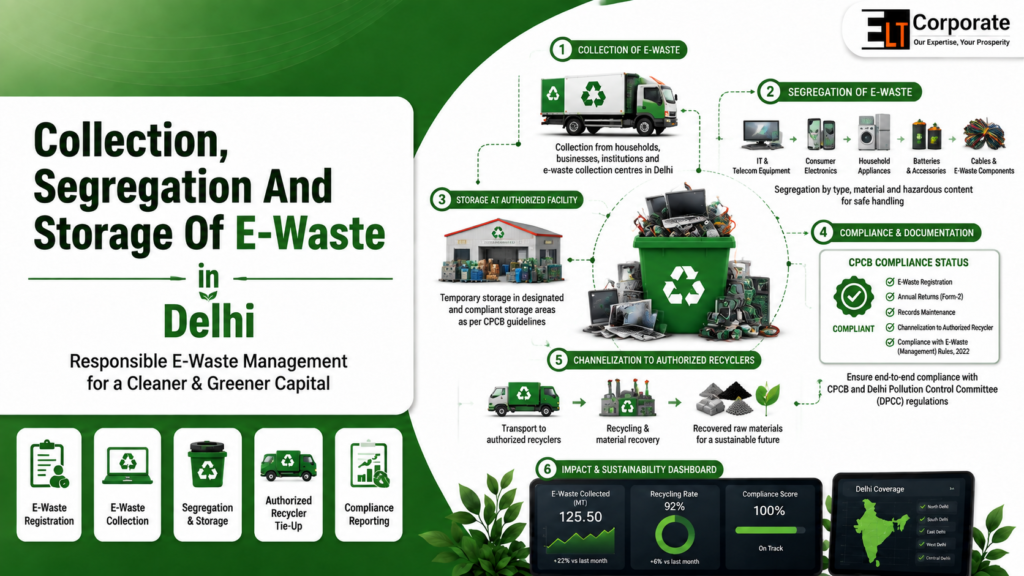
The first step in effective e-waste management is proper collection.
E-waste should be collected separately rather than being mixed with general municipal waste.
Depending on the type of organization and its role in the e-waste supply chain, collection may involve producers, manufacturers, bulk consumers, collection mechanisms, refurbishers and registered recyclers/dismantlers as applicable under the regulatory framework.
The objective is to ensure that discarded electrical and electronic equipment is eventually channelized through environmentally sound management channels.
How Should E-Waste Be Collected?
A basic collection system should include:
- Identification of e-waste generated.
- Separation of e-waste from general waste.
- Safe handling of electronic equipment.
- Temporary storage in a suitable designated area.
- Maintaining appropriate records where required.
- Transportation through appropriate channels.
- Channelization to the relevant registered/authorized entity as applicable.
Organizations generating significant quantities of electronic waste should establish a clearly defined internal process for collection and disposal.
Segregation of E-Waste
Segregation means separating e-waste from other types of waste and, where appropriate, separating different categories of electronic equipment.
Segregation is important because mixed waste can make safe handling, transportation and recycling more difficult.
For example, an organization may separately identify:
- IT equipment
- Telecommunication equipment
- Consumer electronics
- Large electrical appliances
- Small electronic equipment
- Cables and accessories
- Other applicable categories
Segregation also helps organizations maintain better records of the quantity and type of e-waste being handled.
Basic E-Waste Segregation Process
A practical segregation system can follow these steps:
Step 1: Identify Electronic Waste
Identify equipment that has been discarded, replaced or declared obsolete.
Step 2: Separate From General Waste
Do not place electronic equipment in ordinary municipal waste bins.
Step 3: Categorize the Equipment
Separate different types of electronic equipment wherever practical.
Step 4: Remove Unnecessary Attachments Safely
Where applicable and safe, accessories can be separated for proper handling.
Step 5: Move E-Waste to the Designated Storage Area
After segregation, the material should be moved to a designated and controlled storage area.
Step 6: Maintain Records
Businesses should maintain appropriate records of e-waste handled/generated as required under the applicable compliance framework.
Storage of E-Waste in Delhi
Storage is another important stage of e-waste management.
E-waste should be stored in a manner that prevents damage, unauthorized access, leakage, fire hazards and environmental contamination.
The storage area should ideally be:
- Clearly designated
- Protected from unnecessary exposure to weather
- Organized and accessible
- Suitable for the type and quantity of e-waste
- Designed to prevent accidental damage
- Maintained in a manner that supports safe handling and transportation
CPCB guidance has emphasized that e-waste storage capacity should be appropriate to the available area, volume of operations and type of e-waste. It also recommends suitable racks, containers or bins for certain categories of e-waste to facilitate effective handling.
Important Storage Practices
1. Use a Dedicated Storage Area
E-waste should be kept separately from general waste and other incompatible materials.
2. Prevent Damage
Electronic equipment should be stacked and handled carefully to prevent breakage or unnecessary damage.
3. Protect Sensitive Equipment
Items should be stored in suitable racks, bins, containers or designated areas depending on their nature.
4. Control Access
Only authorized personnel should handle stored e-waste.
5. Maintain Inventory
Organizations should maintain an internal record of the quantity and type of e-waste stored and subsequently transferred.
6. Avoid Unsafe Storage Conditions
Storage should be managed to minimize risks such as fire, breakage, leakage or environmental contamination.
E-Waste Management Rules Applicable in India
The E-Waste (Management) Rules, 2022 provide the current central regulatory framework for e-waste management in India, with amendments issued subsequently. The framework establishes responsibilities for different stakeholders and incorporates the concept of Extended Producer Responsibility (EPR).
The rules also assign responsibilities to local bodies. Where e-waste is found mixed with municipal solid waste, local bodies are required to ensure that it is properly segregated, collected and channelized to a registered recycler or refurbisher. They are also required to facilitate e-waste collection, segregation and disposal systems.
What Is Extended Producer Responsibility (EPR)?
Extended Producer Responsibility (EPR) places responsibility on producers for environmentally sound management of the e-waste generated from their products, according to the applicable regulatory requirements.
Under the e-waste framework, producers have responsibilities related to the collection and environmentally sound management of e-waste through the prescribed EPR mechanism.
The objective is to ensure that electronic products do not simply become unmanaged waste after their useful life.
Role of DPCC in E-Waste Management in Delhi
The Delhi Pollution Control Committee (DPCC) is the state-level pollution control authority responsible for various environmental regulatory functions in Delhi.
DPCC provides information relating to e-waste management, applicable rules, authorized/refurbishing-related information and relevant regulatory processes.
Organizations involved in e-waste activities should therefore verify the latest requirements directly with DPCC and CPCB before commencing or modifying their operations.
Can You Start an E-Waste Collection and Storage Business in Delhi?
This is an important compliance question.
Businesses should not assume that simply obtaining a general waste-related permission automatically allows them to collect, segregate and store e-waste in Delhi.
DPCC has specifically issued directions concerning stand-alone e-waste collection activities. In a 2023 circular, DPCC stated that certificates for the activity described as “Waste Electrical and Electronics Equipment Collection Segregation and Storage (without Dismantling and Recycling)” under the White Category were declared null and void for handling e-waste in Delhi, referring to the position that stand-alone collection was not permitted under the applicable framework at that time.
Therefore, a business planning to undertake e-waste collection, storage, refurbishment, dismantling or recycling should first determine:
- What exact activity it intends to undertake
- Whether the activity is permitted at the proposed location
- Which authority/registration applies
- Whether CPCB registration is required
- Whether DPCC consent/authorization is applicable
- Whether the activity can be performed independently or only as part of an applicable regulated chain
- What records and returns need to be maintained
Always verify the latest DPCC/CPCB position before starting operations, because regulatory requirements and implementation directions can change.
E-Waste Collection Centres in Delhi
Delhi has historically maintained lists of e-waste collection centres and other relevant facilities through DPCC. However, businesses and consumers should verify the current authorization/registration status before handing over e-waste to any facility.
DPCC’s e-waste resources include information concerning e-waste collection, dismantling, recycling and refurbishing facilities in Delhi-NCR.
The safest approach is to use an entity that is appropriately registered/authorized under the applicable current framework rather than relying solely on a private scrap dealer.
Collection vs Segregation vs Storage of E-Waste
These three activities are related but different.
| Activity | Meaning |
|---|---|
| Collection | Receiving or gathering discarded electrical and electronic equipment |
| Segregation | Separating e-waste from other waste and categorizing it appropriately |
| Storage | Temporarily keeping e-waste in a designated and safe area before further channelization |
| Transportation | Moving e-waste to the appropriate downstream entity |
| Refurbishment | Preparing eligible products/components for continued use |
| Dismantling | Separating components/materials from e-waste |
| Recycling | Processing e-waste to recover materials/resources |
Each activity may have different regulatory requirements. Therefore, a company should identify its exact business activity before applying for any approval or registration.
Documents and Compliance Records
The exact documentation depends on the nature of the entity and its role under the applicable rules.
Depending on the activity, businesses may need documentation relating to:
- Business constitution documents
- PAN and GST details, where applicable
- Address and site-related documents
- Details of the proposed activity
- Storage area details
- Process flow
- Equipment details
- Environmental safeguards
- Agreements with relevant downstream entities
- E-waste records
- Registration/authorization documents
- Annual returns or other regulatory filings, where applicable
Because requirements can vary by stakeholder category, businesses should verify the current CPCB/DPCC requirements before submitting an application.
Best Practices for Businesses Generating E-Waste
Companies can make their e-waste management process more effective by implementing a simple internal system.
Create an E-Waste Policy
Prepare an internal policy explaining how obsolete electronics will be identified, stored and disposed of.
Maintain an Asset Register
Track computers, laptops, printers and other electronic assets that are approaching the end of their useful life.
Separate E-Waste
Do not mix electronic waste with paper, plastic, food waste or general municipal waste.
Secure Data Before Disposal
For computers, laptops, mobile devices and storage media, organizations should follow an appropriate data sanitization process before handing over equipment for further processing.
Use Appropriate Storage
Keep obsolete electronics in a designated storage location until they are transferred through the appropriate channel.
Work With Properly Registered Entities
Before transferring e-waste, verify the current registration/authorization status of the relevant downstream entity.
Maintain Transfer Records
Maintain records of what was transferred, when it was transferred and to whom it was transferred, as appropriate to the organization’s compliance requirements.
Common Mistakes in E-Waste Management
Businesses should avoid the following practices:
❌ Mixing e-waste with municipal waste
❌ Selling electronic waste to an unknown scrap dealer without checking credentials
❌ Burning electronic components
❌ Dismantling equipment without appropriate regulatory permissions
❌ Storing large quantities without proper controls
❌ Keeping e-waste exposed to unsuitable environmental conditions
❌ Ignoring record-keeping requirements
❌ Assuming a general waste permission covers e-waste activities
❌ Starting an e-waste collection business without checking current DPCC/CPCB requirements
How to Manage E-Waste Responsibly in Delhi
A simple compliance-oriented approach can be:
Identify → Segregate → Store Safely → Record → Verify Downstream Entity → Transfer → Maintain Documentation
This approach helps businesses create a controlled e-waste management process while reducing the risk of improper disposal.
Why Professional Compliance Support Can Help
E-waste regulations can involve multiple stakeholders, including producers, consumers, refurbishers, recyclers, dismantlers, local bodies, CPCB and state pollution control authorities.
For businesses planning to establish an e-waste-related activity in Delhi, professional regulatory support can help with:
- Understanding the applicable regulatory framework
- Identifying the correct category of activity
- Assessing applicable CPCB requirements
- Assessing DPCC requirements
- Preparing documentation
- Reviewing the proposed storage facility
- Understanding EPR-related obligations
- Maintaining compliance records
- Regulatory application support
However, the exact compliance pathway should always be determined based on the company’s actual business activity and the latest applicable rules and directions.
Conclusion
Proper collection, segregation and storage of e-waste in Delhi is essential for environmental protection, resource recovery and regulatory compliance.
Businesses and institutions should ensure that e-waste is kept separate from general waste, stored safely and channelized through the appropriate regulatory chain. At the same time, anyone planning to operate an e-waste collection, storage, refurbishment, dismantling or recycling facility should verify the latest requirements of CPCB and DPCC before starting operations.
With the implementation of the E-Waste (Management) Rules, 2022 and subsequent amendments, organizations should focus not only on disposing of electronic waste but also on maintaining a documented and environmentally sound management system.
If your business is planning to undertake an e-waste-related activity in Delhi, obtaining professional regulatory guidance before commencing operations can help identify the applicable compliance requirements and avoid costly regulatory issues.
Need help with E-Waste compliance in Delhi? Contact a regulatory compliance professional to understand the applicable CPCB and DPCC requirements for your business.
Frequently Asked Questions (FAQs)
1. What is e-waste?
E-waste is discarded electrical and electronic equipment and its components that are no longer wanted or useful.
2. Can e-waste be mixed with municipal waste?
E-waste should be separately managed and should not be treated as ordinary municipal waste. The E-Waste Management Rules provide for proper segregation and channelization of e-waste.
3. Who regulates e-waste management in Delhi?
CPCB operates at the central level, while DPCC performs the relevant state-level pollution control and regulatory functions in Delhi.
4. Is e-waste recycling permitted in Delhi?
Businesses should verify the latest DPCC position and applicable permissions before undertaking recycling or dismantling activities. DPCC’s current e-waste information states that dismantling and recycling are not allowed in NCT of Delhi under the referenced Delhi regulatory position.
5. Can I start an e-waste collection centre in Delhi?
Do not assume that stand-alone collection is automatically permitted. The applicable activity, regulatory framework and current DPCC/CPCB directions must be checked before starting operations. DPCC has issued specific directions regarding stand-alone e-waste collection in Delhi.