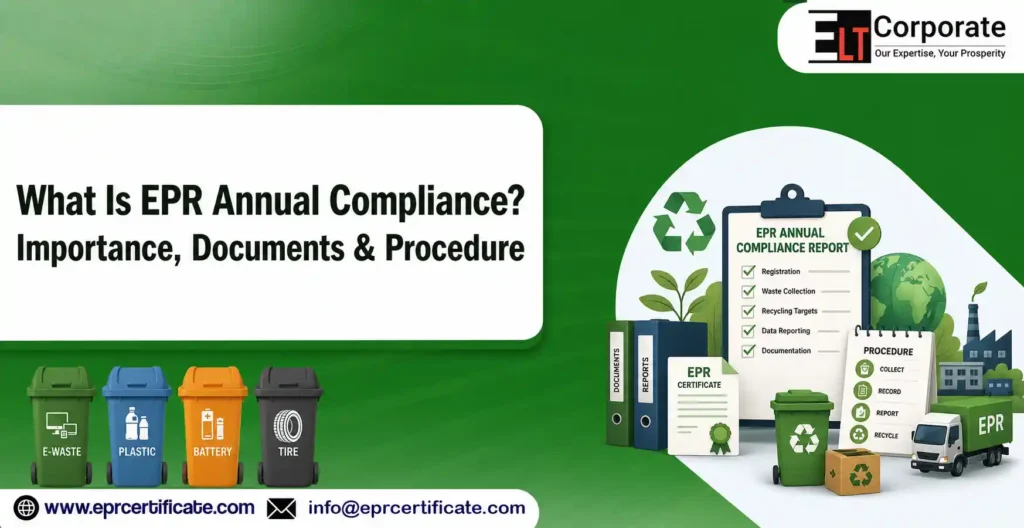
EPR annual compliance is an essential legal obligation for corporations manufacturing, importing, promoting, distributing, or using goods covered under the Extended Producer Liability Rules in India.
EPR stands for Extended Producer Responsibility. It is possible that the producer, importer, brand owner, or producer is responsible for coping with the waste generated from their merchandise after use.
This compliance is particularly applicable to businesses involving the following:
- plastic packaging
- E-waste
- Wasting batteries
- Waste the tire
- The oil used
- Other Notified Waste Classes
Timely filing of EPR annual compliance enables organizations to comply with CPCB requirements and stay away from consequences, information, or regulations in business operations.
What Is EPR Annual Compliance?
EPR Annual Compliance is the yearly reporting process where registered entities submit details of their EPR obligations, waste collection, recycling, disposal, and EPR certificate fulfilment to the concerned authority through the online portal.
In simple words, it is a yearly proof that the company has fulfilled its responsibility for managing the waste generated from its products or packaging.
The annual compliance generally includes:
- Details of products placed in the market
- Quantity of waste generated or estimated
- EPR target assigned to the company
- Recycling or processing certificates
- Details of registered recyclers or processors
- Sales, import, or production data
- Compliance documents and declarations
Who Needs to File EPR Annual Compliance?
EPR annual compliance is required for businesses registered under EPR rules.
The following entities may need to file annual returns:
- Producers
- Importers
- Brand owners
- Manufacturers
- Recyclers
- Refurbishers
- Waste processors
- Bulk consumers, wherever applicable
For example, if a company imports products packed in plastic packaging, it may have to comply with EPR Plastic Waste rules.
Similarly, if a company imports electronic goods, batteries, tyres, or lubricants, EPR compliance may be applicable depending on the product category.
Importance of EPR Annual Compliance
EPR annual compliance is not just a formality. It is a legal requirement and plays a major role in environmental responsibility.
1. Legal Compliance
Filing EPR annual returns helps the company comply with applicable environmental rules and CPCB requirements.
Non-compliance may result in:
- Show cause notices
- Environmental compensation
- Portal restrictions
- Delay in renewal
- Cancellation or suspension of registration
- Difficulty in import or business operations
- Avoidance of Penalties
If a company fails to meet its EPR target or does not file annual compliance on time, it may attract penalties.
Proper filing helps reduce the risk of legal action and financial loss.
- Smooth Business Operations
Many businesses require EPR registration and compliance for import, manufacturing, sales, tender participation, and regulatory approvals.
Timely annual compliance helps in:
- Smooth renewal of EPR registration
- Avoiding portal blockage
- Maintaining clean compliance records
- Supporting future applications
- Avoiding business interruption
4. Environmental Responsibility
EPR ensures that waste is collected, recycled, or disposed of through authorized channels.
It supports:
- Waste reduction
- Recycling
- Circular economy
- Responsible production
- Sustainable business practices
- Better Brand Image
Companies that follow EPR compliance show that they are serious about environmental responsibility.
This improves trust among:
- Customers
- Government authorities
- Business partners
- Investors
- International clients
Common EPR Categories in India
EPR compliance may apply under different waste management rules.
Common EPR categories include:
Plastic Waste EPR
Applicable to producers, importers, and brand owners using plastic packaging.
Examples include:
- Plastic pouches
- Plastic bottles
- Wrappers
- Packaging films
- Multilayered packaging
- Rigid plastic packaging
E-Waste EPR
Applicable to producers and importers of electrical and electronic equipment.
Examples include:
- Computers
- Mobile phones
- Printers
- LED lights
- Consumer electronics
- Electrical equipment
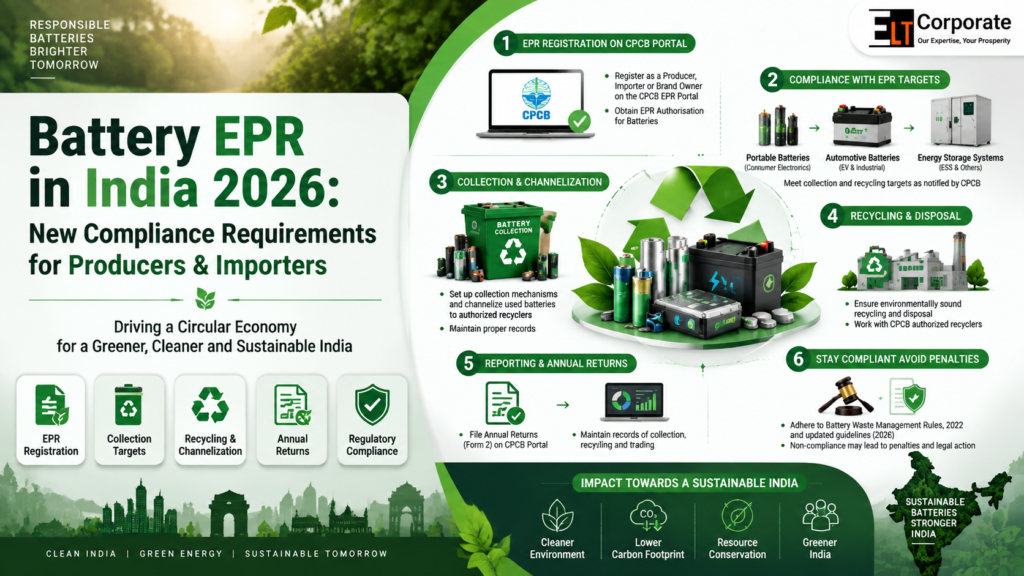
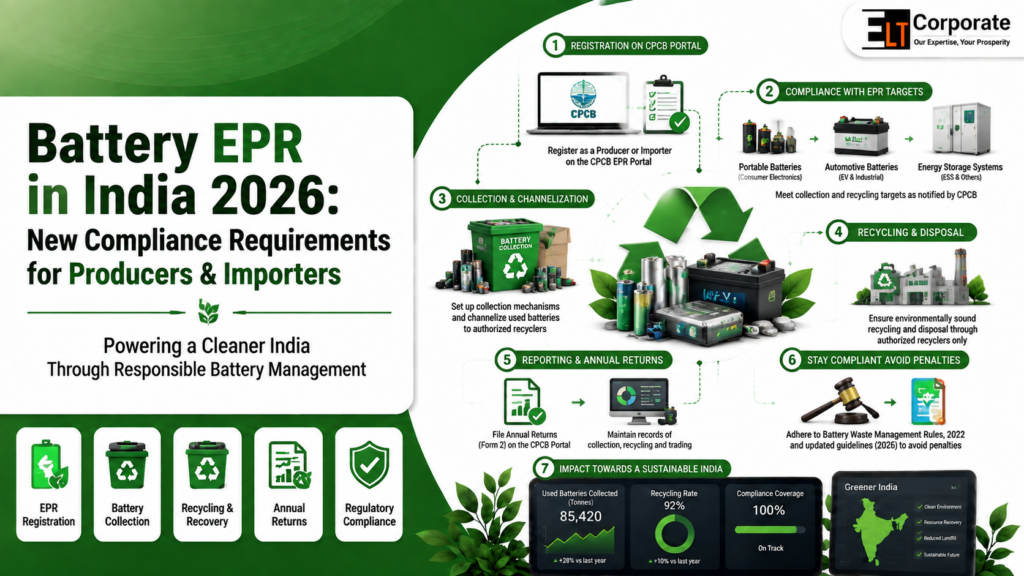
Battery Waste EPR
Applicable to producers and importers of batteries.
Examples include:
- Lithium-ion batteries
- Lead-acid batteries
- Portable batteries
- Industrial batteries
- Automotive batteries
- EV batteries
Waste Tyre EPR
Applicable to producers, importers, and recyclers dealing with tyres.
Examples include:
- New tyres
- Used tyres
- Imported tyres
- Tyre waste
- Crumb rubber processing
Used Oil EPR
Applicable to entities dealing with base oil, lubricating oil, or used oil as per applicable rules.
Documents Required for EPR Annual Compliance
The documents may vary depending on the EPR category. However, some common documents are required in most cases.
Basic Company Documents
- Company PAN card
- GST certificate
- CIN or LLP registration certificate
- IEC certificate, if import is involved
- Authorized signatory details
- Board resolution or authorization letter
- Aadhaar and PAN of authorized person
- Factory or office address proof
Business Data Documents
- Sales data
- Purchase data
- Import data
- Production data
- Product-wise details
- Category-wise quantity details
- Financial year-wise business data
EPR Registration Documents
- EPR registration certificate
- CPCB portal login details
- Previous annual return, if applicable
- Previous compliance records
- EPR target details
Waste Management Documents
- Recycler agreement
- Waste processor agreement
- EPR certificates
- Recycling certificates
- Waste collection details
- Transfer details on portal
- Disposal or processing proof
Product and Packaging Details
- Product list
- Brand details
- Packaging material details
- Category-wise packaging data
- Battery chemistry details, if applicable
- Electrical product details, if applicable
- Tyre or oil details, wherever applicable
Declaration and Undertaking
- Authorized signatory declaration
- Accuracy of data undertaking
- Compliance undertaking
- Self-declaration, if required
Procedure for EPR Annual Compliance
The EPR annual compliance process should be handled carefully because incorrect data can lead to portal errors or regulatory queries.
Below is a simple step-by-step procedure.
Step 1: Check Applicability
First, identify whether EPR compliance applies to your business.
Check:
- Nature of product
- Type of packaging
- Import or manufacturing activity
- Waste category
- Whether EPR registration is already obtained
- Applicable rules and portal requirements
Step 2: Collect Business Data
The next step is to collect complete business data for the relevant financial year.
This may include:
- Sales quantity
- Import quantity
- Manufacturing quantity
- Packaging quantity
- Product category
- Waste category
- Recycling target
Data should be properly matched with invoices, import records, and internal documents.
Step 3: Calculate EPR Obligation
After collecting data, the company needs to calculate its EPR obligation.
This means identifying how much waste the company is responsible for collecting, recycling, or processing.
The obligation may depend on:
- Product category
- Packaging category
- Quantity placed in the market
- Previous year data
- Recycling target assigned by portal
- Applicable rules
Step 4: Arrange EPR Certificates
The company must fulfil its EPR target through authorized recyclers, processors, or waste management partners.
EPR certificates or recycling certificates are important proof of compliance.
The certificates should match:
- Correct financial year
- Correct waste category
- Correct quantity
- Correct recycler details
- Correct portal transaction
Step 5: Prepare Annual Return
After arranging all data and certificates, the annual return must be prepared.
The return generally includes:
- Company details
- EPR registration number
- Product details
- Quantity placed in market
- EPR target
- Waste recycled or processed
- Certificates used
- Balance obligation, if any
- Declaration by authorized person
Step 6: File Return on CPCB Portal
The annual return is filed through the relevant CPCB EPR portal.
The portal may be different for:
- Plastic waste
- E-waste
- Battery waste
- Waste tyre
- Used oil
While filing, all information must be checked carefully before final submission.
Step 7: Respond to Queries, If Any
Sometimes, the authority or portal may raise a query.
Common reasons for queries include:
- Incorrect quantity
- Mismatch in sales data
- Wrong category selection
- Missing documents
- Invalid EPR certificate
- Difference between target and fulfilment
- Incorrect recycler details
The company should respond to queries with proper clarification and supporting documents.
Step 8: Maintain Records
After filing the annual compliance, the company should maintain all records safely.
Important records include:
- Filed annual return copy
- EPR certificates
- Recycler agreements
- Sales and import data
- Portal screenshots
- Challans, invoices, and declarations
- Compliance communication
These records may be required during audits, renewal, inspection, or future compliance checks.
Common Mistakes in EPR Annual Compliance
Many companies face issues because of incorrect or incomplete filing.
Common mistakes include:
- Filing after the due date
- Using wrong product category
- Uploading incomplete data
- Not matching portal data with invoices
- Not arranging sufficient EPR certificates
- Using unregistered recyclers
- Ignoring previous year obligations
- Not maintaining proper records
- Submitting incorrect declarations
To avoid these issues, businesses should review all data before filing.
Why Professional Assistance Is Important
EPR annual compliance involves technical, legal, and portal-based work.
A small mistake in data entry or certificate mapping can create problems during filing or renewal.
Professional assistance helps in:
- Checking applicability
- Preparing correct documentation
- Calculating EPR obligation
- Coordinating with recyclers
- Filing annual return
- Handling portal errors
- Responding to queries
- Maintaining compliance records
This helps businesses save time and avoid unnecessary compliance risks.
Conclusion
EPR Annual Compliance is an important responsibility for producers, importers, brand owners, manufacturers, recyclers, and other covered entities.
It proves that the business has fulfilled its responsibility for waste management under applicable EPR rules.
Timely and accurate filing helps businesses avoid penalties, maintain regulatory compliance, and continue operations smoothly.
Companies dealing with plastic packaging, e-waste, batteries, tyres, used oil, or other notified waste categories should carefully review their EPR obligations every year and complete annual compliance within the prescribed timeline.