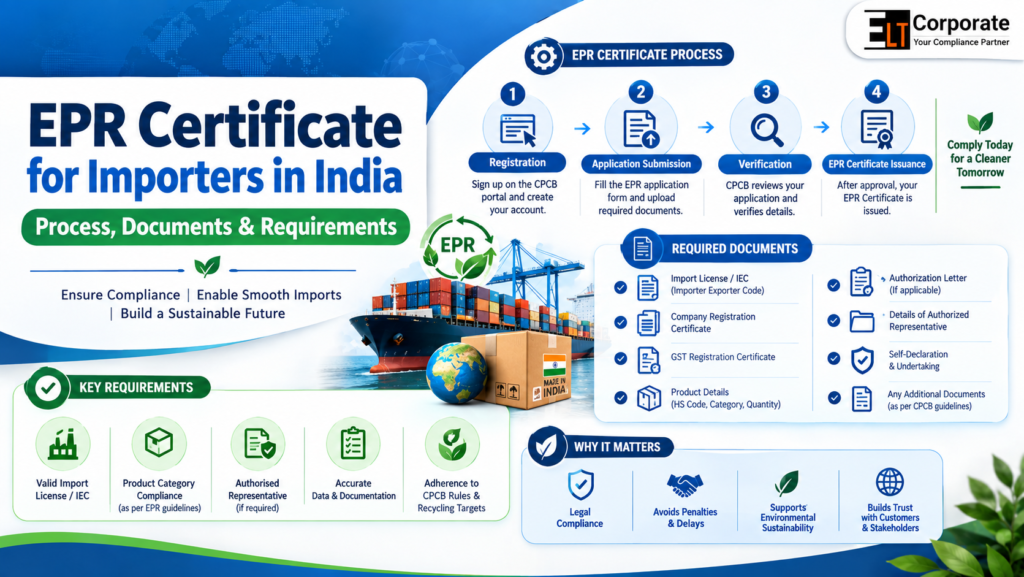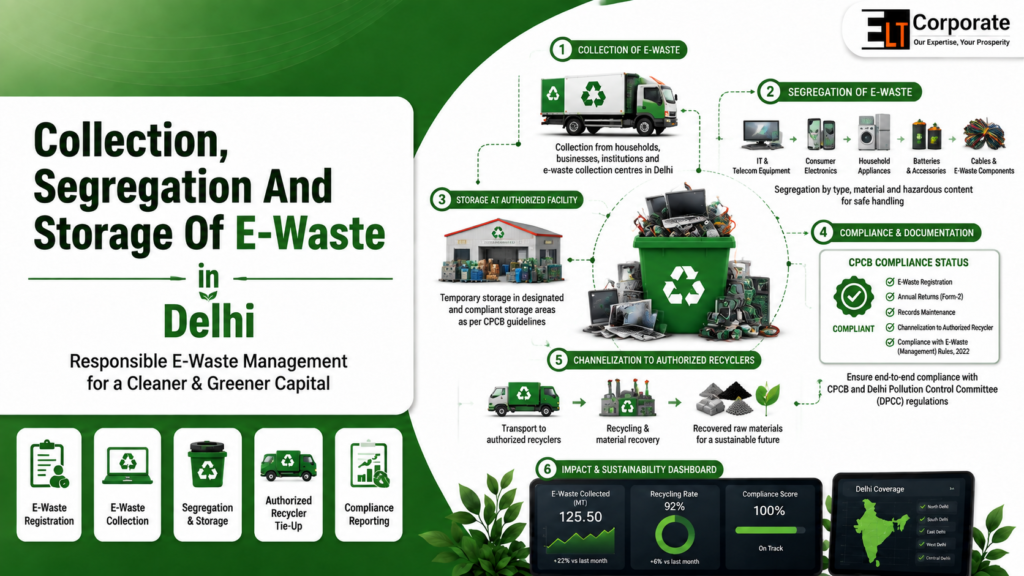
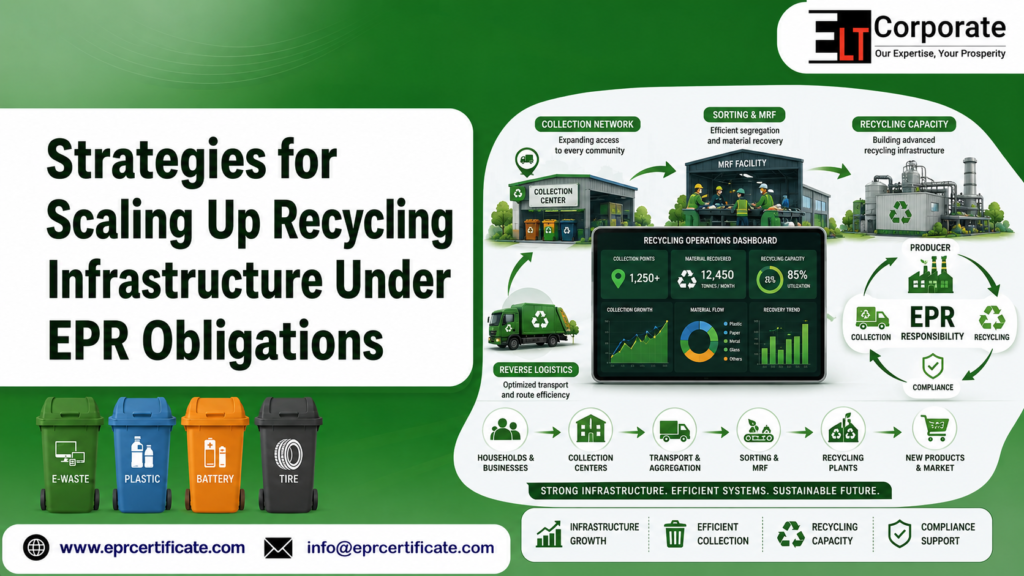
Extended Producer Responsibility, commonly known as EPR, has changed the way businesses handle waste in India.
Earlier, many producers, importers and brand owners focused only on selling products. Now, they must also take responsibility for the collection, recycling and proper disposal of waste generated from their products.
EPR obligations apply across multiple waste categories such as plastic packaging, e-waste, batteries, waste tyres and used oil. CPCB also operates separate EPR portals for these waste streams, including plastic waste, battery waste, e-waste, waste tyre and used oil management.
To meet these obligations effectively, India needs strong, scalable and transparent recycling infrastructure.
Why Recycling Infrastructure Matters Under EPR
EPR compliance is not only about obtaining registration or filing annual returns.
It requires a working system where waste is:
- Collected from the market
- Segregated properly
- Transported safely
- Processed by authorized recyclers
- Reported with proper documentation
- Verified through recycling certificates
Without strong recycling infrastructure, EPR compliance becomes only paperwork.
A good recycling system helps companies achieve legal compliance, reduce environmental impact and build a circular economy.
Key Challenges in Scaling Recycling Infrastructure
Many businesses face practical difficulties while implementing EPR.
Some common challenges include:
- Lack of authorized recyclers in certain regions
- Poor collection network
- High transportation cost
- Informal waste handling
- Low consumer awareness
- Poor segregation at source
- Limited tracking and documentation
- Fake or weak recycling claims
- Difficulty in generating genuine recycling certificates
These issues make it difficult for producers and brand owners to meet their EPR targets properly.
Strategy 1: Build a Strong Waste Collection Network
The first step is to create a reliable collection system.
Recycling cannot happen unless waste reaches the right recycler.
Companies should create collection points at:
- Retail stores
- Service centres
- Warehouses
- Dealer locations
- Residential societies
- Commercial hubs
- Industrial areas
- E-commerce return centres
For example, electronic brands can collect old devices through service centres. Battery brands can collect used batteries through dealers and distributors.
A wide collection network reduces leakage into the informal sector.
Strategy 2: Partner With Authorized Recyclers
Under EPR, businesses should work only with authorized recyclers, refurbishers, processors and waste management agencies.
This helps ensure that waste is handled in a legally compliant and environmentally safe manner.
Before selecting a recycler, companies should check:
- CPCB/SPCB authorization
- Processing capacity
- Type of waste handled
- Validity of registration
- Past compliance record
- Recycling certificate process
- Site audit readiness
- Documentation quality
For battery waste, the Battery Waste Management Rules, 2022 apply to all types of batteries, irrespective of chemistry, shape, volume, weight, material composition and use.
So, selecting the right recycler becomes very important.
Strategy 3: Develop Regional Recycling Hubs
One major problem in EPR implementation is the uneven availability of recycling units.
If waste has to travel long distances, the cost increases.
Regional recycling hubs can solve this issue.
These hubs can be developed near:
- Industrial zones
- Metro cities
- Manufacturing clusters
- Port areas
- E-commerce distribution centres
- High-consumption markets
Benefits of regional hubs include:
- Lower logistics cost
- Faster waste processing
- Better tracking
- Local employment generation
- Reduced carbon footprint
- Better state-wise compliance
Regional hubs also help companies manage waste closer to the point of generation.
Strategy 4: Integrate the Informal Waste Sector
A large portion of waste in India is still collected by informal workers.
Instead of ignoring them, companies should include them in the formal recycling chain.
This can be done through:
- Training programs
- ID-based registration
- Safety equipment
- Fixed collection pricing
- Digital payment systems
- Tie-ups with authorized recyclers
- Awareness on hazardous waste handling
Informal workers already have strong ground-level reach.
By formalizing them, businesses can improve collection efficiency and reduce illegal disposal.
Strategy 5: Use Digital Tracking Systems
EPR compliance requires proper records.
Manual tracking can lead to errors, missing data and weak documentation.
Businesses should use digital tools to track:
- Waste collection quantity
- Collection location
- Transport details
- Recycler details
- Processing status
- Recycling certificates
- EPR target achievement
- Annual return data
The CPCB EPR system already uses centralized online portals for different waste streams. For example, the e-waste portal operates under the E-Waste Management Rules, 2022.
A digital system improves transparency and reduces the risk of non-compliance.
Strategy 6: Improve Source Segregation
Recycling becomes difficult when waste is mixed.
For better recycling output, waste should be segregated at the source.
Businesses should promote segregation of:
- Plastic packaging
- Paper packaging
- Metal waste
- Glass waste
- Batteries
- Electrical and electronic waste
- Hazardous components
- Non-recyclable waste
Proper segregation improves material recovery.
It also reduces contamination and processing cost.
Strategy 7: Invest in Advanced Recycling Technology
Traditional recycling methods may not be enough for growing EPR targets.
Companies should support modern recycling technologies such as:
- Automated sorting systems
- Plastic washing lines
- Shredding and granulation units
- Battery material recovery systems
- E-waste dismantling lines
- Metal recovery systems
- Refurbishment units
- Waste-to-resource technologies
Technology improves efficiency, quality and recovery rate.
It also helps recyclers handle larger volumes safely.
Strategy 8: Create Producer Responsibility Organizations
Small and medium businesses may not have the capacity to build their own waste collection and recycling network.
In such cases, they can work through Producer Responsibility Organizations, also known as PROs.
PROs help in:
- Waste collection
- Recycler coordination
- EPR target fulfilment
- Documentation
- Recycling certificate management
- Awareness campaigns
- Compliance reporting
This model is useful for start-ups, importers and brand owners with limited infrastructure.
Strategy 9: Encourage Reverse Logistics
Reverse logistics means using the existing supply chain to bring waste back from customers to recyclers.
For example:
- Delivery vehicles can collect used packaging
- Service centres can collect old electronics
- Dealers can collect used batteries
- E-commerce return channels can collect packaging waste
Reverse logistics reduces additional transport cost.
It also makes waste collection more convenient for consumers.
Strategy 10: Conduct Consumer Awareness Campaigns
Recycling infrastructure cannot grow without consumer participation.
Consumers must know where and how to return waste.
Businesses should educate consumers through:
- Product labels
- QR codes
- Website instructions
- WhatsApp campaigns
- Retail posters
- Social media posts
- Dealer awareness programs
- Collection drive announcements
Simple messages work best.
For example:
- “Return used batteries only at authorized collection points.”
- “Do not throw e-waste in household dustbins.”
- “Send back empty packaging for responsible recycling.”
Awareness creates better collection.
Strategy 11: Ensure Proper Documentation
Documentation is the backbone of EPR compliance.
Companies must maintain proper records for every stage of waste movement.
Important documents may include:
- Recycler agreement
- Waste collection records
- Transport records
- Recycler authorization
- Recycling certificates
- EPR registration certificate
- Annual return data
- Audit reports
- Invoices and challans
- State-wise collection details
Weak documentation may create problems during CPCB or SPCB scrutiny.
Proper records protect the company from future compliance risks.
Strategy 12: Support Public-Private Partnerships
Government bodies, private companies and recyclers should work together to build large-scale recycling infrastructure.
Public-private partnerships can help in:
- Setting up recycling parks
- Developing collection centres
- Creating awareness campaigns
- Training informal workers
- Improving technology adoption
- Building regional waste management clusters
This approach reduces the burden on individual companies.
It also creates long-term infrastructure for sustainable waste management.
Strategy 13: Monitor Recycler Performance
Only signing an agreement with a recycler is not enough.
Companies should regularly monitor recycler performance.
This can be done through:
- Site visits
- Monthly recycling reports
- Certificate verification
- Capacity checks
- Compliance audits
- Waste processing photographs
- GPS-based transport tracking
- Review of authorization validity
Regular monitoring helps prevent false claims and non-compliance.
Strategy 14: Focus on Circular Economy
The final goal of EPR is not only waste disposal.
The bigger objective is to create a circular economy.
This means materials should be reused, recycled and brought back into production.
Companies can support circularity by:
- Using recycled materials
- Designing recyclable packaging
- Reducing unnecessary packaging
- Avoiding hard-to-recycle materials
- Promoting refill models
- Supporting product repair and refurbishment
- Creating take-back schemes
A circular approach reduces dependence on virgin materials.
It also improves brand reputation.
Benefits of Scaling Recycling Infrastructure
Strong recycling infrastructure offers multiple benefits.
For businesses:
- Easier EPR compliance
- Better recycling certificate management
- Reduced legal risk
- Improved brand image
- Better ESG performance
- Smooth annual return filing
For the environment:
- Less landfill burden
- Reduced pollution
- Better resource recovery
- Lower carbon footprint
- Safer handling of hazardous waste
For society:
- Green jobs
- Formalization of waste workers
- Cleaner cities
- Better public health
- Sustainable consumption habits
Conclusion
Scaling recycling infrastructure is essential for successful EPR implementation.
Businesses cannot treat EPR as a one-time registration activity.
They need proper collection systems, authorized recycling partners, digital tracking, consumer awareness and strong documentation.
A well-planned recycling infrastructure helps companies meet legal obligations and also contributes to a cleaner, safer and more sustainable future.
The companies that invest early in strong EPR systems will not only avoid compliance risks but also gain long-term business credibility.