Extended Producer Responsibility, commonly known as EPR, is no longer just a regulatory formality. It is a serious compliance responsibility for producers, importers, brand owners, manufacturers and other obligated entities.
Under EPR, businesses are required to take responsibility for the waste generated from the products or packaging they place in the market.
This responsibility includes:
- Collection of waste
- Recycling of waste
- Fulfilment of annual EPR targets
- Purchase or generation of EPR certificates
- Filing of annual returns
- Maintaining proper records
CPCB manages different EPR frameworks in India, including plastic waste, e-waste, batteries, used oil and waste tyres through dedicated rules, portals and compliance systems.
What Are Recycling Targets in EPR?
Recycling targets are the minimum quantity of waste that a company must recycle or get recycled during a particular financial year.
These targets are usually calculated based on:
- Quantity of product placed in the market
- Quantity of packaging introduced
- Previous year sales or import data
- Type of product or waste category
- Applicable EPR rules
For example, a brand using plastic packaging may have to fulfil plastic packaging EPR targets. A battery producer may have to meet collection and recycling targets under Battery Waste Management Rules. CPCB states that producers of batteries must meet collection and recycling targets as given in the rules to fulfil EPR obligations.
Why Recycling Targets Matter
EPR recycling targets help the government track whether waste is actually being collected and recycled.
They also create accountability for businesses.
Without recycling targets, many companies may sell products in the market but ignore the waste generated after use.
EPR targets help in:
- Reducing landfill waste
- Promoting recycling industry
- Creating circular economy
- Controlling pollution
- Making brands responsible
- Improving traceability of waste
Who Needs to Meet EPR Recycling Targets?
EPR targets may apply to different types of businesses depending on the waste category.
Common obligated entities include:
- Producers
- Importers
- Brand owners
- Manufacturers
- Refurbishers
- Recyclers
- Bulk consumers in some cases
- Entities placing covered products in the market
For plastic packaging, PIBOs — Producers, Importers and Brand Owners — are generally covered.
For e-waste, producers need registration and are assigned EPR obligations or recycling targets through the E-Waste EPR system.
Common EPR Categories Where Targets Apply
Recycling targets are commonly applicable under:
- Plastic Waste EPR
- E-Waste EPR
- Battery Waste EPR
- Waste Tyre EPR
- Used Oil EPR
- End-of-Life Vehicle rules, where applicable
Each category has its own rules, documents, portal process and compliance mechanism.
So, a company must first identify the correct EPR category before calculating its targets.
How Are EPR Recycling Targets Calculated?
EPR targets are usually calculated on the basis of data submitted by the company.
This may include:
- Sales quantity
- Import quantity
- Manufacturing quantity
- Packaging consumption
- Product category
- Waste category
- Previous year data
- Applicable rule-based formula
Wrong data can create wrong targets.
That is why companies should maintain accurate sales, purchase, import and packaging records from the beginning.
How to Meet EPR Recycling Targets
Meeting EPR targets requires proper planning. Companies should not wait until the annual return deadline.
1. Identify Your EPR Applicability
First, check whether your business falls under EPR rules.
Ask these questions:
- Do you sell products in plastic packaging?
- Do you import products with packaging?
- Do you manufacture or import batteries?
- Do you sell electrical or electronic equipment?
- Do you deal in tyres, used oil or other covered products?
If yes, EPR compliance may apply.
2. Register on the Correct EPR Portal
Registration is the first compliance step.
Depending on the category, registration may be required on the relevant CPCB EPR portal.
For battery waste, CPCB states that producers, recyclers and refurbishers must register through the online centralized portal.
3. Calculate Your Annual Obligation
After registration, calculate your annual EPR target carefully.
Use correct data such as:
- Sales invoices
- Import documents
- Purchase records
- GST data
- Packaging details
- Product-wise quantity
- Category-wise waste data
Avoid assumptions.
Even a small data error can create a major compliance issue later.
4. Work With Authorized Recyclers
Targets should be fulfilled only through authorized recyclers or registered waste processors.
Before engaging any recycler, verify:
- Registration status
- Validity of certificate
- Approved recycling capacity
- Waste category allowed
- Portal availability
- Past compliance history
Do not buy certificates from unverified sources.
5. Procure Valid EPR Certificates
EPR certificates are proof that the required quantity of waste has been recycled.
These certificates are generated or transferred through the applicable portal mechanism.
Keep records of:
- Certificate number
- Quantity covered
- Recycler details
- Financial year
- Category of waste
- Transaction proof
6. Maintain Proper Documentation
Documentation is the backbone of EPR compliance.
Important records include:
- EPR registration certificate
- Sales data
- Import data
- Packaging consumption details
- Recycler agreements
- EPR certificates
- Invoices
- Annual returns
- Portal acknowledgements
- Communication with CPCB/SPCB
Good documentation protects the company during scrutiny.
7. File Annual Return on Time
Annual return filing is a critical requirement.
It shows how much waste obligation was assigned and how much was fulfilled.
The plastic packaging EPR portal includes provisions related to annual returns, system-generated reports and environmental compensation tracking.
Late filing or wrong filing can create compliance risk.
Practical Tips to Meet EPR Targets Easily
Companies can make EPR compliance easier by following a planned approach.
Useful tips:
- Track sales and packaging data monthly
- Do not wait for year-end
- Keep category-wise records
- Use only registered recyclers
- Verify certificate availability in advance
- Match target quantity with certificate quantity
- Keep extra buffer where possible
- File returns before deadline
- Avoid duplicate or fake certificates
- Review portal data regularly
Common Mistakes Companies Make
Many companies fail EPR compliance due to poor planning.
Common mistakes include:
- Taking EPR registration but not fulfilling targets
- Filing wrong sales or import data
- Selecting the wrong waste category
- Buying certificates at the last moment
- Not checking recycler validity
- Missing annual return deadlines
- Not maintaining invoice-wise records
- Ignoring CPCB notices
- Assuming consultant work is complete without portal verification
- Treating EPR as a one-time registration
EPR is not just registration.
It is an annual compliance responsibility.
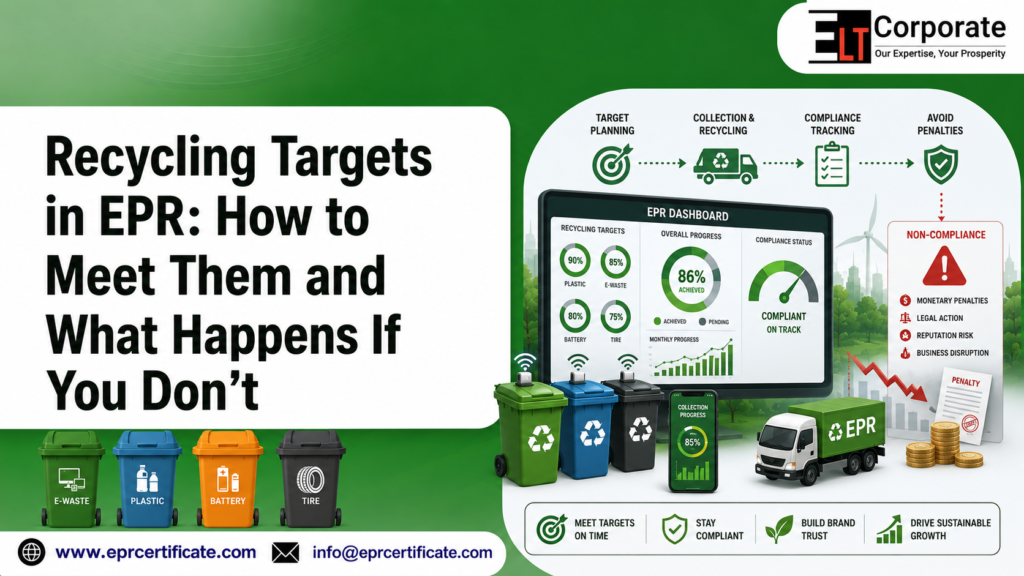
What Happens If You Don’t Meet EPR Recycling Targets?
Failure to meet EPR targets can lead to serious consequences.
The impact may include:
- Environmental compensation
- CPCB or SPCB notices
- Portal restrictions
- Delay in future renewals
- Rejection of annual return
- Compliance scrutiny
- Legal action under applicable rules
- Business reputation damage
- Difficulty in working with marketplaces or large buyers
In some cases, authorities may ask the company to explain why targets were not fulfilled.
If the explanation is not satisfactory, penalties or compensation may be imposed.
Environmental Compensation
Environmental compensation is a financial liability imposed for non-compliance.
It may be applied when a company:
- Fails to meet EPR targets
- Fails to file annual return
- Provides incorrect data
- Does not comply with portal requirements
- Violates applicable EPR rules
Payment of environmental compensation does not always remove the original obligation.
In many cases, the company may still have to fulfil pending EPR targets.
Can Missed EPR Targets Be Fulfilled Later?
In some cases, missed targets may be carried forward or adjusted as per applicable rules and portal mechanism.
However, this depends on:
- Waste category
- Applicable EPR rules
- CPCB directions
- Portal status
- Reason for delay
- Compliance history of the company
Businesses should not assume that late fulfilment will always be accepted.
It is better to meet targets within the prescribed timeline.
Best Compliance Strategy for Businesses
The best strategy is to treat EPR as a yearly compliance calendar.
A company should create an internal EPR plan covering:
- Applicability check
- Registration status
- Data collection
- Target calculation
- Recycler finalization
- Certificate procurement
- Annual return filing
- Record maintenance
- Compliance review
This helps avoid last-minute pressure and penalties.
Final Checklist for EPR Target Fulfilment
Before closing the financial year, check:
- EPR registration is valid
- Sales/import data is updated
- EPR target is calculated correctly
- Authorized recycler is selected
- EPR certificates are available
- Certificate quantity matches obligation
- Annual return is prepared
- Portal data is verified
- Supporting documents are saved
- Compliance proof is ready for audit
Conclusion
Recycling targets under EPR are not optional.
They are a mandatory responsibility for businesses covered under EPR rules.
Companies that plan early can meet their targets smoothly. Companies that ignore EPR may face notices, environmental compensation, portal issues and legal risk.
The safest approach is simple:
- Identify your EPR obligation
- Register on time
- Track your data
- Work with authorized recyclers
- Fulfil targets
- File annual returns
- Keep proper records
EPR compliance is not just about avoiding penalties.
It is about building a responsible, sustainable and legally compliant business.