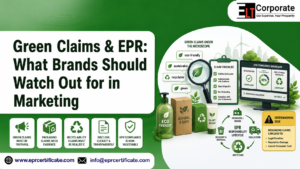
Consumers today prefer brands that care about the environment. That is why many companies use words like eco-friendly, sustainable, recyclable, green, plastic-neutral, carbon-neutral, and environment-safe in their marketing.
But these claims can create legal and reputational risk if they are not backed by proper proof.
In India, the Central Consumer Protection Authority issued guidelines in 2024 to prevent greenwashing and misleading environmental claims. These guidelines require brands to make truthful, clear, and evidence-backed environmental claims.
At the same time, brands covered under Extended Producer Responsibility (EPR) must comply with waste management responsibilities, especially for plastic packaging, e-waste, batteries, tyres, and used oil. CPCB also provides EPR-related registration and compliance mechanisms for Producers, Importers, Brand Owners and Plastic Waste Processors.
What Are Green Claims?
Green claims are statements made by a brand to show that its product, packaging, process, or business activity is better for the environment.
Common examples include:
- Eco-friendly product
- 100% recyclable packaging
- Plastic-neutral brand
- Sustainable packaging
- Biodegradable material
- Carbon-neutral operations
- Made from recycled plastic
- Zero-waste product
These claims sound attractive, but every claim must be supported by proper data, documents, certification, or scientific evidence.
What Is Greenwashing?
Greenwashing means making a product or brand look environmentally responsible when the claim is false, exaggerated, vague, or incomplete.
For example:
- Saying “eco-friendly” without proof
- Using green colour and leaves on packaging to create a false impression
- Claiming “plastic-neutral” without valid EPR fulfilment
- Saying “biodegradable” without proper testing or certification
- Highlighting one small green feature while hiding the overall environmental impact
Greenwashing misleads consumers and can damage brand trust.
Why EPR Matters in Green Marketing
EPR means Extended Producer Responsibility.
Under EPR, producers, importers, and brand owners are responsible for managing the waste generated from their products or packaging.
For example, if a brand sells products in plastic packaging, it may need to:
- Obtain EPR registration
- Declare packaging quantity
- Fulfil recycling or processing targets
- Purchase valid EPR certificates
- File annual returns
- Maintain proper records
- Follow CPCB portal requirements
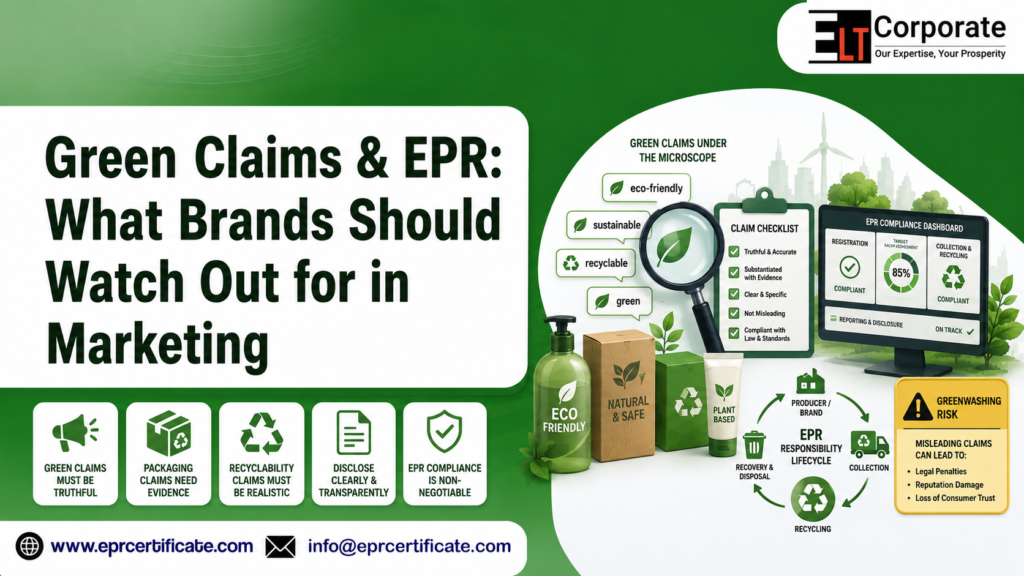
EPR compliance is not just a back-end legal task. It directly affects how a brand can talk about sustainability in advertisements, websites, labels, brochures, and social media.
Major Marketing Risks for Brands
1. Using vague words without proof
Words like green, eco-friendly, clean, natural, sustainable, planet-safe should not be used casually.
Brands should avoid claims that are:
- Too broad
- Not measurable
- Not supported by data
- Not linked to a specific product feature
Better approach:
- Instead of “eco-friendly packaging,” say “packaging contains 40% recycled material,” only if you have proof.
2. Claiming “100% recyclable” without checking actual recyclability
Many brands write “100% recyclable” on packaging.
But this can be risky if:
- The material is technically recyclable but not practically recycled
- Packaging has mixed layers
- Local recycling infrastructure is not available
- The claim applies only to one part of the packaging
Brands should clearly mention:
- Which part is recyclable
- Whether it is recyclable in normal recycling systems
- Whether any condition applies
3. Saying “plastic-neutral” without valid EPR records
“Plastic-neutral” is a strong marketing claim.
Brands should not use it unless they have strong proof, such as:
- EPR registration
- EPR target details
- EPR certificate purchase records
- Recycler or processor documentation
- CPCB portal records
- Internal calculation of plastic footprint
Without these records, the claim may be treated as misleading.
4. Using EPR compliance as a marketing certificate
EPR compliance does not automatically mean the product is eco-friendly.
EPR shows that the brand is fulfilling waste management responsibility. It does not mean:
- The product has no environmental impact
- The packaging is fully sustainable
- The product is carbon-neutral
- The brand is completely green
Brands should not overstate the meaning of EPR registration.
5. Making claims without accessible disclosure
The CCPA guidelines highlight the need for adequate disclosure and credible evidence for environmental claims. Claims should specify whether they apply to the product, packaging, manufacturing process, service, or overall business.
Brands should disclose:
- What exactly is green
- Which product or packaging part is covered
- What evidence supports the claim
- Whether the claim has any limitation
- Whether the certification is third-party verified
6. Using certifications incorrectly
Many brands use logos, seals, or symbols to show environmental responsibility.
This can be risky if:
- The certificate has expired
- The certificate applies to another product
- The certification body is not credible
- The claim goes beyond the certificate scope
- The logo is used without permission
Always verify the certificate scope before using it in marketing.
Documents Brands Should Keep Ready
Before making green claims, brands should maintain a proper evidence file.
Important documents include:
- EPR registration certificate
- EPR fulfilment records
- EPR certificates purchased from registered recyclers/processors
- Annual return filing proof
- Packaging material composition details
- Test reports for biodegradable or compostable claims
- Recycled content proof
- Supplier declarations
- Third-party certifications
- Internal claim approval sheet
- Legal review of marketing content
Green Claim Checklist Before Publishing Ads
Before publishing any green claim, ask these questions:
- Is the claim true?
- Is it specific?
- Is it supported by documents?
- Does it apply to the full product or only one part?
- Is the evidence recent?
- Can the consumer understand the claim easily?
- Is there any hidden condition?
- Is the claim exaggerated?
- Has the legal/compliance team reviewed it?
- Are EPR records matching the claim?
If the answer is unclear, the claim should be revised.
Safer Claim Examples
Risky claim:
- “Our brand is 100% eco-friendly.”
Better claim:
- “Our product packaging uses recyclable material. Please dispose of it through authorised recycling channels.”
Risky claim:
- “We are plastic-free.”
Better claim:
- “This product uses paper-based outer packaging. Some inner components may contain plastic.”
Risky claim:
- “We are plastic-neutral.”
Better claim:
- “We have fulfilled our plastic packaging EPR obligation for the applicable financial year through authorised channels.”
Risky claim:
- “This product is biodegradable.”
Better claim:
- “This packaging has been tested for biodegradability as per applicable standard. Conditions apply.”
Role of Marketing Team
Marketing teams should not create green claims independently.
They should coordinate with:
- Compliance team
- EPR consultant
- Legal team
- Packaging supplier
- Certification body
- Testing laboratory
- Sustainability team
This helps avoid misleading claims and improves brand credibility.
Role of Compliance Team
The compliance team should review every environmental claim before it goes live.
They should check:
- EPR applicability
- Registration status
- Fulfilment target
- Annual return status
- Product-wise packaging data
- Supporting documents
- Claim wording
- Disclosure language
A small review before publishing can prevent complaints, penalties, and brand damage.
Key Takeaway for Brands
Green marketing is powerful, but it must be honest.
Brands should remember:
- Do not use vague green words without proof.
- Do not treat EPR registration as a sustainability certificate.
- Do not exaggerate recycling or biodegradability claims.
- Keep all evidence ready before making claims.
- Make disclosures clear and easy to understand.
- Review every claim from legal and EPR compliance angle.
Conclusion
Green claims can build consumer trust only when they are truthful, specific, and evidence-based.
With increasing attention on greenwashing and EPR compliance, brands must be careful while using environmental claims in marketing.
A responsible brand should not only comply with EPR requirements but also communicate its environmental efforts honestly.
Clear claims, proper records, and transparent disclosures are the best way to protect both consumers and the brand.