
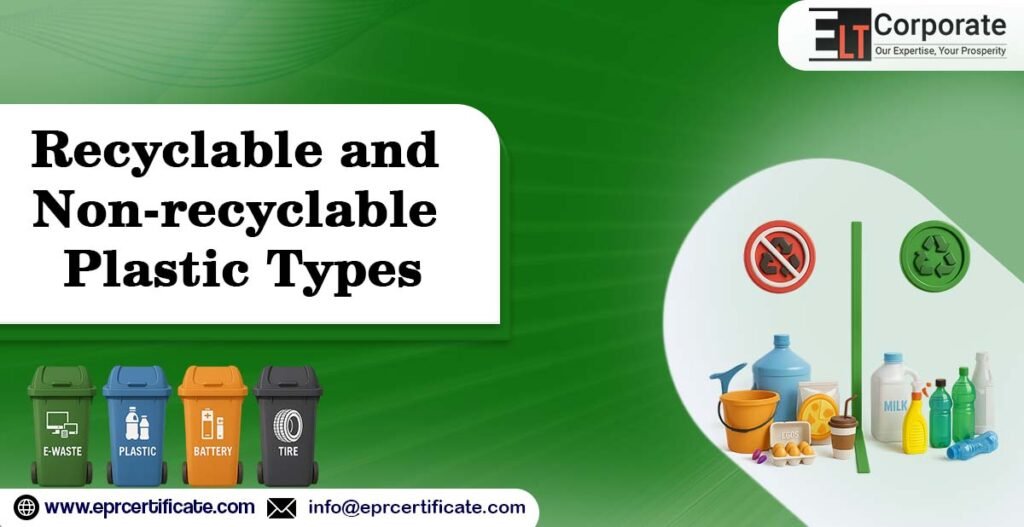
Types of Plastics Recyclable and Non-recyclable Plastic is a necessary part of our modern life, but its impact on our environment.. To manage plastic waste responsibly, it is important to understand a variety of plastics, their recycling and how they fit into India’s EPR and waste management structure.
This article serves as your simplified guide for plastic types, recurrence for non-transportation vs. Non-Practable Plastic, Documents, Compliance Process and Penalty.
What are Plastics and Why Classification Matters?
Plastics are synthetic polymers made from petrochemicals. They are classified into different categories based on their resin codes, chemical properties, and recyclability.
Understanding plastic types helps:
- Promote eco-friendly packaging.
- Support CPCB EPR registration compliance.
- Reduce environmental hazards.
- Align with global sustainability norms.
Types of Plastics Based on Recyclability
Recyclable Plastics
These plastics can be collected, reprocessed, and reused in new products.
PET
Usually used: water bottles, food packaging.
Properties: Light, transparent, recycled.
HDPE (High Density Polyethylene)
Usually used: milk containers, detergent bottles, piping.
Properties: Strong, resistant to moisture and chemicals.
LDPE (Low Density Polyethylene)
Usually used: carry bags, cling films, packaging foils.
Properties: Flexible, recycled (often downcycled).
PP (Polypropylene)
Usually used: food containers, bottle caps, straws.
Properties: Heat-resistant, recycled in motor vehicle and domestic products.
Non-Recyclable Plastics
These plastics are difficult or impossible to recycle and often end up in landfills or incineration.
- PVC (Polyvinyl Chloride)
- Commonly used in: Pipes, window frames, and flooring.
- Problem: Contains toxic additives, not easily recyclable.
- PS (Polystyrene / Thermocol)
- Commonly used in: Disposable cups, plates, and packaging peanuts.
- Problem: Lightweight but non-biodegradable; recycling is costly.
- Multi-Layered Plastics (MLP)
- Commonly used in: Chips packets, sachets, laminated pouches.
- Problem: Mix of plastic + aluminium layers; non-recyclable in most facilities.
Plastic Waste Registration Process under CPCB
Step 1 – Identify Plastic Category
Classify plastic packaging into recyclable or non-recyclable.
Step 2 – Prepare Documents
Company Incorporation, GST, PAN, CIN, Packaging Details, EPR Plan.
Step 3 – Apply on CPCB Portal
Submit application for Plastic Waste EPR Authorisation online.
Step 4 – Submission of EPR Plan
Include recycling tie-ups, collection centres, and disposal mechanisms.
Step 5 – CPCB Assessment
Authorities verify compliance and recycling feasibility.
Step 6 – Grant of Authorisation
EPR Authorisation issued; validity is usually 5 years.
Documents Required for Plastic Waste EPR Registration
- Incorporation Certificate (MOA/AOA/Partnership Deed)
- PAN & GST Certificate
- CIN Number
- Import Export Code (IEC) for importers
- Packaging Material Details (Recyclable/Non-Recyclable)
- EPR Management Plan with recycler tie-ups
- Agreements with PROs/recyclers
- Undertaking/Declaration on company letterhead
Who Needs EPR for Plastic Waste?
According to CPCB, the following must obtain authorisation:
- Producers – Manufacturing plastic packaging.
- Importers – Bringing plastic products into India.
- Brand Owners – Using plastic packaging under their brand.
- Manufacturers of Plastic Packaging Material.
Top 5 Benefits of Plastic Waste EPR Compliance
- Environmental Protection – Landfill reduces waste and pollution.
- Regulatory compliance – CPCB punishment and commercial restrictions are avoided.
- Brand price – enhances corporate image with durable practices.
- Resource efficiency – Encourages recycling, reduces the use of raw materials.
- Global Market Alignment – Complete international stability and ESG norms.
Penalties for Non-Compliance
Failure to register or comply with plastic waste management rules can result in:
- Monetary fines under the Environment Protection Act, 1986.
- Seizure of non-compliant products.
- Suspension of business operations.
- Legal action and prosecution in serious violations.
Why Choose ELT Corporate?
At ELT Corporate, we simplify plastic waste EPR registration with:
- End-to-end compliance support with CPCB.
- Guidance on recyclable vs. non-recyclable packaging.
- Documentation and filing support.
- Liaison with PROs & authorised recyclers.
- Affordable consulting with guaranteed timelines.
Conclusion
Plastic can be either a valuable recycled resource or a serious environmental burden of how they are managed. By understanding recycled and non-purinavination plastic types, businesses can align with India’s plastic waste management rules and contribute to a greenery, permanent future.
With the correct compliance partner like ELT Corporate, you can get smooth EPR registration, avoid punishment, and improve your environmental footprint.
FAQs
Q1. What are recyclable plastics in India?
PET, HDPE, LDPE, and PP are widely recyclable plastics.
Q2. Are multi-layered plastics banned in India?
Yes, certain categories of MLPs are restricted under Plastic Waste Management Rules.
Q3. How long is plastic EPR authorisation valid?
It is generally valid for 5 years, subject to renewal.
Q4. Do importers also need plastic EPR registration?
Yes, importers bringing plastic packaging into India must obtain authorisation.
Q5. Can one EPR certificate cover multiple packaging materials?
Yes, a single authorisation can cover multiple types of packaging if declared in the EPR plan.
![What Is EPR Annual Compliance? [Importance, Documents & Procedure]](https://eprcertificate.com/wp-content/uploads/2026/04/web-eprt-blog-1-1-300x155.jpg)
![What Is EPR Annual Compliance? [Importance, Documents & Procedure]](https://eprcertificate.com/wp-content/uploads/2026/03/web-eprt-blog-300x155.webp)

![What Is EPR Annual Compliance? [Importance, Documents & Procedure]](https://eprcertificate.com/wp-content/uploads/2026/04/web-eprt-blog-1-1-1024x527.jpg)
![What Is EPR Annual Compliance? [Importance, Documents & Procedure]](https://eprcertificate.com/wp-content/uploads/2026/03/web-eprt-blog-1024x527.webp)