
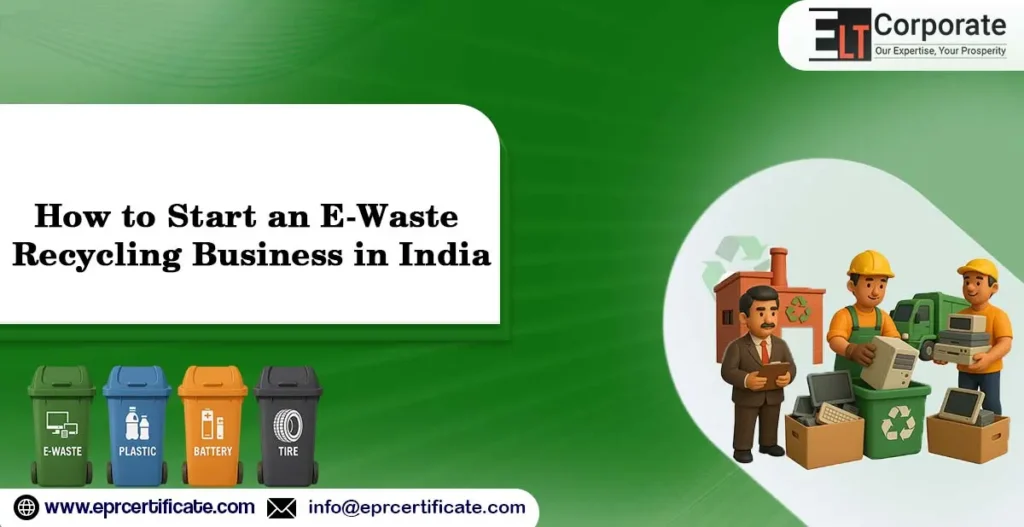
India is one of the world’s fastest growing producers of e-waste. From discarded computers, smartphones and home appliances to industrial electronics – the waste generated poses a massive environmental and health challenge.
With the emphasis on EPR registration by the government and increasing demand for sustainable recycling, starting an e-waste recycling business in India has become a profitable and environmentally responsible venture.
Understanding the E-Waste Challenge
Every year, India generates over 3 million tonnes of e-waste, making it the third-largest generator globally.
Improper disposal leads to:
- Toxic seepage – Heavy metals like mercury, cadmium and lead pollute soil and groundwater.
- Air Pollution – Burning electronic parts releases toxic gases.
- Health risks – Informal recycling exposes workers to hazardous materials.
Proper e-waste management and recycling can convert this waste into valuable materials, reduce imports of raw metals, and protect human health.
Why Start an E-Waste Recycling Business
- High market potential – E-waste in India is increasing by 15-20% annually.
- Government incentives – CPCB and state boards support EPR-compliant recyclers.
- Sustainability Focus – Companies are now required to have recycling under the E-Waste (Management) Rules, 2022.
- Revenue Opportunities – Recover precious metals, plastics and reusable components.
- Low competition, high demand – Authorized recyclers are still limited in India.
Step-by-Step Guide to Start an E-Waste Recycling Business in India
Step 1: Research and Feasibility Study
- Identify the types of e-waste you will be recycling (IT equipment, home electronics, industrial boards, etc.).
- Analyze collection sources – corporate, scrap dealers, municipalities.
- Study CPCB guidelines, EPR obligations and environmental standards.
- Prepare a detailed project report (DPR) including cost, location and technology.
Step 2: Choose the Right Business Model
You can choose from:
- Collection Center – gathers e-waste from consumers for authorized recyclers.
- Dismantling Unit – separates components for reuse or recycling.
- Recycling Facility – uses mechanical and chemical processes to extract valuable materials.
- Producer Responsibility Organization (PRO) – manages EPR compliance and collection on behalf of producers.
Step 3: Register Your Company
- Register your business as Private Limited Company, LLP or Proprietorship.
- Get GST, PAN and Import-Export Code (if applicable).
- Establish accounting and compliance systems.
Step 4: Obtain Mandatory Approvals
You must acquire the following licenses before operations:
| Approval | Issuing Authority | Purpose |
| E-Waste Recycling Authorization | CPCB / SPCB | For collecting, dismantling, or recycling e-waste |
| Consent to Establish & Operate | State Pollution Control Board | To operate under the Water and Air Acts |
| Factory License | Local Authority | To run the recycling facility |
| Fire Safety & Building Approvals | Local Body | For workplace safety |
| EPR Registration (if Producer/Importer) | CPCB | Compliance for producers or importers of electronics |
Step 5: Setup of Recycling Plant
- Select non-residential industrial area approved by SPCB.
- Install machinery for shredding, separation and metal extraction.
- Implement pollution control systems and worker safety measures.
- Maintain proper storage and labeling for hazardous fractions.
Step 6: Build Collection Channels
- Partner with corporate offices, retailers and collection agents.
- Encourage safe disposal by running awareness campaigns.
- Offer pickup or buy-back options for used electronics.
Step 7: Hire Skilled Workforce
- Recruit trained technicians to destroy and handle hazardous waste.
- Conduct safety training on protective gear, waste separation and handling chemicals.
Step 8: Comply with EPR and Recordkeeping
- Maintain data on quantities collected, processed and recycled.
- Submit periodic reports to CPCB or SPCB.
- Issuance of Recycling Certificate for EPR customers.
- Ensure traceability and transparency across the entire waste chain.
Investment and Profitability
The investment depends on scale and automation:
| Scale | Approx. Investment | Expected ROI |
| Small (Collection + Dismantling) | ₹20–30 lakhs | 20–25% |
| Medium (Recycling Plant) | ₹50 lakhs–₹1 crore | 25–35% |
| Large (Integrated Facility) | ₹2–5 crores | 35–40% |
Revenue streams include selling recovered metals, plastic granules, refurbished electronics, and EPR credit services.
Government Policies Supporting E-Waste Recycling
- E-Waste Management Rules, 2022 – mandates EPR for all producers and recyclers.
- Digital India & Make in India – promoting electronics manufacturing with green disposal.
- CPCB Authorization – provides recognition and guidance to compliant recyclers.
- State Board Incentives – certain states offer subsidies for pollution-control equipment.
Future Outlook
- 2026–2027 – Growth of PRO-led collection networks in metros.
- 2028–2030 – Rise of smart recycling plants with AI sorting and metal recovery tech.
- Beyond 2030 – India to emerge as a global e-waste recycling hub.
Why Partner with ELT Corporate?
At ELT Corporate, we guide entrepreneurs and corporations to set up and run compliant e-waste recycling ventures:
- CPCB/SPCB authorization assistance.
- EPR registration and reporting support.
- Legal documentation and environmental audit.
- Business model planning and license coordination.
- Ongoing advisory for sustainability and ESG integration.
With our expert support, you can launch your recycling business with confidence and long-term compliance.
FAQs
Q1. Is CPCB authorization mandatory for all e-waste recyclers?
Yes, CPCB or the respective State Board must approve every recycler or dismantler before operations.
Q2. Can I start a small-scale e-waste collection business?
Yes, you can start as a collection and dismantling center with lower investment and expand later into full recycling.
Conclusion
Starting an e-waste recycling business in India is not just a commercial opportunity — it’s a commitment toward a greener, circular economy.
With growing e-waste generation and evolving EPR policies, authorized recyclers play a critical role in sustainable resource recovery and environmental protection.
Partner with ELT Corporate for end-to-end compliance, registration, and strategic setup of your e-waste recycling business — and lead India’s green revolution responsibly.
![What Is EPR Annual Compliance? [Importance, Documents & Procedure]](https://eprcertificate.com/wp-content/uploads/2026/04/web-eprt-blog-1-1-300x155.jpg)
![What Is EPR Annual Compliance? [Importance, Documents & Procedure]](https://eprcertificate.com/wp-content/uploads/2026/03/web-eprt-blog-300x155.webp)

![What Is EPR Annual Compliance? [Importance, Documents & Procedure]](https://eprcertificate.com/wp-content/uploads/2026/04/web-eprt-blog-1-1-1024x527.jpg)
![What Is EPR Annual Compliance? [Importance, Documents & Procedure]](https://eprcertificate.com/wp-content/uploads/2026/03/web-eprt-blog-1024x527.webp)