
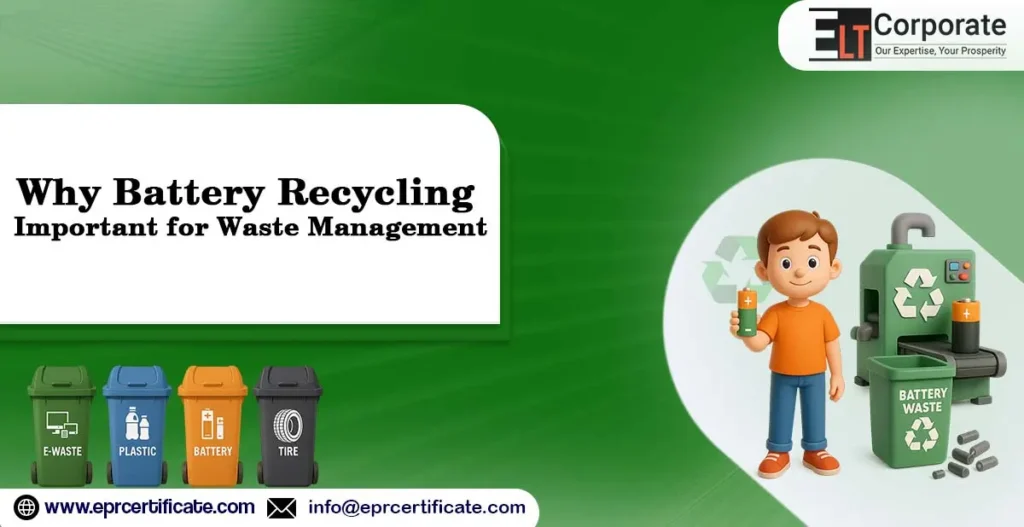
Battery recycling waste has become one of the fastest growing environmental concerns due to increasing use of smartphones, laptops, electric vehicles and domestic electronics. Improper disposal of batteries can be released into soil and water, creating a serious threat to human health and environment.
In India, battery recycling is not only an environmental requirement, but also a legal requirement under the battery waste management rules, 2022. This guide explains how the battery recycling works, why it matters, and what steps should be taken.
What Is Battery Recycling?
Battery waste is the process of collecting, decomposing and recovering valuable materials from the battery used to protect the recycling resources and the protection of resources. Different types of battery-level-acid, lithium-ion, nickel-cadmium and alkaline-specific recycling processes are required.
Battery recycling helps:
- Consumers – Safely dispose of hazardous waste.
- Manufacturers – Meet EPR (Extended Producer Responsibility) obligations.
- Recyclers – Recover valuable metals like lead, lithium, and cobalt.
Why Battery Recycling Matters
- Environmental protection – Prevents toxic leakage in soil and ground water.
- Resources Recovery – Protection of important minerals (lithium, cobalt, nickel) for re -use.
- Regulatory compliance – required under India’s battery waste management rules, 2022.
- Circular economy – supports permanent production cycles.
- Global trade fulfills environmental-transport norms for export in readiness-developed markets.
Step-by-Step: How Battery Recycling Works
Step 1 – Collection & Segregation
Used batteries are collected from consumers, retailers, and service centers, and segregated based on type (lead-acid, lithium-ion, NiMH, alkaline).
Step 2 – Secure Transport
The battery is transported to authorized recycles under CPCB/SPCB guidelines with proper labeling and dangerous waste handling measures.
Step 3 – dissolution and crushed
The battery is destroyed; Cover materials (plastic, steel, aluminum) are separated. Crushing electrode releases components.
Step 4 – Chemical Processing
Recyclers use smelting, hydrometallurgical, or pyrometallurgical methods to recover valuable metals (lead, cobalt, nickel, lithium).
Step 5 – Material Recovery & Reuse
Extracted metals are sent back to manufacturers for use in new batteries, reducing dependence on mining.
Compliance & Documentation Required in India
Businesses dealing with batteries must comply with the Battery Waste Management Rules, 2022:
- EPR Registration with CPCB (for manufacturers, importers, assemblers).
- Collection & Take-back Systems for used batteries.
- Labelling & Marking: Recyclable and hazard symbols must be displayed.
- Annual Returns filed with SPCB/CPCB on collection and recycling status.
- Authorization for Recyclers from State Pollution Control Boards.
Top 5 Benefits of Battery Recycling
- Regulatory compliance – penalty and business suspension is avoided.
- Consumer Trust – Shows commitment to stability.
- Resources reduce efficiency-lection and energy-intensive raw material extraction.
- Market Benefits – ESG and global supply series meets requirements.
- Waste reduction – Dangerous waste in landfill prevents accumulation.
Penalties for Non-Compliance
Failure to comply with the Battery Waste Management Rules can result in:
- Heavy fines under the Environment Protection Act, 1986.
- Suspension of EPR authorization.
- Seizure of non-compliant products.
- Legal action against persistent violators.
Why Choose ELT Corporate for Battery Recycling Compliance?
At ELT Corporate, we help businesses navigate compliance seamlessly:
- EPR Registration & Reporting – Filing applications and annual returns.
- Collection & Take-back Solutions – Designing systems for reverse logistics.
- Recycling Partner Support – Connecting with authorized recyclers.
- Documentation & Labeling – Ensuring packaging meets CPCB standards.
- Advisory & Legal Support – Handling notices, penalties, and disputes.
Conclusion
Battery recycling is more than only one waste management practice – this is an important step towards a safe environment, resource protection and regulatory compliance. By adopting proper recycling measures, businesses can strengthen their brand reputation, protect the planet and contribute to India’s circular economy.
With ELT Corporate as your compliance partner, you can ensure that your battery waste management procedures align with CPCB rules, reduce risks, and highlight their commitment to stability.
![What Is EPR Annual Compliance? [Importance, Documents & Procedure]](https://eprcertificate.com/wp-content/uploads/2026/04/web-eprt-blog-1-1-300x155.jpg)
![What Is EPR Annual Compliance? [Importance, Documents & Procedure]](https://eprcertificate.com/wp-content/uploads/2026/03/web-eprt-blog-300x155.webp)

![What Is EPR Annual Compliance? [Importance, Documents & Procedure]](https://eprcertificate.com/wp-content/uploads/2026/04/web-eprt-blog-1-1-1024x527.jpg)
![What Is EPR Annual Compliance? [Importance, Documents & Procedure]](https://eprcertificate.com/wp-content/uploads/2026/03/web-eprt-blog-1024x527.webp)