
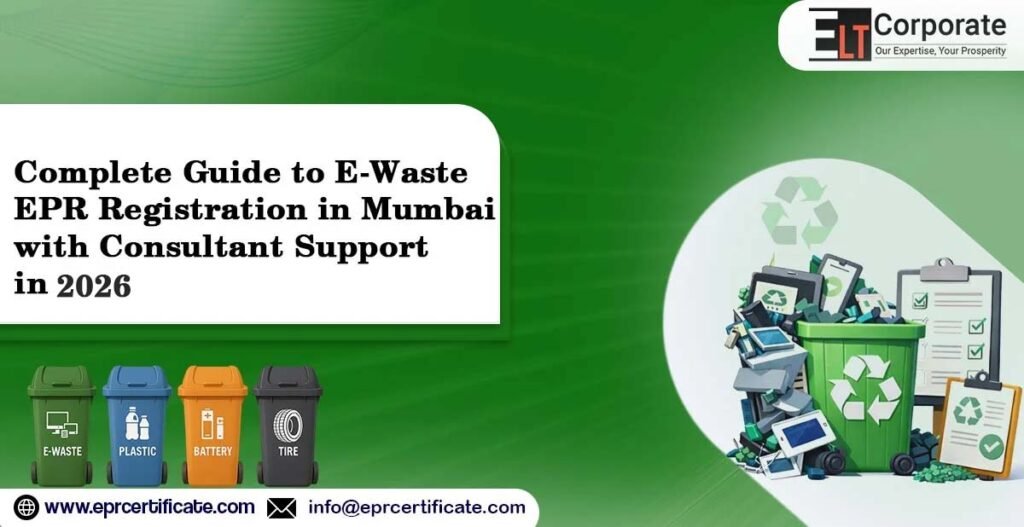
If you manufacture, import, sell or brand electrical and electronic equipment (EEE) in Mumbai, you probably fall under the E-Waste (Management) Rules of India and you need EPR (Extended Producer Responsibility) registration. In 2026, compliance is increasingly system-driven: registration, annual reporting and EPR target fulfillment largely happens through the CPCB online EPR portal, with strict scrutiny of documentation and channel partners. This guide explains what e-waste EPR registration means, who needs it, how the process works in Mumbai, and how an advisor can minimize delays and compliance risks.
What is E-Waste EPR Registration?
EPR is a policy mechanism that makes “producers” responsible for the collection, recycling, and environmentally sound management of e-waste generated from the products they introduce into the market.
In practical terms, EPR registration is the authorization that allows an eligible entity to:
- Legally place notified EEE products in the Indian market
- Declare sales/put-on-market quantities
- Meet EPR recycling targets via eligible recyclers and authorized channels
- File returns and maintain compliance records through the CPCB system
Read More: What is EPR Certification
Why Mumbai Businesses Should Pay Attention in 2026
Mumbai is one of India’s largest consumption and distribution hubs for electronics—home to:
- Corporate IT procurement and asset refresh cycles
- Large retail and e-commerce supply chains
- Importers and brand owners operating across Maharashtra and beyond
In 2026, businesses are increasingly expected to show:
- Clear product category mapping (as per notified schedules)
- Verified legal documents and GST linkages
- Traceable EPR fulfilment plans with compliant recyclers/refurbishers
- Accurate reporting to avoid penalties, blocks, or notices
For fast-moving sellers and import-heavy businesses, errors often happen at the classification, documentation, and portal submission stages—where consultant support can make a material difference.
Who Needs E-Waste EPR Registration?
You typically need EPR registration if you fall into any of these roles:
1) Producer (most common)
A “producer” can be:
- Manufacturer selling EEE under own brand
- Importer of EEE (even if manufactured abroad)
- Brand owner selling products made by a third party (OEM/ODM)
- Seller introducing products in India under its brand
2) Manufacturer (in some cases)
If you manufacture notified EEE and supply to brands/companies, you may need compliance documentation and portal mapping that aligns with producer obligations.
3) Bulk consumer / institutional user (compliance obligations differ)
Large offices, IT parks, banks, hospitals, and educational institutions generate significant e-waste and must ensure disposal through authorized channels (not always EPR registration, but documented compliance is essential).
If you sell electronics in Mumbai via retail or e-commerce, don’t assume the marketplace’s compliance covers you—brand ownership and import status often decide EPR applicability.
E-Waste Categories Covered Under EPR
EPR targets are linked to notified product categories such as:
- IT and telecommunications equipment (laptops, desktops, printers, routers, etc.)
- Consumer Electronics (TVs, Audio/Video Equipment)
- large and small household appliances
- Lighting equipment (where applicable)
- Electrical equipment and related equipment
- Monitoring/control equipment and similar categories
Correct category mapping is one of the most important steps – incorrect mapping can lead to reporting mismatches, target miscalculations and portal rejections.
Key Benefits of EPR Registration (Beyond Compliance)
EPR registration is not just a legal checkbox. In 2026, it supports:
- Vendor onboarding with large corporates and government tenders
- Reduced operational risk during audits and inspections
- Stronger ESG and sustainability reporting
- Brand reputation—especially for premium consumer brands and importers
- Eligibility to scale distribution without compliance roadblocks
Step-by-Step Process for E-Waste EPR Registration in Mumbai (2026)
Here’s what the trip typically looks like:
Step 1: Determine Applicability and Unit Type
An advisor will first confirm:
- Are you a manufacturer, importer, brand owner or manufacturer?
- Which GST unit is responsible?
- What is your sales channel footprint (Mumbai only vs All India)?
- Which product categories apply?
Step 2: Compile the required documents
While the exact documents may vary by entity type, you generally prepare:
- Company Incorporation/Registration Documents
- Authorized signatory proof and board/authorization letter
- GST Registration and PAN
- Product List with Category Mapping
- Import Details (if applicable)
- Brand Authorization/OEM Agreement (if manufacturing is outsourced)
- E-Waste Management Scheme/EPR Scheme
- Details of channel partners (recyclers/refurbishers) where applicable
A consultant helps standardize formats, check name/address consistency, and prevent upload rejections.
Step 3: Create/Verify Profile on CPCB EPR Portal
Registration and application submission is done online. Major functions include:
- Correct selection of entity role(s)
- Listing of product categories and market availability details
- Uploading documents in accepted formats and sizes
- Ensuring matching of signatory details and declarations
Step 4: Submit Application and Answer Questions
After submission, officials may give clarifications. Common query areas:
- product category mismatch
- incomplete contract/authorization
- Conflicting GST/Brand details
- E-waste scheme details unavailable
- Unclear import/manufacturing responsibility
Consultants generally handle drafting and resubmission of responses quickly.
Step 5: Compliance setup after registration
Registration is only the start. Ongoing compliance may include:
- Annual/periodic filing (as applicable)
- Maintaining invoices, sales data, and proof of fulfilment
- Target planning and fulfilment through authorized recyclers
- Internal SOPs for documentation and audit readiness
Common Mistakes Mumbai Businesses Make (and How Consultants Prevent Them)
Mistake 1: Assuming the “Seller” Is Not Responsible
If you own the brand or import the product, you are often the responsible manufacturer – even if you only “sell” on marketplaces.
Mistake 2: Wrong range mapping
An incorrectly mapped product listing can lead to portal flags, goal misalignment, or approval delays.
Mistake 3: Weak agreements with channel partners
Non-standard or incomplete agreements with recyclers/refurbishers may give rise to objections.
Mistake 4: Poor data hygiene
Mismatch between GST certificate, incorporation documents and portal entries is a frequent cause of rejection.
Mistake 5: Treating EPR as a one-time task
In 2026, compliance is constant – goals, reporting and recordkeeping matter just as much as certifications.
What Consultant Support Looks Like (End-to-End)
If you hire an EPR consultant in Mumbai, support often includes:
- Eligibility assessment and strategy (producer/importer/brand owner mapping)
- Product category mapping and schedule alignment
- Document checklist + drafting of authorizations, plans, and declarations
- Portal application filing with error-free data entry
- Query handling and response preparation
- Post-registration compliance calendar: filings, target planning, documentation SOPs
- Optional: Training for internal teams (procurement, sales ops, compliance)
This reduces delays and helps you stay compliant as you scale across Maharashtra and India.
How to Choose the Right EPR Consultant in Mumbai
Use these filters:
- Proven experience with CPCB EPR portal filings
- Ability to support both registration and ongoing compliance
- Clear scope: documents, portal submission, queries, post-registration support
- Transparent pricing (avoid “guaranteed approval” claims)
- Understanding of your business model: importer vs OEM vs marketplace brand
A good consultant will ask about your SKUs, import structure, brand ownership, and sales channels before quoting—because these directly impact your EPR pathway.
Estimated Timeline in 2026 (Practical View)
Actual timelines depend on data readiness and query cycles. In practice:
- If documents and SKU mapping are ready, filing can be completed quickly
- Approval time varies based on portal scrutiny and clarifications
The biggest controllable factor is submission quality, which is exactly where consultant support helps most.
Final Checklist Before You Start
- Confirm whether you are a producer/importer/brand owner
- Prepare SKU-wise product list with correct categories
- Align GST/PAN/company details across all documents
- Draft an E-waste management/EPR plan that matches your operations
- Identify compliant channel partners (where applicable)
- Plan post-registration reporting and recordkeeping SOPs
Conclusion
E-waste EPR registration in Mumbai in 2026 is a compliance requirement for most electronics producers, importers and brand owners. The process is documentation-heavy, portal-driven, and often query-prone – especially for businesses with multiple product lines or complex supply chains. With the right consultant support, you can speed up approvals, reduce visits to authorities, and build a sustainable compliance system that suits your business.
Who needs E-Waste EPR registration in Mumbai?
Any producer, importer, or brand owner of electronic products selling in Mumbai must obtain EPR registration as per E-Waste Management Rules.
Is EPR registration mandatory in 2026?
Yes, EPR registration is mandatory in 2026 and required for legal sale, import, and distribution of notified electronic items.
How long does E-Waste EPR registration take?
Timelines depend on document accuracy and portal queries, but consultant support helps reduce delays significantly.
![What Is EPR Annual Compliance? [Importance, Documents & Procedure]](https://eprcertificate.com/wp-content/uploads/2026/04/web-eprt-blog-1-1-300x155.jpg)
![What Is EPR Annual Compliance? [Importance, Documents & Procedure]](https://eprcertificate.com/wp-content/uploads/2026/03/web-eprt-blog-300x155.webp)

![What Is EPR Annual Compliance? [Importance, Documents & Procedure]](https://eprcertificate.com/wp-content/uploads/2026/04/web-eprt-blog-1-1-1024x527.jpg)
![What Is EPR Annual Compliance? [Importance, Documents & Procedure]](https://eprcertificate.com/wp-content/uploads/2026/03/web-eprt-blog-1024x527.webp)