Introduction
E-Waste Recycling Business in India is growing rapidly due to increasing electronic waste generation and the demand for sustainable waste management solutions. Businesses involved in recycling must follow CPCB guidelines and obtain necessary approvals to operate legally.
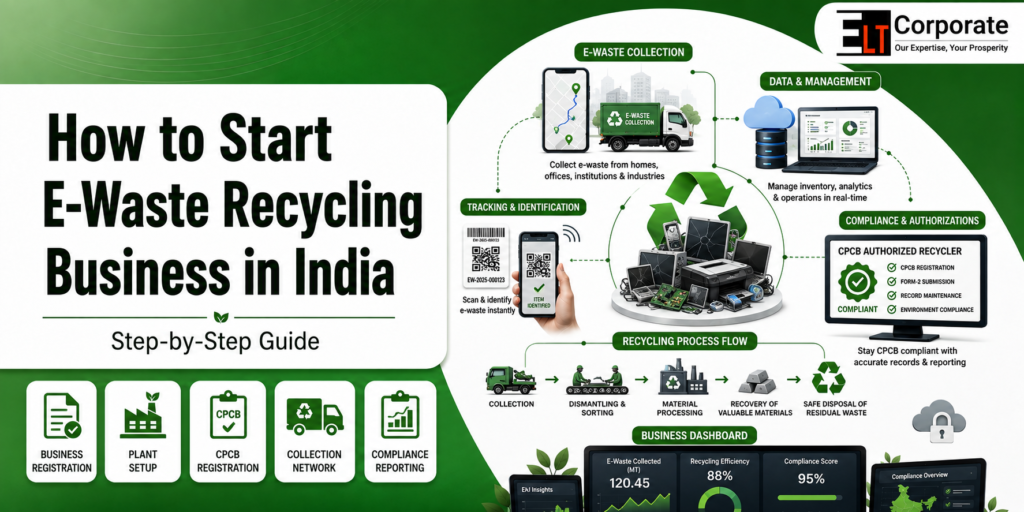
Starting an E-Waste recycling business requires proper planning, registration, recycling infrastructure, and compliance with environmental regulations.
Understand E-Waste Recycling Business | Meaning
E-Waste Recycling Business involves collecting, segregating, dismantling, and processing discarded electronic products to recover reusable materials.
The process helps reduce environmental pollution and recover valuable resources like metals, plastics, and electronic components.
Why Start E-Waste Recycling Business in India?
Growing E-Waste Generation
Increasing use of electronic products has created a continuous demand for proper recycling solutions.
Valuable Material Recovery
Recycling helps recover materials like copper, aluminium, gold, and plastics for reuse.
Increasing Demand for Authorised Recyclers
Companies require authorised recyclers to fulfil their EPR waste management obligations.
Sustainable Business Opportunity
E-Waste recycling supports environmental protection and the circular economy.
What Types of E-Waste Can Be Recycled?
- Computers & Laptops – Recycling of electronic components and metals.
- Mobile Phones – Recovery of valuable materials from devices.
- Televisions – Processing of electronic parts and plastics.
- Electrical Appliances – Recycling of household electronic equipment.
- Circuit Boards – Recovery of precious metals and components.
Regulations Governing E-Waste Recycling Business in India
E-Waste recycling activities are regulated under the E-Waste (Management) Rules, 2022.
Businesses must obtain CPCB registration and follow prescribed recycling and reporting requirements.
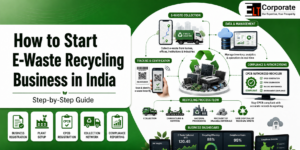
How to Start E-Waste Recycling Business in India Step by Step?
Step 1: Register Your Business Entity
Create a legally recognised business entity before starting recycling operations.
Documents Required:
- Certificate of Incorporation – Proof of company registration.
- PAN Card – Required for tax identification.
- GST Certificate – Required for business transactions.
Step 2: Select Recycling Facility Location
Choose a suitable location with proper infrastructure for safe recycling operations.
Documents Required:
- Ownership/Rent Agreement – Proof of facility possession.
- Electricity Bill – Address verification document.
- Site Layout Plan – Shows facility arrangement.
Step 3: Obtain Pollution Control Approvals
Environmental approvals are required before establishing and operating the recycling facility.
Required Approvals:
- Consent to Establish (CTE) – Permission to set up the plant.
- Consent to Operate (CTO) – Approval to start operations.
- Hazardous Waste Authorisation – Permission for handling hazardous waste.
Step 4: Apply for CPCB E-Waste Recycler Registration
Register your recycling facility with CPCB to legally process E-Waste.
Documents Required:
- Company Documents – Proof of business identity.
- Recycling Process Details – Explanation of recycling method.
- Machinery Details – Details of installed equipment.
- Capacity Details – Processing capacity information.
- Facility Photographs – Proof of operational setup.
Step 5: Install Required Recycling Machinery
Install suitable machinery according to the type and quantity of E-Waste processed.
Common Machinery:
- Dismantling Tools – Used for separating electronic components.
- Shredder Machine – Used for size reduction of waste.
- Magnetic Separator – Used for metal separation.
- Recovery System – Used for material recovery.
Step 6: Develop E-Waste Collection Network
Create a reliable system for collecting electronic waste from different sources.
Collection Sources:
- Manufacturers – Regular industrial waste supply.
- Corporate Offices – Bulk electronic waste collection.
- Government Institutions – Large-scale waste generation.
- Scrap Dealers – Additional collection channel.
Documents Required for E-Waste Recycler Registration
- Company Registration Proof – Confirms legal business identity.
- GST Registration Certificate – Business tax registration.
- PAN Card – Tax identification document.
- Pollution Control Approvals – Environmental compliance proof.
- Site Documents – Facility verification.
- Machinery Details – Recycling capability proof.
- Recycling Process Flow – Operational details.
Investment Required for E-Waste Recycling Business
Small Scale Recycling Unit
Suitable for collection and basic dismantling activities.
Medium Scale Recycling Plant
Requires machinery and processing infrastructure.
Large Scale Recycling Facility
Includes advanced technology and automated recycling systems.
Revenue Opportunities in E-Waste Recycling Business
Sale of Recovered Materials
Recovered metals and plastics can be sold to industries.
EPR Recycling Services
Registered recyclers can support companies in meeting EPR obligations.
Collection Services
Businesses can provide waste collection solutions to organisations.
Common Challenges in E-Waste Recycling Business
High Investment
Setting up recycling infrastructure requires significant initial investment.
Compliance Requirements
Maintaining CPCB and environmental compliance is essential.
Waste Collection Management
A strong collection network is required for continuous operations.
Benefits of Starting E-Waste Recycling Business
- Growing market demand – Increasing requirement for recycling services.
- Sustainable business model – Supports environmental protection.
- Multiple revenue sources – Income from recycling and recovery.
- Government focus – Increased opportunities under waste management regulations.
Why Choose ELT Corporate for E-Waste Compliance?
ELT Corporate provides complete regulatory support for E-Waste compliance.
- CPCB Registration Assistance
- Documentation Support
- Compliance Guidance
- End-to-End Regulatory Solutions
Conclusion
Starting an E-Waste Recycling Business in India requires proper registration, environmental approvals, and a structured recycling system.
With increasing electronic waste generation and demand for authorised recyclers, this sector offers a sustainable and profitable business opportunity.