Starting a new brand in India is exciting.
But if your product uses plastic packaging, batteries, electrical/electronic items, tyres, or used oil-related products, you may need EPR Compliance before scaling your business.
EPR stands for Extended Producer Responsibility.
It means the brand owner, importer, producer, or manufacturer is responsible for managing the waste generated from their product or packaging after consumer use.
In India, CPCB has separate EPR portals for plastic waste, battery waste, e-waste, waste tyre, and used oil management.
What is EPR Compliance?
EPR Compliance is a legal responsibility under which a business must ensure proper collection, recycling, processing, or disposal of waste generated from its products or packaging.
For start-ups, this usually applies when they sell products using:
- Plastic bottles
- Plastic pouches
- Wrappers
- Courier packaging
- Labels and films
- Battery-operated products
- Electrical and electronic goods
- Tyres
- Lubricant or oil-related products
For example, if a start-up sells cosmetics, food products, supplements, electronics, toys, gadgets, or packaged consumer goods, EPR may apply.
Why EPR Compliance is Important for Start-ups
Many new brands focus only on marketing, packaging, and sales.
But ignoring EPR can create legal and business problems later.
EPR Compliance helps in:
- Avoiding CPCB notices
- Selling legally on e-commerce platforms
- Building trust with distributors
- Improving brand image
- Avoiding penalties
- Supporting environmental responsibility
- Ensuring smooth business expansion
For many businesses, EPR registration is now becoming a basic compliance requirement before serious market entry.
Who Needs EPR Registration?
EPR may be required for:
- Brand owners
- Importers
- Manufacturers
- Producers
- E-commerce sellers
- Private label owners
- Start-ups using plastic packaging
- Companies selling electronic or battery-based products
For plastic packaging, CPCB refers to businesses such as Producers, Importers and Brand Owners, commonly called PIBOs. CPCB also provides registration information for brand owners under Plastic Waste Management.
Step-by-Step Roadmap for EPR Compliance
Step 1: Identify Whether EPR Applies to Your Business
The first step is to check your product category.
Ask yourself:
- Do we use plastic packaging?
- Do we import packed goods?
- Do we sell under our own brand name?
- Do we sell electronic products?
- Do we sell battery-operated items?
- Do we deal with tyres or oil-related products?
If the answer is yes, EPR may apply.
Common start-up examples:
- Cosmetic brands
- Food brands
- D2C brands
- Supplement brands
- Electronics brands
- Toy brands
- Mobile accessory brands
- Home appliance brands
- EV product brands
- Auto accessory brands
Step 2: Identify Your Role
After checking applicability, identify your legal role.
You may be a:
- Producer – You manufacture products or packaging.
- Importer – You import products or packed goods into India.
- Brand Owner – You sell products under your brand name.
- Manufacturer – You manufacture goods or components.
- Recycler / Processor – You process or recycle waste.
For most start-ups, the role is usually Brand Owner or Importer.
Correct role identification is very important.
Wrong category selection may lead to rejection, delay, or compliance mismatch.
Step 3: Select the Correct EPR Category
EPR is not one single registration.
Different products require different EPR registrations.
Major EPR categories include:
- Plastic Waste Management
- E-Waste Management
- Battery Waste Management
- Waste Tyre Management
- Used Oil Management
For batteries, the Battery Waste Management Rules, 2022 apply to all types of batteries, regardless of chemistry, shape, volume, weight, material composition, and use.
For e-waste, the CPCB E-Waste EPR Portal allows producers to apply online for Registration Certificate and EPR obligations.
Step 4: Prepare Basic Company Documents
Before filing the EPR application, keep your documents ready.
Common documents required include:
- Company PAN
- GST certificate
- CIN / LLP certificate / partnership deed
- MSME certificate, if available
- Authorized signatory details
- Aadhaar and PAN of authorized person
- Import Export Code, if importer
- Brand details
- Product details
- Packaging details
- Factory or office address proof
- Website details, if available
- Undertaking or declaration
- Previous year sales or import data, if applicable
Start-ups should maintain proper product and packaging records from day one.
Step 5: Prepare Product and Packaging Data
This is one of the most important steps.
You need to calculate and classify your packaging or product waste.
For plastic packaging, you may need details like:
- Type of plastic used
- Quantity of plastic packaging
- Product category
- Brand name
- Packaging format
- State-wise sales data
- Import quantity, if applicable
- Recyclable or non-recyclable category
For e-waste or batteries, you may need:
- Product type
- Model details
- Battery chemistry
- Sales quantity
- Import details
- Recycling target details
- Collection mechanism
Wrong quantity calculation can create problems during annual compliance.
Step 6: Register on the Correct CPCB EPR Portal
Once documents and data are ready, the application is filed on the relevant CPCB EPR portal.
CPCB currently lists separate EPR portals for:
- Plastic Waste Management
- Battery Waste Management
- Waste Tyre Management
- E-Waste Management
- Used Oil Management
The applicant must create login credentials, fill details, upload documents, and submit the application online.
Step 7: Submit Application and Pay Government Fee
After completing the form, the applicant must submit the application along with the applicable government fee.
The fee may depend on:
- Type of EPR registration
- Business category
- Quantity of waste obligation
- Turnover
- Product category
- Applicant type
Start-ups should not wait until they receive a notice.
It is better to apply before scaling sales or launching on marketplaces.
Step 8: Respond to CPCB Queries
Sometimes CPCB may raise queries during application review.
Common queries include:
- Incorrect document upload
- Mismatch in GST and company details
- Wrong category selection
- Incomplete product details
- Incorrect packaging quantity
- Missing authorization letter
- Wrong sales data
- Non-clear undertaking
- Incorrect portal category
The applicant should respond carefully and within time.
A wrong reply can delay approval.
Step 9: Obtain EPR Registration Certificate
After successful review, CPCB grants the EPR Registration Certificate.
This certificate may include:
- Name of applicant
- Registration number
- Category of registration
- Validity period
- Type of waste covered
- EPR obligations
- Compliance conditions
The certificate should be safely maintained.
It may be required by:
- E-commerce platforms
- Distributors
- Importers
- Customs authorities
- Corporate buyers
- Regulatory authorities
Step 10: Fulfil Annual EPR Obligation
Getting registration is only the first step.
The real compliance starts after registration.
The business must fulfil its EPR obligation by ensuring proper waste collection, recycling, processing, or use of certificates as applicable.
This may involve:
- Working with authorized recyclers
- Purchasing EPR certificates
- Maintaining recycling records
- Filing annual returns
- Submitting sales data
- Keeping invoices and proofs
- Updating product details
For batteries, government communication states that EPR requires waste batteries to be collected and sent for recycling or refurbishment, and prohibits disposal in landfills.
Step 11: File Returns and Maintain Records
Start-ups must maintain proper compliance records.
Important records include:
- Sales data
- Purchase data
- Import data
- Packaging consumption data
- Recycler agreements
- EPR certificates
- Invoices
- Annual return copies
- CPCB communication
- Renewal documents
Poor recordkeeping is one of the biggest reasons for compliance issues.
Step 12: Plan Renewal and Future Updates
EPR registration has validity.
Before expiry, renewal should be planned in advance.
Also update CPCB if there are changes in:
- Company name
- Brand name
- Product category
- Packaging type
- Authorized person
- Address
- Import status
- Manufacturing status
- Business activity
A start-up should review its EPR status every year.
Common Mistakes Start-ups Make in EPR Compliance
Many start-ups make avoidable mistakes.
Common mistakes include:
- Applying under the wrong category
- Ignoring EPR because the business is small
- Not calculating plastic packaging quantity
- Not keeping invoices properly
- Using brand name without compliance planning
- Not filing annual returns
- Not responding to CPCB queries properly
- Assuming GST registration is enough
- Selling on marketplaces without checking EPR requirement
- Taking registration but not fulfilling annual obligation
These mistakes can lead to notice, delay, penalty, or business interruption.
Documents Checklist for EPR Registration
Keep these documents ready before starting the application:
- Company PAN
- GST certificate
- CIN / LLP / firm registration proof
- Authorized signatory PAN and Aadhaar
- Board resolution or authorization letter
- Import Export Code, if applicable
- Product list
- Brand details
- Packaging details
- Sales data
- Import data
- Factory license, if applicable
- Recycler agreement, if required
- Undertaking or declaration
- Website and marketplace details
Benefits of EPR Compliance for New Brands
EPR Compliance is not just a legal formality.
It also gives business benefits.
Key benefits include:
- Better brand credibility
- Smooth e-commerce listing
- Easy distributor onboarding
- Lower legal risk
- Better investor confidence
- Support for sustainable branding
- Better preparedness for audits
- Improved corporate image
For start-ups, EPR can become a strong trust-building point.
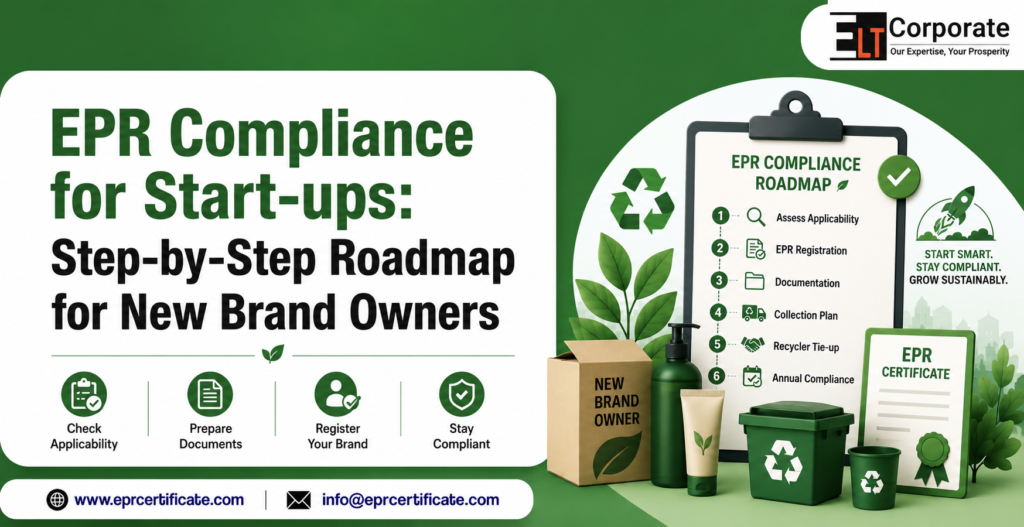
EPR Compliance Roadmap at a Glance
Start-ups can follow this simple roadmap:
- Check product and packaging category
- Identify whether you are producer, importer, or brand owner
- Select correct EPR registration type
- Prepare documents
- Calculate packaging or product waste quantity
- File application on CPCB portal
- Pay applicable government fee
- Reply to CPCB queries
- Obtain EPR certificate
- Fulfil recycling or waste management obligation
- File returns
- Maintain records
- Renew registration on time
Final Thoughts
EPR Compliance is now an important part of doing business in India.
For start-ups and new brand owners, it should not be treated as an afterthought.
If your product uses plastic packaging, batteries, electronics, tyres, or oil-related materials, you should check EPR applicability at the product planning stage itself.
Early compliance helps your brand avoid legal issues, build trust, and grow smoothly in the market.
A start-up that manages EPR properly from the beginning is better prepared for marketplace listing, distributor onboarding, investor review, and future expansion.