Are you a producer, importer, or brand owner in India wondering what documents you need for EPR registration? Navigating the Extended Producer Responsibility (EPR) compliance can feel overwhelming, especially with varying requirements for different waste categories. This guide simplifies the process, providing a clear, category-wise list of all essential documents.
Why Is EPR Registration So Important?
EPR registration isn’t just a legal formality; it’s a crucial step towards environmental responsibility and sustainable business practices. It ensures that manufacturers, importers, and brand owners take responsibility for the entire lifecycle of their products, particularly for the waste generated. Proper registration helps you avoid heavy penalties, maintain a good market reputation, and contribute to India’s waste management goals.
Required Documents for EPR Registration: A Prerequisite Checklist
Getting your EPR registration right starts with having all the correct documents. These vary slightly depending on your business type (Producer, Importer, Brand Owner – PIBO, or Plastic Waste Processor – PWP) and the waste stream (Plastic, E-waste, Batteries, Tires). Below is a comprehensive breakdown.
Common Documents for All EPR Applicants
Company & Identity Proof:
PAN Card of the company or proprietor.
GST Certificate (from all operational states).
Certificate of Incorporation (CIN) or Udyog Aadhaar (for
proprietorship/partnership).
Aadhaar & PAN of the Authorized Signatory.
Importer Exporter Code (IEC) (mandatory for importers).
Environmental Clearances (if applicable):
Air and Water Consent (from State Pollution Control Board/PCC).
Business Operations:
Factory License or MSME Certificate (if applicable).
DIC Registration (if applicable).
Detailed product category information (e.g., plastic packaging type, e-waste category).
Undertakings & Declarations:
RoHS Compliance Declaration (for e-waste).
Covering Letter on the entity’s official letterhead.
Category-Wise Detailed Document Requirements
The Central Pollution Control Board (CPCB) mandates specific additional documents based on your role.
- For Producers / Manufacturers
Product-Specific Information:
Details of plastic packaging categories (rigid, flexible, multi-layered) and estimated annual production volumes.
Product flow diagram and manufacturing process description.
Images of product packaging (JPEG format).
Waste Management Plan:
Detailed, state-wise Action Plan for collection, segregation, and recycling/disposal of waste.
Agreements or Memorandums of Understanding (MOUs) with CPCB-registered Recyclers, Producer Responsibility Organizations (PROs), or Collection Agencies, along with their valid registration proof.
Proof of membership with any relevant industrial association or chamber. B. For Importers
Product-Specific Information:
Import data (e.g., Bill of Lading, Purchase Orders) for the current and previous financial years.
Details of plastic packaging categories and estimated annual import volumes. Images of product packaging (JPEG format).
Waste Management Plan:
Comprehensive state-wise Action Plan for collecting and recycling/disposing of waste.
Agreements or MOUs with CPCB-registered Recyclers, PROs, or Collection Agencies.
- For Brand Owners
Product & Branding Information:
Details of products being branded and their associated packaging types. Proof of Brand Ownership or Registration.
Agreements with manufacturers or producers whose products they are branding. Waste Management Plan:
A robust plan for managing their brand’s packaging waste.
Agreements or MOUs with CPCB-registered Recyclers or PROs.
- For Plastic Waste Processors (PWPs)
Operational Details:
Details of processing capacity and the technology used.
Pollution Control Board Consent (CTO/CTE).
Proof of land ownership or lease agreement for the processing unit.
Compliance:
Documents demonstrating compliance with environmental standards.
Records of plastic waste procurement, processing, and disposal.
Validity of EPR Registration
EPR registration is typically valid for one year for importers and specific categories, while for others, it can be longer, up to five years. It is crucial to check the specific validity period based on your category and renew your registration promptly to maintain compliance.
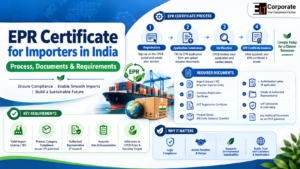
Process: Step-by-Step Document Submission
The EPR registration process usually involves submitting your application through the centralized CPCB EPR Portal.
- Gather All Documents: Use the lists above to collect all necessary paperwork. 2. Prepare Digital Copies: Scan all documents clearly into specified formats (e.g., PDF, JPEG) and ensure they meet size requirements.
- Fill Application Form: Complete the online application form accurately on the CPCB portal.
- Upload Documents: Attach the prepared digital documents to the respective sections of your application.
- Submit and Pay Fees: Review your application, submit it, and pay the applicable registration fees online.
- Follow Up: Track your application status and respond to any queries from the CPCB promptly.
Common Mistakes to Avoid
Ensure a smooth EPR registration process by steering clear of these common pitfalls:
Mismatching Details: Confirm that all company details (name, address, PAN, GST) across all documents are identical.
Expired Documents: Ensure all licenses, consents, and agreements are current and not expired.
Incomplete Waste Management Plan: Provide a clear, actionable, and comprehensive plan with verified recycler partnerships.
Incorrect Category Selection: Apply under the correct PIBO/PWP category relevant to your business activities.
Unregistered Partners: Verify that your recyclers or PROs are officially registered with the CPCB.
Low-Quality Scans: Upload clear, legible digital copies of all documents to avoid rejection.
What Happens If You Ignore EPR Registration?
Ignoring EPR registration can lead to serious consequences. Businesses operating without proper authorization may face significant environmental compensation and penalties imposed by the CPCB. This can also result in legal action, damage to your company’s reputation, and even operational shutdowns. Compliance is not optional; it is essential for continued business operations in India.
The Cost Involved
The cost for EPR registration in India can vary based on your waste category, processing capacity, and the complexity of your operations. Here’s a general idea of the costs involved (excluding professional service fees):
| Fee Type | Rough Range (INR) |
| Government Application Fees | Varies by capacity/category (e.g., ₹10,000 – ₹1,00,000+) |
| Recycler/PRO Agreement Fees | Depends on volume & type of waste (variable) |
| Compliance Audit Fees (if applicable) | Variable |
These figures are indicative and subject to change. It is always best to check the latest CPCB notifications for precise fee structures.
How ELT Corporate Pvt. Ltd. Can Help You
Navigating the complex world of EPR documentation and compliance can be challenging. ELT Corporate Pvt. Ltd. offers expert guidance and support throughout your EPR registration journey. Our team can help you identify the specific documents required, prepare your application, ensure all details are accurate, and facilitate a smooth submission process with the CPCB. Partner with us to achieve hassle-free and timely EPR compliance.
Conclusion
Successful EPR registration hinges on meticulous document preparation and a clear understanding of category-specific requirements. By following this detailed guide and ensuring all your paperwork is in order, you can streamline your application process and achieve compliance efficiently. Don’t let documentation delays hinder your environmental responsibility.
SEO-Friendly FAQs
Q1: Is the document list different for plastic waste EPR vs. e-waste EPR?
Yes, while some common company documents overlap, each waste stream (plastic, e-waste, batteries) has specific additional requirements related to product details, manufacturing processes, and waste management plans. It is crucial to refer to the guidelines for your specific waste category.
Q2: What if I don’t have an agreement with a CPCB-registered recycler before applying?
Having agreements or MOUs with CPCB-registered recyclers or PROs is a mandatory requirement before applying for EPR registration. Your waste management plan needs to demonstrate how you will fulfill your recycling obligations through verified partners.
Q3: How do I categorize plastic packaging for document submission as an importer?
As an importer, you need to provide details on the different categories of plastic packaging (e.g., rigid, flexible, multi-layered) associated with your imported products. Estimating annual import volumes for each category is also essential for your waste management plan.
Q4: How can correct documentation help me avoid environmental penalties?
Accurate and complete documentation is the foundation of successful EPR compliance. It proves to the CPCB that you are diligently meeting your responsibilities, significantly reducing the risk of non-compliance issues, fines, or other legal repercussions.
Q5: What are common document-related errors to avoid on the CPCB portal?
Common errors include uploading unclear or unreadable documents, submitting expired licenses, having mismatched company details across different forms, or failing to provide a detailed and viable waste collection and recycling plan. Double-check all details before submission.