Environmental compliance has now become the mandatory code of conduct for manufacturers in India – more specifically in sectors that produce substantial amounts of post-used waste. Tyres are one sector in this particular category of production. With the advent of ‘Extended Producer Responsibility’ under the Waste Management Rules, it has now been made mandatory for all tyre manufacturers and importers to ensure the recycling/disposal of used tires in an environment-friendly manner.
This is achieved through tyre EPR registration, which is governed by the Central Pollution Control Board (CPCB). In most cases, though, organizations, especially MSMEs and small organizations, find it difficult to comprehend the process, organizational participation, and online procedure.
There is also confusion regarding documentation requirements, recycler tie-ups, annual targets, and EPR registration compliance reporting. Certain manufacturers are under the misconception that the act is applicable to only large companies. There are also fears of complexity in EPR registration.
The fact is, a better understanding of a process before embarking on it or continuing operations can prevent a lot of headaches, wasted resources, and future liabilities. This resource breaks down, in a detailed, no-nonsense, and entrepreneur-friendly way, how a tyre manufacturer must register EPR.
Benefits / Importance of Tyre EPR Registration
Some important advantages for car manufacturers in India who successfully finish their tyre EPR registration are:
- Legal Compliance & Regulatory Protection
Obtaining EPR registration for tyres ensures your business is in compliance with CPCB and Environmental laws. This prevents manufacturers from facing penalties, notices, or abrupt shutdowns due to lack of compliance.
- Uninterrupted Manufacturing & Sales Operations
As long as they have valid approvals for EPR registration in India, they can manufacture, import, and sell their products without the fear of interruption by regulatory bodies.
- Building Brand Trust and Market Credibility
Having an approved EPR certificate online proves to be environmental responsibility. Dealers, OEMs, and corporate buyers feel more comfortable doing business with environmentally compliant manufacturers. EPR registration acts as a good trust-establishing element for them.
- Eligibility for Large Buyers & OEM Partnerships
Most institutional buyers and car manufacturers also require their suppliers to possess EPR approvals. Registering an EPR for tyres is useful for businesses who wish to avail contracts of high values.
- Structured Waste Management & Cost Control
EPR schemes ensure the recycling duties of producers can be planned for in a structured way. Businesses can ensure responsible disposal of their waste while being able to cater to uncertainties in the cost of complying with EPR schemes by cooperating with authorized recyclers.
- Support for Sustainable & ESG-Driven Growth
EPR registration in India helps to promote sustainability strategies and expectations related to ESG factors, becoming ever so essential for business growth and brand creation.
- Decreased Risk of Future Regulatory Attention
The fact that an EPR account has an active digital certificate reduces the chances of audit, notice, or enforcement. This ensures uninterrupted business.
Eligibility Criteria
Under EPR registration India, the following entities are required to apply if they introduce tyres into the Indian market:
- Tyre manufacturers producing tyres in India.
- Importers of new pneumatic or solid rubber tyres.
- Producers selling tyres under their own brand name.
- OEMs supplying tyres along with vehicles.
- MSMEs and startups engaged in tyre manufacturing or importing.
To qualify, the applicant must:
- Be a legally registered entity in India
- Hold a valid GST registration
- Have clear records of tyre quantities placed on the market
- Commit to meeting annual EPR recycling obligations
If your business places tyres into the market – directly or indirectly – tyre EPR registration is mandatory regardless of business size.
Required Documents / Prerequisites
Smooth approval requires proper and correct documentation. Application on the CPCB portal needs verified business and operation-related information. Commonly required documentation includes:
- Certificate of incorporation or proof of business registration
- Certificate of registration under GST
- PAN card of the entity
- ID of authorized signature and authorization letter
- Product information: tire class and specifications
- Sales and import data for the previous financial years
- Agreement or consent letter from authorized tyre recyclers
These documents enable CPCB to check eligibility and calculate the EPR targets before awarding the EPR certificate on an online portal. The most common reason for delays is incompleteness of documentation or inconsistency in application documentation.
Validity of EPR Registration
EPR Registration Validity:
In general, the EPR registration of Tyre is valid for a period of five years from the approval date, provided there is continuous compliance with the requirements and submission of the Annual Return.
EPR Certificate Validity:
A certificate of EPR is applicable online for the recycling of waste tires for 2 years after the end of the concerned financial year in which the certificate is obtained.
Renewal Requirement:
The renewal has to be requested prior to expiration, otherwise suspension, fines, and disruption of operations may occur.
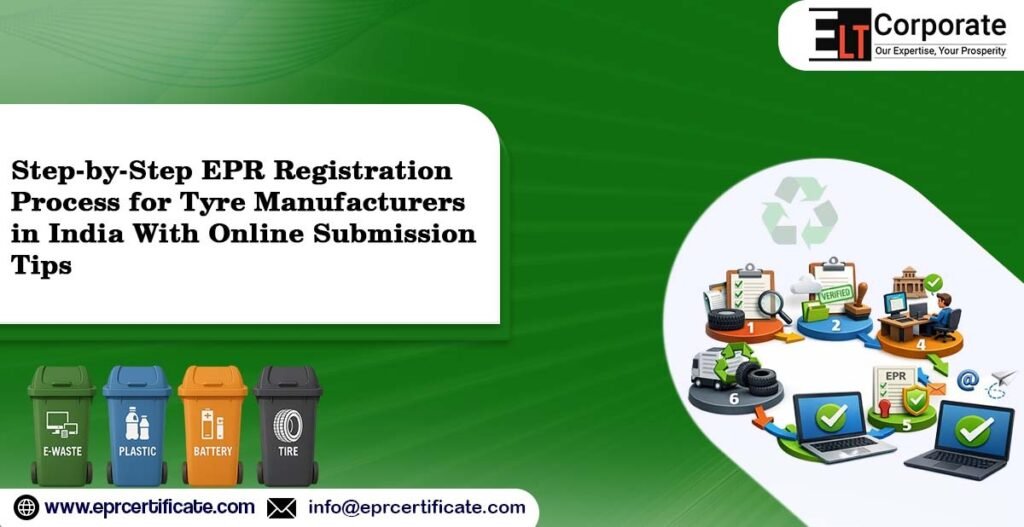
Step-by-Step EPR Registration Process
Below is the simplified process for tyre EPR registration, explained step by step for easy understanding.
Step 1: Make an account from the CPCB portal.
The procedure starts with registration for the mentioned process through the exclusive EPR portal of the CPCB using business details such as the GST number.
Step 2: Fill the EPR Application Form
The applicants are required to provide the necessary information regarding the tyre categories and the number of tyres under each category that they have brought into the market.
Step 3: Upload Required Documents
All supporting documents are submitted in the recommended format. This is accurate as any error could raise a query.
Step 4: Declare Recycler Tie-Ups
The tyre manufacturers must disclose their linking with the CPCB-approved recyclers as part of the tyre EPR registration scheme requirements in waste recovery..
Step 5: CPCB Review and Clarifications
The CPCB scrutinizes the application and may raise questions. The response must be accurate in order to avoid rejection.
Step 6: Issuance of EPR Approval
Finally, when the manufacturer is certified, this is followed by approval by the prescribed authority, and subsequently, the online availability of the EPR certificate is accomplished, legalizing the production and marketing of tires
Common Mistakes to Avoid
Many applications are experiencing delays for reasons that could have been avoided, including:
- Incorrect calculation of tyres in stock.
- Uploading of outdated or mismatched documents.
- Selecting the wrong class of tyre
- Posting of CPCB clarification notices in disregard
- Missing of renewal deadlines
Understanding EPR registration India requirements and preparing data carefully can significantly reduce processing time and compliance risk.
What Happens If You Ignore It?
Failure to take EPR into consideration may be really harmful. The accusation of punishment may involve financial penalties, the suspension of business activities, or the limitation of access to markets for manufacturers failing to comply.
Operating without valid tyre EPR registration can also damage relationships with distributors and OEM partners. Reputational damage and increased regulatory scrutiny normally follow repeated non-compliance, making future approvals more difficult.
The Cost Involved
| Step | Action | Cost (Approx.) | Notes |
| 1 | CPCB Portal Account Creation | Free | Create an official account using business credentials. |
| 2 | Fill EPR Registration Application | Nil | Enter business, tyre category, and quantity details. |
| 3 | Upload Required Documents | Nil – Minimal | Scanning/notarisation of documents if required. |
| 4 | Declare Recycler Tie-Up | ₹10,000 – ₹50,000 per year | Depends on agreement with authorised recyclers. |
| 5 | CPCB Review & Queries | Nil | Respond to CPCB queries or clarification requests. |
| 6 | Approval & EPR Certificate Online Issuance | ₹5,000 – ₹10,000 official fees + ₹10,000 – ₹25,000 optional consultancy | Certificate issued online after verification. |
| 7 | Annual Compliance & Renewal | ₹5,000 – ₹50,000 | Based on tyre quantity, recycler charges, and renewal filing. |
Notes:
- Costs are indicative and may vary depending on tyre volume, recycler agreements, and service providers.
- Professional support is optional but can help avoid delays or errors.
- Timely renewal ensures uninterrupted operations and compliance.
How ELT Can Help You?
ELT supports the entire lifecycle of tyre producers in complying with EPR regulations. Our services range from eligibility to document preparation, handling the CPCB portal, and assisting after approval as well.
Through the simplification of EPR registration in India, ELT ensures accuracy in the process of registering for EPR in India while simultaneously relieving the burden of compliance with any complexity in production.
Conclusion
Tyre EPR Compliance in India is an imperative concern for tire makers. Awareness of the procedure, required documentation, and timelines will help companies in avoiding any fines, penalties, and resulting business stoppages.
But with the right approach and the right experts involved, the EPR registration of tyres is organized and can be made easy and sustainable. The right action today will ensure smooth sailing in the future.
Frequently Asked Questions
- Is tyre EPR registration mandatory for all manufacturers in India?
Yes, all manufacturers and importers introducing tyres into the Indian market must comply. - How long does EPR registration India approval take?
Approval timelines vary but generally range from a few weeks to a month, depending on documentation accuracy. - Can startups apply for an EPR certificate online?
Yes, startups and MSMEs are fully eligible if they place tyres into the market. - What happens if EPR targets are not met?
Failure may result in penalties or suspension of EPR approval. - Are recyclers mandatory under EPR compliance?
Yes, authorised recyclers are required to meet recovery obligations.